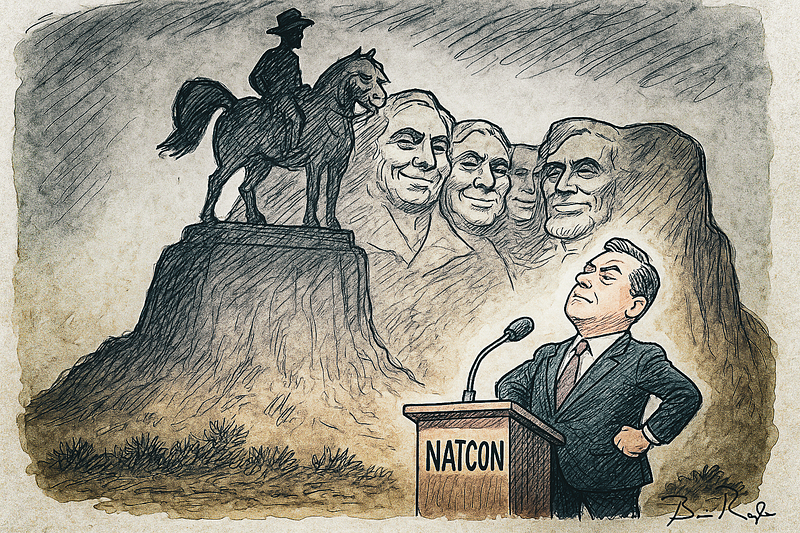
Senator Eric Schmitt stood at the National Conservatism Conference and delivered a speech titled “What Is an American?” The short answer, reading between the lines: in his worldview, an American is white, Christian, and nostalgic for a version of history that never quite existed. Let’s not pretend otherwise. His speech is less about patriotism than it is about laundering exclusionary ideology through folksy frontier mythology.
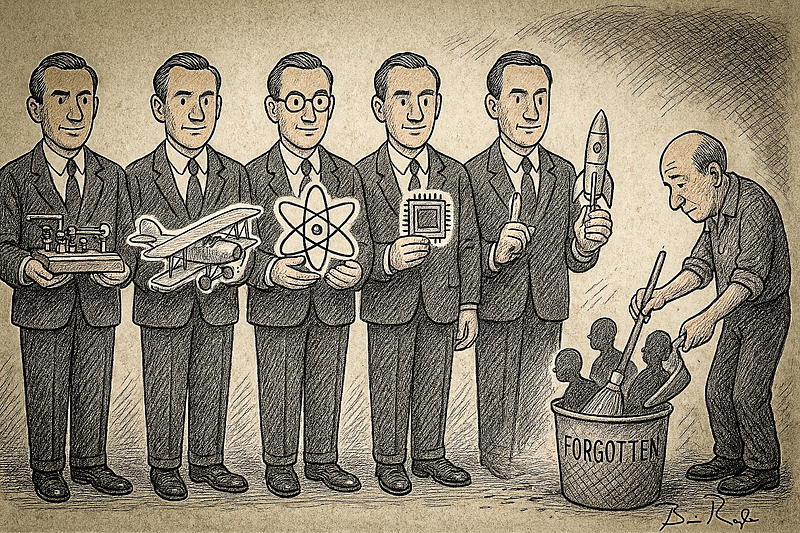
The Great White Inventor Fantasy
Schmitt opened with a greatest hits compilation of American achievements, rattling off accomplishment after accomplishment. He told the crowd it was an American who created the Morse telegraph and later the telephone. An American who mapped the human genome. An American who invented the microchip, the modern computer, and the internet. An American who gave the world the airplane, who broke the sound barrier, who split the atom, who built the first skyscraper. It was an American who planted the first human footprints on the moon, and an American from Missouri (he had to add that little hometown pride) who devised the Hubble Telescope.
Notice anything about this list? Every single figure implied here is white. No mention of Granville Woods, the Black inventor whose telegraph improvements made railroad travel exponentially safer. No acknowledgment of Dr. Kizzmekia Corbett, who co-led development of the Moderna COVID vaccine that saved countless lives. None of the Asian, Jewish, Latino, or Indigenous scientists and engineers who fundamentally shaped this country exist in his carefully curated pantheon.
This isn’t accidental. When your version of America is so narrow it systematically erases everyone except the usual suspects from the history books, that’s not patriotism. It’s propaganda, plain and simple.
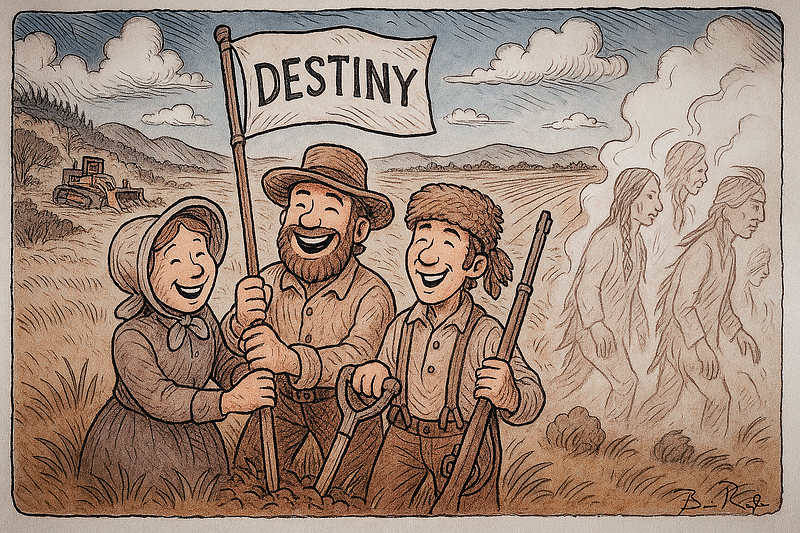
Settler Colonialism as Sacred Birthright
Then Schmitt waxed poetic about America’s origin story, painting a picture straight out of a 1950s Western. According to him, “We’re a nation of settlers, explorers, and pioneers, born on the ocean waters” and “forged in the crucible of a wild frontier. Our people tamed a continent, built a civilization from the wilderness, and wrote our nation’s name in history.”
This is the old manifest destiny script, dusted off and presented as gospel truth. The land was supposedly empty, savage, chaotic, just waiting for white Christians to arrive and “tame” it. The Indigenous nations who had sophisticated civilizations here for millennia? In Schmitt’s telling, they’re reduced to nameless “war bands” that needed to be subdued. That’s not history. That’s settler mythology recycled as national identity, and it’s as dishonest as it is harmful.
Christian Nationalism Without the Mask
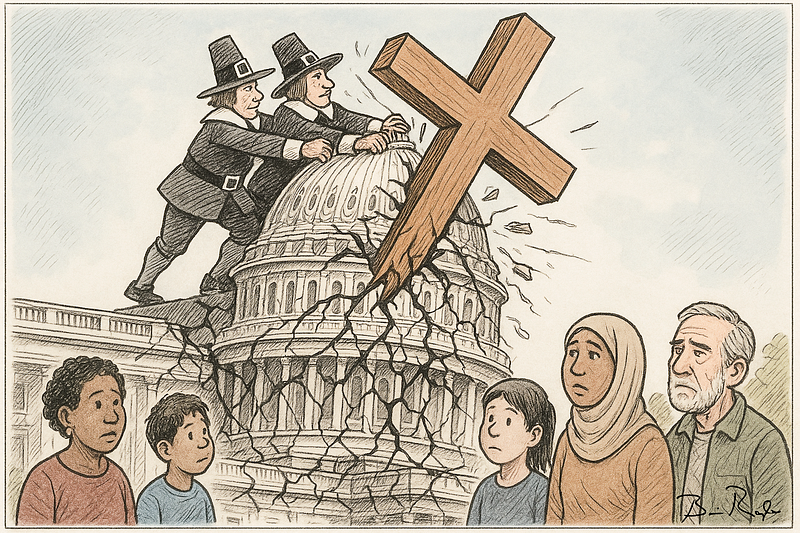
Then came the theological hammer, dropped without subtlety or apology. Schmitt declared that “We Americans are the sons and daughters of the Christian pilgrims that poured out from Europe’s shores to baptize a new world in their ancient faith. Our ancestors were driven here by destiny, possessed by urgent and fiery conviction, by burning belief, devoted to their cause and their God.”
This is Christian nationalism in its purest, most distilled form. He’s not describing America as a pluralistic democracy where people of all faiths and no faith can thrive. He’s describing a divinely ordained theocracy, birthed by Europeans and bound forever to Christianity. The millions of Americans who are Jewish, Muslim, Hindu, Buddhist, atheist, or any other faith tradition? Apparently they don’t count in Schmitt’s America. That’s not civic identity. It’s blood and soil ideology with a crucifix stapled on top.
Confederate Nostalgia in Plain Sight
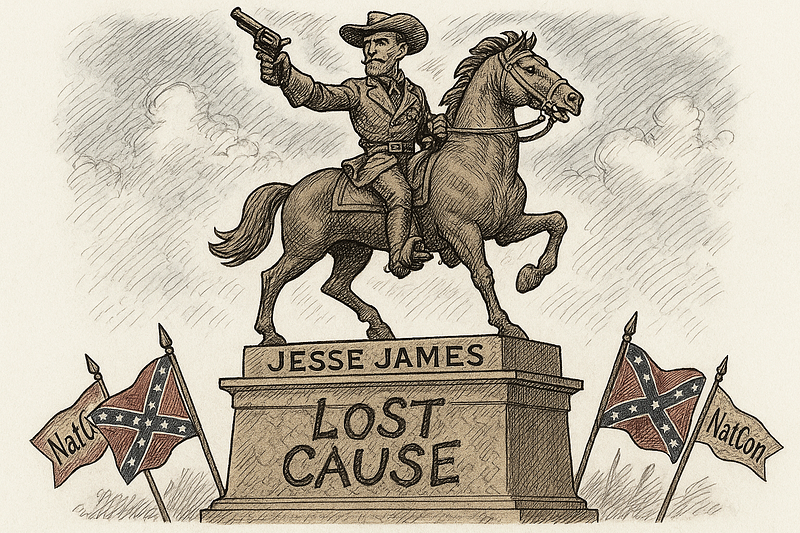
Schmitt couldn’t resist grounding his personal mythology in Missouri lore, and the choices he made are telling. “I’m a Missouri boy,” he proclaimed, from “the state where Lewis and Clark launched their expedition. Where Jesse James lived and Daniel Boone died. The state that launched a thousand wagon trails.”
Lewis and Clark? Sure, they’re standard fare. Daniel Boone? Fine, he’s been mythologized for centuries. But Jesse James? That’s where things get interesting. Jesse James was a Confederate guerrilla fighter, a bank robber who became a folk hero specifically to Lost Cause sympathizers who romanticized the Confederacy. Elevating him as part of America’s heroic pantheon alongside explorers isn’t accidental. It’s Confederate nostalgia dressed up as frontier grit, and anyone familiar with these symbols knows exactly what message is being sent.
The Quiet Part Out Loud
If there was any lingering doubt about where this rhetoric leads, Schmitt dropped the mask entirely with one chilling line: “America doesn’t belong to them. It belongs to us.”
He doesn’t spell out who “they” are, but the implication screams from the page. “Them” means immigrants, non-Christians, progressives, people of color, LGBTQ Americans, anyone who doesn’t fit neatly into his narrow ideological framework. “Us” means white, conservative, Christian nationalists. This is exclusionary language at its most blatant, the kind that divides Americans into real and fake, worthy and unworthy, us and them.
Mount Rushmore and the Architecture of Dominance
Schmitt’s rhetoric dovetails perfectly with America’s built environment of contested symbols. Consider Mount Rushmore, which he celebrates as an unassailable monument to American greatness. The reality is more complex and troubling. The monument was carved into the Black Hills, land sacred to the Lakota Sioux and stolen from them in direct violation of the 1868 Treaty of Fort Laramie. The site was known as Tȟuŋkášila Šákpe, meaning “Six Grandfathers,” and held deep spiritual significance.
The sculptor, Gutzon Borglum, came to the project directly from working on Stone Mountain in Georgia, where he was carving a massive Confederate monument. Rushmore wasn’t some neutral tribute to liberty and democracy. It was a deliberate assertion of white dominance over Indigenous land, created by someone who literally spent his time glorifying the Confederacy.
And about that claim Schmitt makes about the sculptor leaving “three extra inches of granite” for erosion over 30,000 years? Pure mythology. Granite at Mount Rushmore erodes at roughly one inch every 10,000 years according to the National Park Service. There was no symbolic gesture here. The monument itself was the message: we conquered, we won, we’ll carve our faces into your sacred mountain and call it patriotism.
The Pattern Becomes Clear
When you strip away the rhetorical flourishes and examine what Schmitt actually said, his vision of America has some very specific requirements:
First, it must be white. His heroes and inventors are exclusively white men, with no room for the contributions of anyone else.
Second, it must be Christian. He insists our “ancestors” were Christian pilgrims, casually erasing millions of Americans whose families came here for different reasons or followed different faiths.
Third, it must celebrate settler colonialism. He glorifies conquest and frames Indigenous peoples not as the victims of genocide but as obstacles that needed clearing.
Fourth, it has a soft spot for the Confederacy. He valorizes Jesse James and echoes Lost Cause mythology while pretending it’s just innocent frontier nostalgia.
Finally, it must be exclusionary. His explicit “us versus them” framing makes clear that America is about ownership and belonging only to certain people, not a shared democratic experiment.
This isn’t patriotism. It’s a racialized, theocratic worldview desperately trying to recast white Christian dominance as the only legitimate American identity.
Why This Rhetoric Matters
Language like this isn’t just offensive. It’s strategic. When you tie America’s worth exclusively to whiteness, Christianity, and conquest, suddenly any challenge to that order becomes “un-American” by definition. Civil rights? That’s attacking real America. Immigration? That’s diluting real America. Religious pluralism? That’s betraying real America. Indigenous sovereignty? That contradicts the sacred story of how real Americans “tamed” the continent.
This is how authoritarian movements launder bigotry into policy. They don’t start by saying “we want a white Christian ethnostate.” They start by saying “let’s celebrate our heritage” and “America belongs to us” and slowly normalize the idea that some Americans are more American than others. They rewrite history to make their dominance seem natural, inevitable, even divinely ordained.
The Bottom Line
Schmitt’s “What Is an American?” is less a question than a declaration, and his answer should disturb anyone who believes in democratic pluralism. His America is white, Christian, settler colonial, and Confederate adjacent. If you don’t fit that mold, you’re one of “them.” And America, he states flatly, “belongs to us,” not them.
That isn’t just wrong. It’s fundamentally anti-democratic and dangerous. America’s strength has never come from ethnic or religious homogeneity. It’s come from the constant negotiation between different communities, the tension between ideals and reality, the messy, imperfect attempt to create something better than what came before. Schmitt’s vision would end that experiment, replacing it with a closed system where belonging is determined by blood and creed rather than citizenship and commitment to democratic values.
We’ve seen where this rhetoric leads. We’ve seen it in the manifestos of mass shooters who cite “replacement theory.” We’ve seen it in voting restrictions that target communities of color. We’ve seen it in attacks on houses of worship that don’t fit the “right” religious profile. When political leaders mainstream these ideas, they’re not just engaging in harmful nostalgia. They’re laying the groundwork for something much darker.
America does belong to someone, but it’s not Schmitt’s “us.” It belongs to everyone who calls it home, regardless of when they arrived, what language they speak at home, which God they pray to or whether they pray at all, or what color their skin happens to be. That’s not some radical progressive idea. That’s the basic premise of democratic citizenship. And anyone who says otherwise, no matter how many flags they wrap themselves in, is advocating for something fundamentally un-American.
Leave a Reply