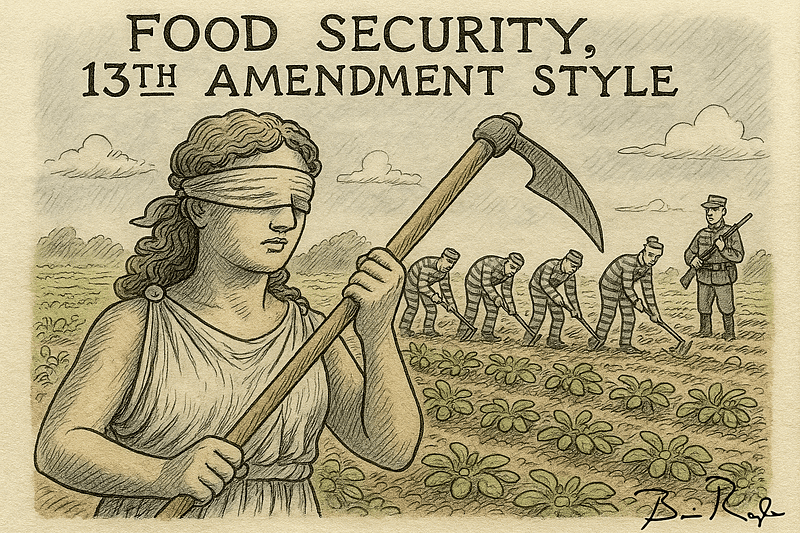
The American labor market is experiencing something beyond typical economic turbulence. What we’re witnessing feels less like a downturn and more like watching the foundation crack beneath a house that’s still being lived in. Crops are rotting unpicked across California’s agricultural valleys. Construction sites that should be buzzing with activity stand silent as monuments to unfinished ambition. Hospital wings echo with the footsteps of too few nurses rushing between too many patients. By mid-2025, the United States faced millions of unfilled jobs while maintaining the world’s largest prison population, most of whom sit idle or work invisibly for wages that wouldn’t buy a cup of coffee.
Even Donald Trump, whose political brand was built on aggressive immigration rhetoric, found himself forced to acknowledge reality. In a moment of uncharacteristic candor, he admitted: “Our farmers are being hurt badly. They have very good workers. They’re not citizens, but they’ve turned out to be great.” He went so far as to suggest on social media that ICE raids on “farm workers and also hotel workers” were “taking very good, longtime workers away” and leaving jobs “almost impossible to replace.”
But agriculture represents just one pressure point in a system-wide labor hemorrhage:
The U.S. Chamber of Commerce has documented dozens of states with more job openings than workers available to fill them. Maine has just 58 workers for every 100 job openings. Georgia has 65 workers per 100 jobs. Even California, with relatively higher unemployment, has only 155 workers for every 100 positions. describes the nation as having achieved “virtually full employment,” but not in a good way. It means companies simply cannot hire at the scale needed to maintain operations, let alone grow. McKinsey’s analysis
This is not a temporary disruption or a cyclical downturn. It represents a fundamental breakdown in the labor supply chain that cuts across every major sector of the American economy.
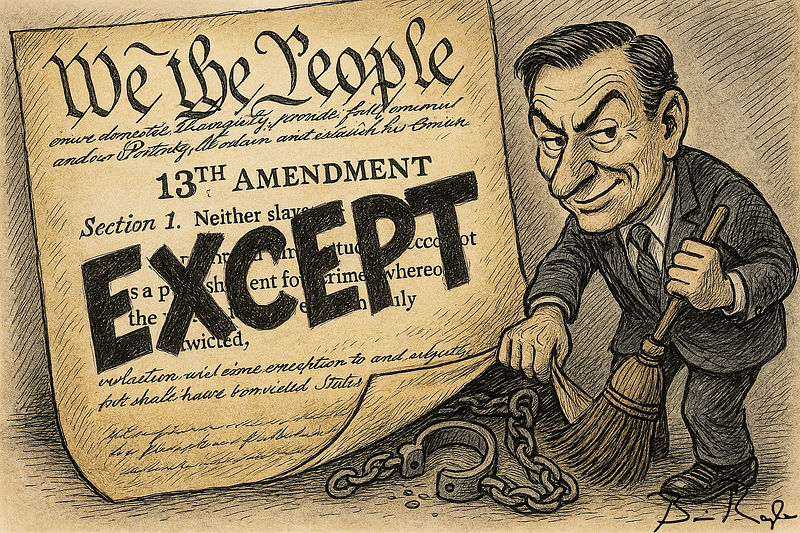
When the architects of Reconstruction drafted the 13th Amendment, they included five words that would echo through centuries: “except as punishment for crime.” This wasn’t an oversight or a compromise. It was a deliberate preservation of a system that Southern states would immediately exploit and that continues operating today.
The Amendment, ratified in 1865, reads in full: “Neither slavery nor involuntary servitude, except as a punishment for crime whereof the party shall have been duly convicted, shall exist within the United States, or any place subject to their jurisdiction.” Those five words in the exception clause created a constitutional pathway for forced labor that governments and corporations have exploited ever since, as documented extensively by the Innocence Project and . University of Chicago legal scholars
The economic impact was staggering. By 1898, Alabama derived 73% of its entire state revenue from leasing convicts to private companies. Not 7.3%. Seventy-three percent. The Tennessee Coal, Iron & Railroad Company, which would later be absorbed into U.S. Steel and become one of the original Dow Jones Industrial Average components, built its fortune largely on convict labor. Prisoners died at rates that would shock modern sensibilities; the average convict in Texas lived just seven years from the start of forced labor.
The legal system consistently reinforced this arrangement. In 1871, Virginia’s Supreme Court explicitly declared in Ruffin v. Commonwealth that prisoners were “slaves of the state” who had “forfeited all personal rights except those which the law in its humanity accords.” This established the doctrine of “civil death” that stripped incarcerated people of constitutional protections. In 1977, the U.S. Supreme Court in Jones v. North Carolina Prisoners’ Labor Union denied prisoners the right to organize. In 1988, United States v. Kozminski defined involuntary servitude in terms that perfectly describe modern prison conditions. As recently as 1999, the 7th Circuit Court dismissed challenges to prison labor as “thoroughly frivolous.”
The convict leasing system that terrorized Black communities for nearly a century technically ended by the 1940s, but it simply morphed into new forms. Chain gangs, which emerged in the 1890s under the cheerfully named “Good Roads Movement,” built much of America’s highway system. The U.S. Department of Agriculture’s Office of Public Roads actively promoted the philosophy that “bad boys make good roads.” Georgia led the implementation, keeping prisoners shackled together in 20-pound chains for 24 hours daily while eating, working, and sleeping. These programs continued into the 1950s in most states, and Georgia didn’t officially end chain gangs until 1955, though Alabama briefly revived them in the 1990s.
Federal Prison Industries, now known as UNICOR, was established by Franklin Roosevelt’s executive order in December 1934 during the Great Depression. Today it operates as a massive enterprise with implications that would have stunned even its Depression-era architects.
The scale of modern prison labor would shock most Americans if they understood its reach. This isn’t about a few inmates making license plates, though they do that too. This is about a hidden workforce that touches virtually every aspect of the American economy.
Start with the numbers: Roughly 800,000 incarcerated people work in U.S. prisons, according to comprehensive analysis by Mission Investors and the . Most work for free or for wages that would be illegal anywhere else. The found that non-industry prison jobs pay an average of 13 to 52 cents per hour. In Texas, Georgia, Arkansas, and Alabama, most prisoners receive nothing at all for their labor. Zero dollars. Economic Policy Institute
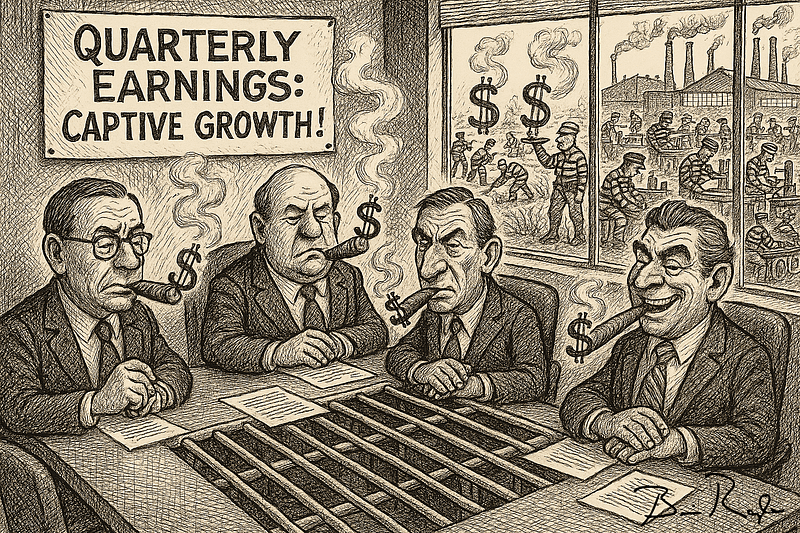
The Department of Defense alone awards approximately $163 million annually in contracts to Federal Prison Industries, according to Government Accountability Office reports. UNICOR generates over $500 million in annual revenue, with more than half coming from DOD contracts.
State prison industries operate parallel systems. Louisiana State Penitentiary, known as Angola, sprawls across 18,000 acres of former plantation land where inmates grow cotton, corn, soybeans, and wheat. They also raise cattle and operate a canning factory. Mississippi’s Parchman Farm encompasses 18,000 acres. Texas prison farms cover 134,000 acres. These operations aren’t historical curiosities; they’re active, profitable enterprises where predominantly Black and Brown inmates work fields that once held slaves, often under armed guard on horseback.
This happens through complex subcontracting arrangements that allow companies to claim ignorance. A major food distributor contracts with a processing company, which contracts with a farm, which uses prison labor. By the time the product reaches store shelves, the connection to forced labor has been laundered through multiple corporate layers.
The Prison Industry Enhancement Certification Program (PIECP), created by Congress in 1979, provides the legal framework for private companies to directly employ prison labor. While PIECP technically requires paying “prevailing wages,” prisons immediately deduct up to 80% for room and board, victim restitution, family support, and mandatory savings accounts that prisoners often never see. A prisoner officially earning $10 per hour might take home $1.50.
The economic incentives create a vicious cycle. Private prison companies profit from high incarceration rates. They lobby for longer sentences and more arrests. More prisoners mean more cheap labor. More cheap labor means more corporate profits and state revenue. Everyone wins except the workers, who remain trapped in poverty even after release, often unable to find employment because of their records, frequently ending up back in prison. It’s a system designed for recidivism.
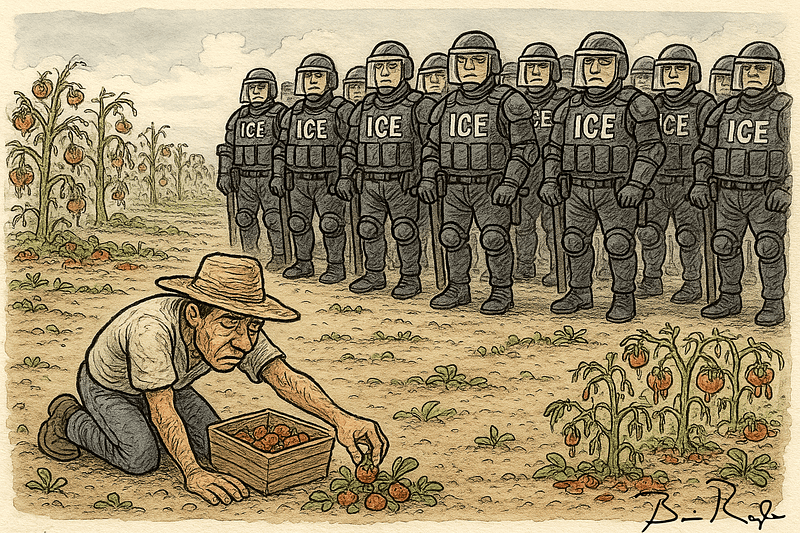
The relationship between immigration enforcement and prison labor isn’t just correlation; it’s an engineered synergy that benefits the same corporate interests at both ends. Every deportation creates two profit opportunities: first from detention, then from replacement labor.
The numbers tell the story. ICE arrested 66,463 individuals in just the first 100 days of 2025, implementing daily arrest quotas of 3,000 people. The agency currently holds 61,226 individuals in detention, with 70.3% having no criminal convictions beyond immigration violations. Private detention companies charge the government an average of $134 per day per detainee, creating a multi-billion dollar industry.
The corporate players connecting these dots aren’t subtle about their interests. CoreCivic and GEO Group, the two largest private prison companies, have spent decades funding ALEC’s parallel campaigns for harsher immigration enforcement and expanded prison labor programs. ALEC’s model legislation portfolio includes both Arizona’s infamous SB 1070 “show me your papers” law and bills making it easier for private companies to use inmate labor.
Georgia’s 2011 experiment provides a perfect case study of this dynamic in action. The state passed HB 87, one of the nation’s strictest anti-immigration laws, modeled on ALEC legislation. Thousands of agricultural workers fled the state. Farmers reported $140 million in crop losses as produce rotted in fields. The state’s solution? Deploy probationers and inmates to harvest crops.
But that was 2011, when the labor market was loose and alternatives existed. In 2025, with crops literally rotting in fields and entire harvests at risk, the political and economic calculations have changed. When voters face $15 strawberries or empty shelves, the moral objections to prison labor tend to quiet down.
Several states have already begun implementing new programs:
The historical precedent is clear and directly applicable. During World War II, Massachusetts issued Executive Orders №25 (1942) and №62 (1943) that explicitly authorized prison labor for wartime production. The language was stark: “total war demands” had created “such shortages of labor and equipment as to make it desirable to employ the inmates and equipment of the penal institutions” for “operations essential to the war effort.”
We’re not at war now, at least not officially. But the “war” metaphor has proven remarkably elastic in American politics. We’ve had wars on drugs, poverty, terror, and crime. Adding a “war on food insecurity” or “war on supply chain disruption” wouldn’t even require much rhetorical innovation.
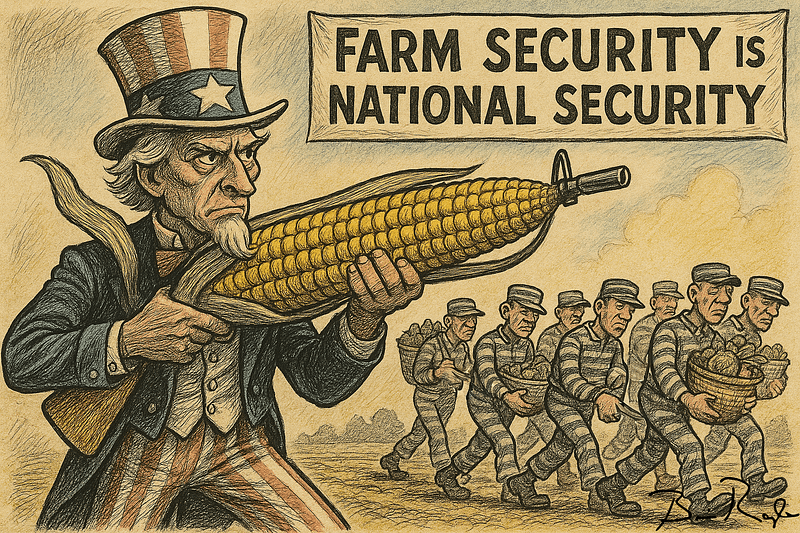
The Defense Production Act of 1950 provides particularly relevant authority. Originally passed during the Korean War, it grants presidents sweeping powers to direct economic production for national defense. The Act has been invoked for everything from smartphone minerals to baby formula shortages. It specifically authorizes the president to:
Crucially, “national defense” has been interpreted broadly to include critical infrastructure, emergency preparedness, and energy security. Food security fits comfortably within this framework, especially given the USDA’s explicit designation of agriculture as critical infrastructure.
The legal architecture for expanded prison labor already exists at the federal level:
A new executive order could easily expand these authorities, directing federal agencies to “maximize utilization of available workforce resources” during the current “critical labor shortage affecting national food security.” The order could:
The rhetoric would be predictably patriotic. Imagine the Fox News segments about inmates “stepping up to feed America” and “paying their debt to society by serving their country.” Critics would be accused of preferring foreign workers to American prisoners, of choosing criminals over farmers, of putting ideology over food security.
State governments wouldn’t need much encouragement. Many already have laws authorizing emergency use of prison labor. California’s infamous inmate firefighter program provides the template: prisoners “volunteering” for dangerous work in exchange for minimal pay and vague promises of sentence reduction. When wildfires threaten wealthy neighborhoods, nobody questions the ethics of sending inmates to fight them for $2 per day plus $1 per hour when actively fighting fires.
The beneficiaries of expanded prison labor form a powerful coalition with aligned interests and significant political influence.
The political coalition supporting expansion includes some surprising members. Law enforcement unions support anything that maintains or expands the prison system. Rural communities that host prisons depend on them economically and will fight to keep them full. Agricultural states’ congressional delegations, regardless of party, prioritize their farming constituents. Even some criminal justice reform advocates have been co-opted with rhetoric about “job training” and “work experience.”
The practical obstacles to large-scale prison agricultural labor are enormous. Modern farming isn’t just picking fruit; it requires skill, experience, and often specialized knowledge. Knowing when produce is ripe, how to handle plants without damaging them, which fruits to pick and which to leave, how to work efficiently in extreme heat, these are skills developed over years, not taught in a day.
The Georgia 2011 failure demonstrated this clearly. Prisoners picked cucumbers so slowly that they rotted before reaching market. They damaged plants through rough handling, reducing future yields. They couldn’t distinguish ripe from unripe produce. Many quit within hours, unable to handle the physical demands. One farmer reported that prisoner crews achieved less than 10% of the productivity of experienced migrant workers.
Safety presents another massive challenge. Agriculture is one of America’s most dangerous industries, with high rates of heat stroke, pesticide exposure, equipment injuries, and musculoskeletal damage. Putting untrained, potentially resentful prisoners into this environment invites disaster. The liability issues alone should terrify any rational farm operator.
The optics are catastrophic. Images of predominantly Black and Brown prisoners working fields under armed guard would evoke slavery so directly that even supporters might blanch. International condemnation would be swift and severe. Consumer boycotts could destroy brands associated with prison-produced goods.
But here’s the thing about crisis: it changes calculations. When shelves are empty and prices soar, moral flexibility increases. History shows this repeatedly. Japanese internment was wrong, but Pearl Harbor made it politically possible. The Patriot Act shredded civil liberties, but 9/11 made opposition politically toxic. COVID lockdowns would have been unthinkable until they weren’t.
We’re watching this dynamic play out now. Trump himself, the architect of family separation and “zero tolerance,” admitted that immigration raids were hurting farmers. But instead of reversing course, the administration is looking for workarounds. Prison labor represents a “solution” that maintains the hardline immigration stance while addressing labor needs.
The framework for public acceptance is already being constructed:
Media management would be crucial but manageable. Friendly outlets would run heartwarming stories about inmates “turning their lives around” through farm work. Critical coverage would be dismissed as “soft on crime” or “preferring foreign workers to Americans.” Corporate PR departments would tout their “second chance” programs while obscuring the economics.
This final section ventures into speculation, but it’s speculation rooted in historical precedent and current trajectories.
Once prison labor becomes normalized outside prison walls for agricultural work, the limiting principle disappears. If inmates can work on farms, why not in factories? If factories, why not construction sites? If construction sites, why not hotels? If hotels, why not private homes?
The progression would likely follow this pattern:
The infrastructure for this already exists:
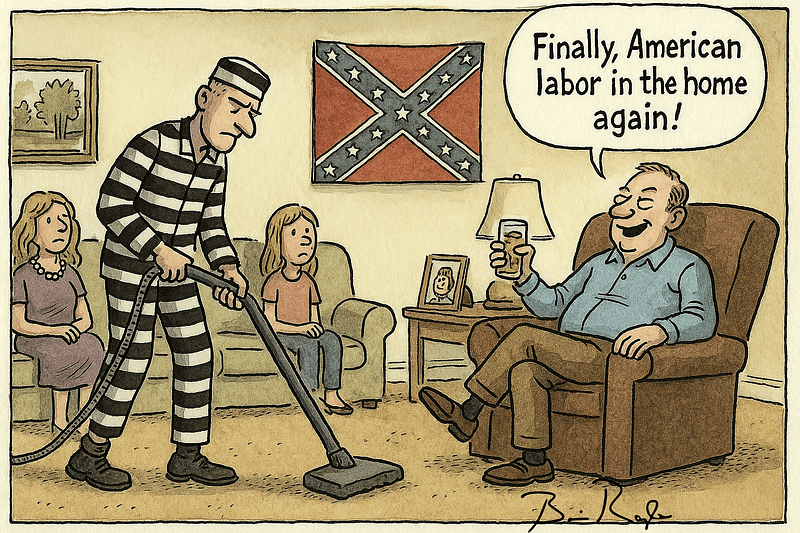
The domestic service component deserves special attention because it represents the most extreme but plausible endpoint. California already sends inmates to fight wildfires threatening wealthy neighborhoods. These same inmates, barred from firefighting jobs after release due to their records, have proven they can work in proximity to private homes. The leap from fighting fires at mansions to maintaining their grounds isn’t that far.
“Supervised community placement” could start with group assignments for yard work or construction, then evolve to individual placements for specialized services. Electronic monitoring ensures compliance. Sentence reductions incentivize participation. Homeowners get affordable help. The state collects fees. Everyone wins except the person wearing the ankle bracelet.
This would particularly appeal to affluent households facing domestic worker shortages after immigration crackdowns. The same communities that support aggressive immigration enforcement would benefit from its consequences through access to cheap, controlled labor. The irony would be lost on most participants.
Historical parallels are uncomfortable but instructive. The post-Civil War Black Codes included provisions for binding out Black children as “apprentices” to white households, effectively continuing slavery for minors. Convict leasing included assignments to private homes as servants. Chain gangs were sometimes diverted to work on private property belonging to politically connected individuals.
We tell ourselves we’re beyond such abuses, that modern oversight would prevent exploitation. But current prison labor already includes:
Adding private household deployment would multiply opportunities for abuse while reducing oversight. A prisoner working in a private home has even less recourse than one in a prison factory. Who would they complain to? How would they prove mistreatment? What leverage would they have?
Once implemented, prison labor systems prove nearly impossible to dismantle. Economic dependencies develop quickly and entrench deeply.
Businesses restructure operations around ultra-cheap labor. A farm paying $0.50 per hour for prison labor cannot compete if forced to pay $15 per hour for free workers. They’ll either fight to maintain the system or go bankrupt trying to transition, taking food production with them.
States become addicted to the revenue. Alabama’s $450 million annual take from prison labor represents significant budget support. Losing that money would require either raising taxes or cutting services, both politically toxic. The path of least resistance is maintaining the status quo.
Communities develop dependencies. Rural towns hosting prisons rely on them for employment and economic activity. Prison labor programs provide additional justification for maintaining facilities that might otherwise close due to falling crime rates. Local businesses benefit from contracts supplying prisons and work programs.
This creates powerful incentives to maintain prison populations. We’ve seen this movie before. Private prison contracts with occupancy guarantees require states to maintain certain prisoner levels or pay penalties. Three-strikes laws and mandatory minimums ensure steady supply. Prosecutors face pressure to secure convictions that feed the system.
Adding economic dependence on prison labor intensifies these pressures. If entire industries rely on prison workers, the criminal justice system must provide them. This could mean:
The racial implications are unavoidable. The system already disproportionately incarcerates Black and Brown people. Adding economic incentives to maintain that population creates a modern version of what legal scholar Michelle Alexander calls “The New Jim Crow,” but with explicitly economic rather than just social control motivations.
ALEC has already shown how this works. Their model legislation from the 1990s and 2000s simultaneously:
Each piece seemed reasonable in isolation. Together, they created an interlocking system that generates profits from human captivity. Adding agricultural and domestic labor would complete the circle, creating a permanent underclass of unfree workers whose labor supports the very communities that voted to incarcerate them.
Resistance exists but faces massive structural obstacles.
Seven states have amended their constitutions to remove slavery exceptions: Colorado (2018), Nebraska (2018),
Utah (2020), Vermont (2022), Oregon (2022), Tennessee (2022), and Alabama (2022). But these amendments have produced minimal practical change. Colorado eliminated the exception in 2018, yet prisoners still work under threat of punishment. Alabama removed it in 2022, but the state continues generating hundreds of millions from prison labor programs.
The disconnect happens because state constitutional amendments don’t override the federal 13th Amendment. Until Congress passes and states ratify a federal amendment, requiring two-thirds of both houses and three-fourths of states, the federal exception remains supreme. Federal facilities and any state accepting federal funding for corrections can continue forced labor regardless of state constitutional language.
The amendment has virtually no chance of passing in the current political climate. It would need 290 House votes, 67 Senate votes, and ratification by 38 state legislatures. States that profit from prison labor have no incentive to support it. Politicians who vote for it risk being labeled “soft on crime” or “pro-criminal.” The prison industry lobby would mobilize massive resources against it.
Consumer activism shows promise but lacks sustained focus. The #Cut50 campaign successfully pressured some companies to stop using prison labor, but most consumers remain unaware of prison labor in their supply chains. Even when exposed, the complexity of modern supply chains makes boycotts difficult to sustain.
International pressure could theoretically matter. The International Labour Organization’s conventions prohibit forced prison labor for private profit, but the U.S. hasn’t ratified the relevant treaties. The UN Special Rapporteur on Contemporary Forms of Slavery has criticized American prison labor, but such statements carry no enforcement mechanism.
The most realistic near-term reforms are incremental:
But even these modest reforms face enormous opposition from states dependent on prison labor revenue and companies profiting from cheap workers.
The trajectory seems clear even if the timeline remains uncertain. Watch for these signals of expansion:
Each step will be justified by immediate practical needs. Each will seem reasonable given the previous steps. The aggregate effect will be the reconstruction of a constitutionally sanctioned slave labor system operating in plain sight.
The bitter irony is that this system would be defended most vigorously by those who claim to revere the Constitution and celebrate American freedom. The same voices demanding “law and order” and “border security” will champion putting prisoners to work in fields and factories. They’ll wrap chains in the flag and call it patriotism.
We stand at a crossroads that feels both unprecedented and entirely predictable. The convergence of labor shortages, immigration crackdowns, and constitutional loopholes creates conditions where mass prison labor expansion isn’t just possible but increasingly probable.
The economic logic is seductive. Why let 1.2 million prisoners sit idle while crops rot and projects stall? Why pay minimum wage when the Constitution explicitly permits paying nothing? Why import workers when we have a captive workforce already here?
But accepting this logic means accepting that slavery never really ended, just changed form. It means admitting that our economic system depends on coerced labor. It means acknowledging that the land of the free runs on the backs of the unfree.
The farmers reporting 70% of their workforce vanishing after ICE raids aren’t the villains here. They’re caught between an immigration system that criminalizes their workers and an economic system that makes fair wages impossible. The real crime is forcing them to choose between bankruptcy and exploitation.
The prisoners who would be sent to these fields aren’t the villains either. Most are there for non-violent offenses, many for crimes of poverty or addiction. They’re disproportionately Black and Brown, poor, under-educated. They’re the grandchildren and great-grandchildren of sharecroppers and field hands, repeating cycles of exploitation that never really broke.
Even the politicians pushing these policies aren’t entirely villainous, though their moral flexibility is stunning. They’re responding to real crises with the tools the Constitution provides. If those tools happen to be the same ones used to maintain slavery by another name for 160 years, well, that’s America.
The villain, if there is one, is our collective willingness to tolerate exploitation when it keeps prices low and profits high. It’s our acceptance of a Constitution that explicitly permits slavery. It’s our failure to recognize that “except as punishment for crime” created a loophole large enough to drive 800,000 human beings through.
The question isn’t whether America will expand prison labor to address economic needs. We’re already doing it. The question is whether we’ll acknowledge what we’re doing and decide if that’s who we want to be.
Your strawberries are going to come from somewhere. They’ll be picked by people without choices, whether they’re immigrants without papers or prisoners without rights. The only question is which form of exploitation you’re comfortable with, and whether you’re willing to pay the real cost of food produced by free people earning living wages.
History suggests we’ll choose the exploitation. We always have before. But history also shows that every generation gets a chance to break the cycle. The abolitionists of the 1860s eliminated slavery except as punishment for crime. Maybe this generation can finish the job and eliminate it entirely.
Or maybe we’ll just build better cages and call it progress.
Time will tell. But not much time. The fields are empty, the shifts need filling, and the Constitution explicitly allows only one form of slavery. The machinery is already in motion. The only question is whether we’ll stop it or let it roll over us, pretending we don’t see the chains.
Economic Policy Institute. “Forced prison labor in the ‘Land of the Free’: Rooted in Racism and Economic Exploitation.” January 16, 2025. https://www.epi.org/publication/rooted-racism-prison-labor/
Mission Investors Exchange. “Prison Labor in the United States: An Investor Perspective.” 2020. Labor Market Analysis: Associated General Contractors of America. “Construction Workforce Shortages Are Leading Cause of Project Delays.” August 28, 2025. https://missioninvestors.org/sites/default/files/resources/Prison%20Labor%20in%20the%20United%20States%20-%20An%20Investor%20Perspective.pdf Construction Dive. “Construction hiring hits lowest rate ever recorded.” March 2025. https://www.agc.org/news/2025/08/28/construction-workforce-shortages-are-leading-cause-project-delays-immigration-enforcement-affects
CRE Daily. “U.S. Construction Industry Needs 439K New Workers in 2025.” https://www.constructiondive.com/news/construction-hiring-job-lowest-rate-march-2025/746842/
McKinsey Global Institute. “Empowering the US workforce: How to address US labor shortages.” April 28, 2025.
https://www.credaily.com/briefs/us-construction-industry-needs-439k-new-workers-in-2025/ NSI Nursing Solutions. “2025 National Health Care Retention & RN Staffing Report.” 2025.
Redhammer. “U.S. Construction Labor Trends — February 2025.” https://www.mckinsey.com/industries/public-sector/our-insights/empowering-the-us-workforce U.S. Chamber of Commerce. “Understanding America’s Labor Shortage: The Most Impacted States.” August 8, 2025.
https://www.nsinursingsolutions.com/documents/library/nsi_national_health_care_retention_report.pdf Immigration Enforcement Impact: CBS News. “Federal data reveals 1.2 million drop in immigrant workers under Trump.” 2025.
CalMatters. “Worksite immigration raids return to California.” July 2025. https://www.redhammer.io/blog/u-s-construction-labor-trends—february-2025
CNBC. “Trump immigration policy impact on labor force.” August 21, 2025. https://www.uschamber.com/workforce/the-states-suffering-most-from-the-labor-shortage
LAist. “Immigration sweeps are making construction labor shortage worse.” 2025. https://www.cbsnews.com/news/immigrants-us-labor-force-trump-census-bureau-data/
Missouri Independent. “If Trump wants more deportations, he’ll need to target the construction industry.” July 1, 2025. Reuters. “Immigration raids leave crops unharvested, California farms at risk.” June 30, 2025. https://calmatters.org/justice/2025/07/worksite-immigration-raids/
The Guardian. “ICE raids leave crops unharvested at California farms: ‘We need the labor’.” July 1, 2025. https://www.cnbc.com/2025/08/21/trump-immigration-policy-labor-force.html
Prison Labor History and Law: American Civil Liberties Union. “Captive Labor: Exploitation of Incarcerated Workers.”
https://laist.com/news/los-angeles-activities/immigration-sweeps-construction-labor-shortage American Civil Liberties Union. “New ACLU/GHRC Report Finds Widespread Coercion and Exploitation of Incarcerated Workers.”
Brennan Center for Justice. “A Guide to Emergency Powers and Their Use.” https://missouriindependent.com/2025/07/01/if-trump-wants-more-deportations-hell-need-to-target-the-construction-industry/
Center for Constitutional Rights. “Imprisoned Workers Bring State Lawsuit to Abolish Involuntary Servitude.” https://www.reuters.com/business/immigration-raids-leave-crops-unharvested-california-farms-risk-2025-06-30/ Constitutional Accountability Center. “The War Over the 13th Amendment and Modern-Day Slavery.” https://www.theguardian.com/us-news/2025/jul/01/ice-raids-crops-california-farms .
“Prisoners’ Rights Under Law.” https://www.aclu.org/news/human-rights/captive-labor-exploitation-of-incarcerated-workers
Equal Justice Initiative. “Convict Leasing.”
https://www.aclu.org/press-releases/new-aclughrc-report-finds-widespread-coercion-and-exploitation-incarcerated-workers Innocence Project. “How the 13th Amendment Kept Slavery Alive: Perspectives From the Prison Where Slavery Never Ended.” September 17, 2021.
Library of Congress. “Convict Leasing System.” June 2021. https://www.brennancenter.org/our-work/research-reports/guide-emergency-powers-and-their-use
UAB Institute for Human Rights. “Modern American Slavery: Forced Prison Labor.” February 1, 2024. https://ccrjustice.org/home/press-center/press-releases/imprisoned-workers-bring-state-lawsuit-abolish-involuntary
University of Chicago Law School. “Putting a Legal Lens on Forced Prison Labor and the Thirteenth Amendment.” 2024. https://www.theusconstitution.org/news/the-war-over-the-13th-amendment-and-modern-day-slavery/
Encyclopedia.com University of Chicago News. “Rethinking prison labor under the 13th Amendment.” June 5, 2025. https://www.encyclopedia.com/reference/encyclopedias-almanacs-transcripts-and-maps/prisoners-rights-under-law https://eji.org/news/history-racial-injustice-convict-leasing/ https://innocenceproject.org/news/how-the-13th-amendment-kept-slavery-alive-perspectives-from-the-prison-where-slavery-never-ended/ https://blogs.loc.gov/inside_adams/2021/06/convict-leasing-system/ https://sites.uab.edu/humanrights/2024/02/01/modern-american-slavery-forced-prison-labor/ https://www.law.uchicago.edu/news/putting-legal-lens-forced-prison-labor-and-thirteenth-amendment https://news.uchicago.edu/story/rethink
Originally published at https://vagabondvisions.beehiiv.com.
Leave a Reply