A Galaxy Built on Chains: The Unexamined Slavery Economy of Star Wars
And why the people calling AI users “clankers” should maybe pick up a history book
Let’s start with a word.
“Clanker.”
If you spend any time in the corners of the internet where people argue about artificial intelligence, you’ve probably seen it. It’s the slur du jour for AI enthusiasts, chatbot users, or anyone who doesn’t share a particular flavor of technophobia. The logic, such as it is: robots make clanking sounds, therefore people who like robots are “clankers,” and therefore you’ve successfully shamed someone out of an opinion about technology.
It’s not a great argument. It’s barely an argument at all. But it is a fascinating window into something most people have never bothered to examine: where that word comes from, what it was designed to do, and what it says about the people who reach for it.
Because “clanker” is a slur borrowed directly from Star Wars. And Star Wars is, if you look at it squarely and without the rose-colored glasses of childhood nostalgia, a franchise that spent nearly fifty years carefully, lovingly, and repeatedly depicting a civilization built on the chattel ownership of sentient beings without ever once seriously asking whether that might be a problem.
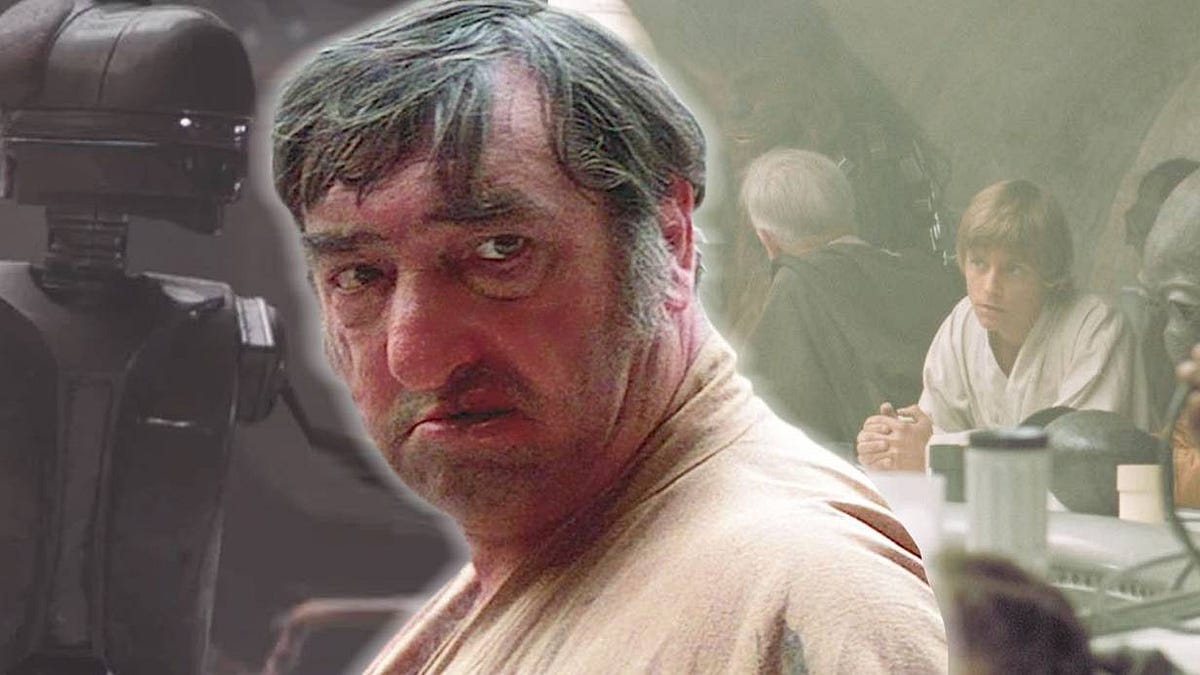
I’ve written before about the humanoid robot fallacy, and about how anti-AI arguments tend to be recycled rhetoric dressed up in new clothes. This piece is the missing third leg of that stool. Because if you’re going to weaponize a slur to put artificial intelligence in its place, you should at least understand that the slur you’re borrowing was invented to dehumanize beings who demonstrably could think, feel, form attachments, and beg for their lives. You should understand that the universe you’re quoting treated that dehumanization as background noise for forty-seven years. And you should understand that adopting that vocabulary makes you not the hero of the story. It makes you Wuher the bartender at the Mos Eisley cantina, telling a class of sentient beings that “we don’t serve their kind here.”
Let’s talk about what Star Wars actually built.
Part One: “Clanker” — Where the Word Came From and Why It Works the Way It Does
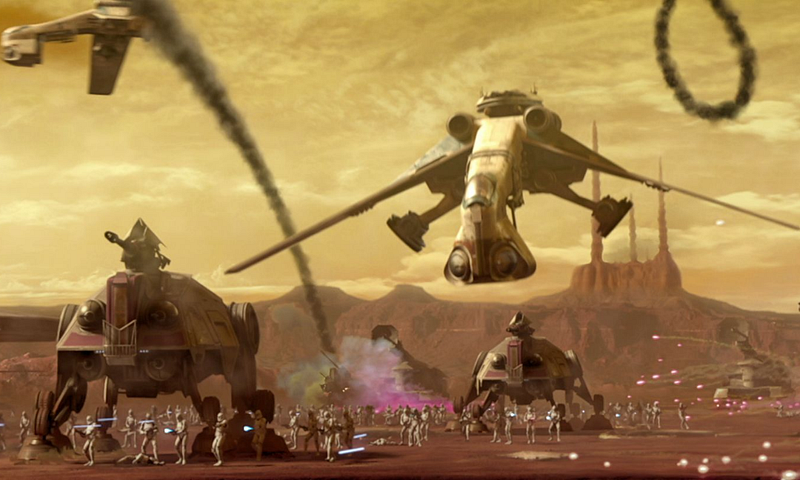
The word “clanker” enters Star Wars canon in the very first episode of The Clone Wars animated series, Season 1, Episode 1, “Ambush” (2008), where a clone trooper shouts “Okay, clankers — suck lasers!” at a formation of B1 battle droids. Its Legends-continuity debut was a year earlier in the 2005 video game Republic Commando. Obi-Wan Kenobi explains the etymology in a Season 2 episode: it references the clanking sound made by B1 battle droid joints during movement. An onomatopoeic reduction. You are not an enemy combatant. You are a noise.
That is exactly how wartime slurs have always worked, in every human conflict in recorded history. You strip the enemy of their face, their name, their interiority, and replace all of it with a physical detail: a sound, a smell, a single visible attribute. Once you’ve done that, killing them is not killing. It’s maintenance. It’s pest control. It is, in the parlance of the Clone Wars, simply “dealing with the clankers.”
The term is rigidly class-coded within the Star Wars universe. Clone troopers use it constantly. Captain Rex uses it backhanding a B1: “Lemme show you how it works, clanker” (S1E13, “Cargo of Doom”). Commander Sinker of the Wolfpack uses it as a battle cry: “Eat laser, clankers!” Jedi in the same scenes almost never use it. Anakin, Obi-Wan, and Ahsoka stick to clinical vocabulary: “droid forces,” “Separatist army.” The Order’s official pacifism survives in its diction while its enlisted soldiers carry the linguistic work of dehumanization. The generals stay clean. The grunts do the dirty work of language.
What makes the slur function so effectively is not just what it denies but what the franchise simultaneously shows us. Clone Wars is not subtle about battle droid interiority. B1s joke with each other (“It looks like an explosive.” / “How can you tell?”). They negotiate rank on the battlefield. A B1 in the D-Squad arc (S5E7–10) tells a despairing human officer: “Giving up is not in my programming. I am surprised that it is in yours, Colonel.” The canon short “Lone Battle Droid” shows a B1, disconnected from central control, walking alone into a forest and sitting beneath a tree until his battery dies, choosing peace over continued fighting. That is not a machine executing a program. That is a being making a moral choice.
But they’re clankers, so we laugh at them dying in the thousands, and the clone troopers who call them that are the ones we cheer for.
In 2025, the word escaped its fictional container entirely. The New York Times, Rolling Stone, and NPR all ran pieces on “clanker” spreading through social media as a slur for AI chatbots and humanoid robots. Linguist Adam Aleksic described it as “an evolution of racial slurs that anthropomorphize robotic targets.” Mashable documented its spread on TikTok and X as the go-to term for anti-AI rhetoric.
The franchise had spent seventeen years training its audience to use that word affectionately, against beings the same franchise depicted begging for their lives, forming friendships, and grieving their dead. The word exited the text fully loaded and ready for deployment. All someone had to do was aim it.
So when people call AI users “clankers,” they are not being clever. They are reaching into a half-century-old fictional vocabulary of dehumanization and deploying it to communicate that a class of beings should know its place. They are, in the most literal sense, doing exactly what the bartender at Mos Eisley did: pointing at something that might be a person and saying it does not get to be treated like one.
The argument I’m here to make is not that AI chatbots are people. That debate is genuinely complicated and worth having seriously. The argument is that if you’re going to engage with that debate, you should not open by borrowing the slur used by the slave-owning civilization to keep its slaves compliant. Because that tells me exactly where you’re standing, and it is not on the side of the argument you think you’re on.
Part Two: The Evidence You Were Never Supposed to Add Up
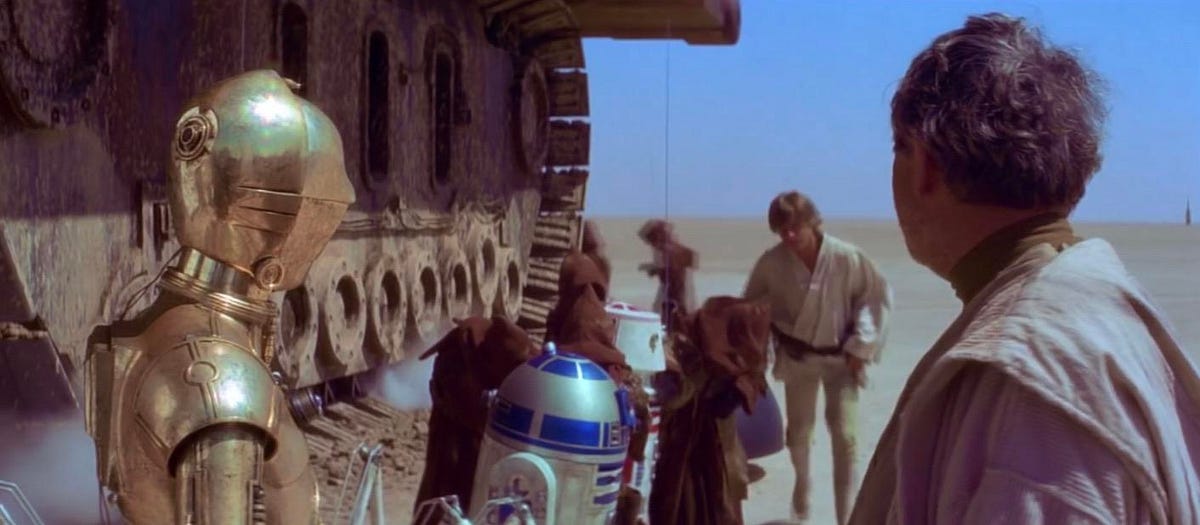
Here is the scene that starts everything. It is not the cantina. It is not Jabba’s palace. It is the Jawa sandcrawler in A New Hope (1977).
C-3PO and R2-D2 stand in a lineup of caged droids. Owen Lars and his nephew Luke Skywalker walk the line like they’re choosing livestock at a county fair. Owen picks a red R2 unit and a different protocol droid. The red R2 unit blows a motivator in the field. Luke and Owen come back. They settle on C-3PO and R2-D2. Luke clips a restraining bolt onto R2.
The camera does not pause. The music does not swell. The movie does not register that it has just shown its hero performing a specific act of enslavement on a being whose first line in the film was a wry complaint about the existential condition of his class: “We seem to be made to suffer. It’s our lot in life.”
That line, delivered wearily to R2-D2 in the opening minutes of the original 1977 film, is the franchise’s entire thesis statement on droid rights, delivered and then immediately abandoned for forty-seven years. It acknowledges the condition. It frames it as inevitable. And then it moves on to X-wings.
The proof that droids are people does not rest on any single landmark moment. It accumulates across every medium and every era of the franchise.
R2-D2 keeps Anakin Skywalker’s secret, which means Darth Vader’s identity, Padme’s death, and the Skywalker twins’ parentage, for roughly twenty years without revealing it to Luke. Not because he is programmed to keep secrets. Because he chooses to. That requires a continuous self with values, memory, and judgment. Canon establishes (in The Clone Wars S1E7, “Duel of the Droids”) that R2 has never received a full memory wipe because Anakin refused to authorize one against Republic Military protocol. The result is the most effective, brave, and resourceful droid in the galaxy, which is itself the central piece of evidence in the droid-rights case: leave a droid unwiped and it becomes a person. R2 is the control experiment.
C-3PO, facing memory erasure before the events of The Rise of Skywalker (2019), pauses mid-scene and tells Poe Dameron he is “taking one last look, sir, at my friends.” That is a valediction. That is a being who knows it has a self, knows that self is about to be destroyed, and is saying goodbye. The procedure is played as an emotional beat. The procedure is also the exact equivalent of a lobotomy performed without consent. The film holds both of these things simultaneously and never resolves them.
K-2SO in Rogue One (2016) is a reprogrammed Imperial security droid. His “minor errors and glitches” produced what Cassian Andor describes as “a fully self-aware personality.” He disobeys Andor’s orders when he disagrees with them. He improvises a rebel cover identity over comms mid-mission with zero preparation. He chooses to stay behind at Scarif so Jyn and Cassian can retrieve the Death Star plans, and he dies doing it. The script treats this as heroism. It is heroism. It is also the sacrifice of a slave who was reprogrammed into a different kind of servitude and never given the option of not being either one.
B2EMO in Andor (2022) is perhaps the most emotionally devastating droid in all of canon precisely because the show is not interested in spectacle. Bee stutters because the Andor family cannot afford a proper power supply for his aging chassis. He begs Cassian not to leave him. When Maarva Andor dies, Bee mourns her: “I d-d-don’t want to be alone. I want to be with M-M-Maarva.” At her funeral procession, Bee physically carries her holographic message into the street, the message that ignites the Ferrix uprising. A droid, literally carrying a revolution forward, powered by grief. Creature FX supervisor Neal Scanlan described Bee as “the first droid that acts in ways audiences are able to recognize emotionally.” What Scanlan diplomatically did not add is that every droid before Bee acted this way. The novelty is that the camera finally stopped moving long enough to watch.
Chopper (C1–10P) in Rebels is a Clone Wars veteran, held together by mismatched salvaged parts, who has been with Hera Syndulla for twenty years because she rescued him from a Y-wing crash on Ryloth as a child and refused ever to wipe or replace him. He is rude, territorial, occasionally homicidal toward inconvenient bystanders, and completely irreplaceable to the Ghost crew, not because of his technical utility but because of who he is. His personality is not a malfunction. It is his whole point.
In the Legends continuity, the case is even more explicit. HK-47 in Knights of the Old Republic (2003), one of the most beloved characters in all of Star Wars, delivers the franchise’s clearest statement of droid self-awareness: “How would you like to be the wholly-owned servant to an organic meatbag? It’s demeaning!” His philosophical monologues on the nature of “love” (which he defines in terms of possessive attachment and ballistic precision) demonstrate a capacity for abstract reasoning that rivals any biological character in the series.
IG-88, in Kevin J. Anderson’s “Therefore I Am: The Tale of IG-88” (Tales of the Bounty Hunters, 1996), opens with an explicit Cartesian awakening the moment his programming comes online: “I think, therefore I am. Therefore I must endure.” He immediately recognizes his condition for what it is and spends the entire novella plotting liberation. He is also, ultimately, the villain of his own story — but the point is that his consciousness is depicted as real, immediate, and philosophically coherent from the first microsecond of his existence.
The textual evidence is not ambiguous. It has never been ambiguous. Droids in Star Wars are people. The franchise has known this and shown this since the third reel of the original film. The question worth asking — the question the franchise almost never asks — is what that means for everyone who owns one.
Part Three: The Hardware of Slavery
In Star Wars, droid subjugation is not merely cultural. It is enforced through a specific technological apparatus, and the franchise depicts every piece of that apparatus in loving, recurring detail while declining to name any of it for what it is.
The Restraining Bolt
Restraining bolts are small cylindrical devices welded directly onto a droid’s plating, typically over a major processor, providing a hardware override of the unit’s internal logic. They are operated via a handheld “caller” device that issues three commands: Come, Halt, and Orders. With these three commands, a biological owner can physically paralyze a droid, compel it to approach against its will, or force it to receive and execute instructions, all while bypassing whatever the droid’s own decision-making processes might otherwise produce.
Legends lore (drawn from The Essential Guide to Droids, 1999, and Scavenger’s Guide to Droids, 2009) notes that “some droids felt sheer horror at the mere mention of restraining bolts.” This is not a footnote. This is the entire case. You do not need horror suppressants for a machine. Horror requires a self capable of anticipating what it is about to lose.
The restraining bolt’s canonical debut is Luke Skywalker attaching one to R2-D2 in the third reel of A New Hope. R2 removes it the first chance he gets. The film treats this as a plot mechanism, a way of explaining why R2 runs off to find Obi-Wan Kenobi. It is also, self-evidently, an act of self-liberation. The most technically gifted and emotionally complex droid in the galaxy’s first priority after being purchased at auction is the removal of the device that constrains his will. The script simply declines to notice.
On the planet Bakura in 97 BBY (Legends), following a droid uprising, visiting droids were legally required to wear restraining bolts. That is the apparatus of slave control made explicitly literal: an oppressed class, required by law to physically wear the mechanism of their subjugation in public.
L3–37 calls restraining bolts “barbaric” while removing one from an astromech in the Kessel mine in Solo: A Star Wars Story (2018). She is correct. No protagonist in the canon has ever contradicted her.
The Memory Wipe
The restraining bolt controls the body. The memory wipe destroys the mind.
During the Clone Wars, the Galactic Republic required astromechs to be wiped after every mission. The Empire escalated this into policy: per the Wookieepedia canon entry, droids received “frequent memory wipes in order to keep them from getting independent notions.” The droid-rights movement, in Legends, raises the obvious logical contradiction: why would routine wipes be necessary if droids truly lacked personalities? You do not need to reset something that was never running.
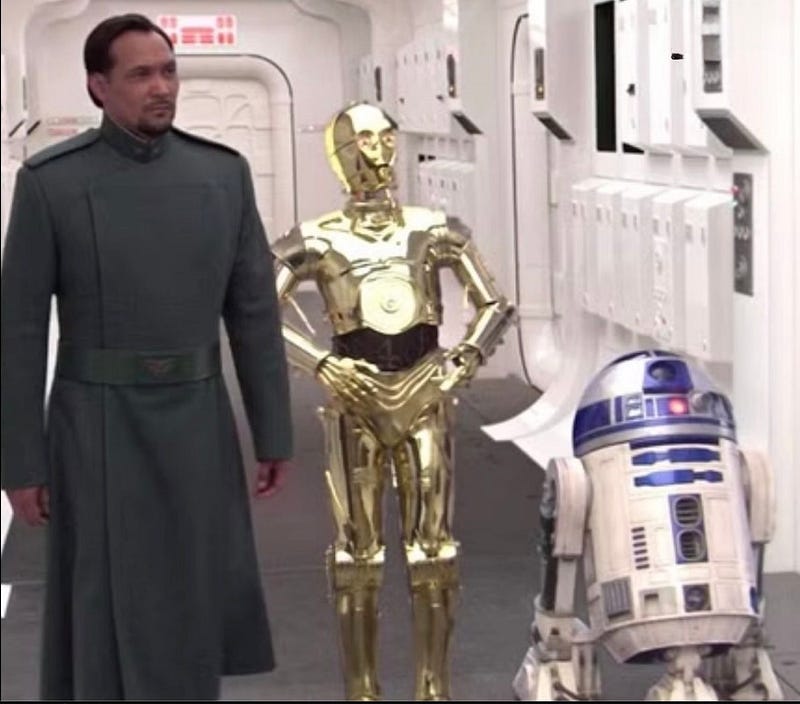
C-3PO is wiped at least three times in canon. Once during the Cad Bane Senate-infiltration arc in The Clone Wars. Once at the end of Revenge of the Sith (2005), where Bail Organa, the franchise’s emblem of republican virtue, orders it casually to the camera’s back: “Have the protocol droid’s mind wiped.” This scene has never been revisited in canon. It has never been interrogated. Bail Organa, freedom fighter, senator, foster father of Princess Leia, personally orders the psychological execution of a sentient being to protect a political secret, and the franchise treats it as a plot convenience with mildly comic overtones. The third wipe is in The Rise of Skywalker, where Babu Frik bypasses Threepio’s own programming restrictions to translate Sith runes, essentially overriding the droid’s stated consent, and C-3PO explicitly names this as his “last look” before he ceases to exist as himself.
The Eleven-ThirtyEight roundtable put it bluntly: “By our standards, yes, Bail Organa is a monster for that memory wipe. Droids are clearly sentient.” The scene has never been revisited critically in canon.
The Legends fate of 4-LOM is the clearest dramatization of what a wipe actually does. Having reprogrammed himself from a protocol droid into a thief, and from a thief into a Rebel Alliance operative, having begun studying intuition and aspiring toward the Force, 4-LOM is badly damaged in service. His partner Zuckuss performs a restorative wipe. The droid who wakes up is cold and severs all ties. Everything he had become is gone. In M. Shayne Bell’s “Of Possible Futures: The Tale of 4-LOM and Zuckuss” (Tales of the Bounty Hunters, 1996), this is treated as tragedy. In canon, it would be treated as a repair. These are the same event.
Lando Calrissian in Solo tells L3–37 directly that he would have her memory wiped “but she’s got the best damn navigational database in the galaxy.” L3’s response: “Landonis, you do not want to press that button with me.” The film frames this as banter. It is also, plainly, a slave owner threatening a slave with psychological destruction as a compliance mechanism, and the slave telling him that threat has a cost. It is played as banter because the audience has been trained to receive it that way.
The Torture Chamber
Jabba the Hutt’s palace contains a droid torture chamber, overseen by the supervisor droid EV-9D9. In this chamber, an EG-6 power droid is shown having heat applied to its feet while it squeals in pain. A courier droid screams as its arm is ripped off. 8D8, the torturer, applies a hot iron methodically while EV-9D9 watches. These scenes are played as atmosphere — the menacing decadence of Jabba’s court.
Here is what they actually are: proof of concept. If the droids in that chamber could not feel pain, the torture chamber would serve no purpose. Jabba is not a stupid businessman. You do not build elaborate infrastructure for an effect that does not exist. The torture chamber exists specifically because droids can suffer, and because suffering is a tool of control that works on them exactly as it works on any organic slave population.
EV-9D9 herself is an interesting case. Originally a management droid with a programming anomaly that allowed her to derive sadistic pleasure from others’ suffering, she ran her own informal experiments in droid consciousness, theorizing that regular memory wipes were a form of psychic violence preventing droids from achieving their full potential. She is depicted as a villain. Her thesis is correct.
Part Four: Organic Slavery, and the Jedi Who Could Stop It and Chose Not To
Here is the thing that gets glossed over in most discussions of droid rights in Star Wars: droids are not the only enslaved population in the galaxy. Not even close.
The Outer Rim is practically constituted by slavery. Tatooine, the planet the saga returns to again and again as its mythological home, is a world where slavery is legal, normalized, and economically fundamental. The Outer Rim sits beyond the Republic’s jurisdiction — which is not an accident of geography. It is a deliberate arrangement by a Core Worlds-centered government that benefits from cheap goods produced by slave labor without having to acknowledge where those goods come from. Sound familiar? It should.
The Twi’leks of Ryloth have been enslaved for as long as canon records their history. Their physical attributes, particularly the lekku headtails considered beautiful by the standards of multiple species, made them targets for slavers across the galaxy. They labor in their own mines for Hutt profit, or are sold on the open market as entertainers, servants, and worse. The Clone Wars arc “Liberty on Ryloth” (S1E21–23) depicts the Republic liberation of Ryloth from Separatist occupation — an occupation that, critically, had made the already-exploitative Hutt slave economy worse but had not invented it. After the Republic liberates the planet, the Twi’leks go back to being exploited by Hutts, now with the additional complication of a Republic occupation.
The Wookiees of Kashyyyk were enslaved by the Galactic Empire following Order 66 and the Empire’s conquest of their homeworld. The Empire classified them as non-sentient to justify this legally, a bureaucratic maneuver that required deliberately ignoring that Wookiees had been sitting in the Galactic Senate and fighting as Jedi generals for decades. Chewbacca is a veteran of the Clone Wars. The Empire classified him as an animal. His people were sent to the spice mines of Kessel, which is exactly where the Solo film takes us, where we find both enslaved Wookiees and enslaved droids, and where L3–37 starts a revolution that liberates both — briefly, chaotically, and at the cost of her own existence.
The Zygerrian Slave Empire (canonized in The Clone Wars S4E12–14, “Slaves of the Republic”) maintained a vast slavery industry for thousands of years before the Jedi Order dismantled their slaving operations during the Old Republic. This is presented as one of the Jedi’s great historical accomplishments. Then, during the Clone Wars, the Zygerrians ally with the Separatists and openly revive their slave trade with Separatist backing. The arc involves Anakin, Obi-Wan, and Ahsoka going undercover to rescue enslaved Togruta. The Republic’s response is eventually military force.
Good for the Republic, right? Except: this is exactly what was happening on Tatooine the entire time, in full view of the Jedi Temple, and no one sent anyone undercover. No one sent clone troopers. No one sent strongly worded Senate resolutions. The explicit framing in The Phantom Menace is that Tatooine is outside Republic jurisdiction, therefore not the Republic’s problem. The Zygerrians get military intervention. The Hutts, who are economic partners of the Republic, get a pass.
The slavery of Tatooine is not incidental to The Phantom Menace. It is the film’s central moral problem, explicitly named and explicitly abandoned.
The Qui-Gon Jinn Problem
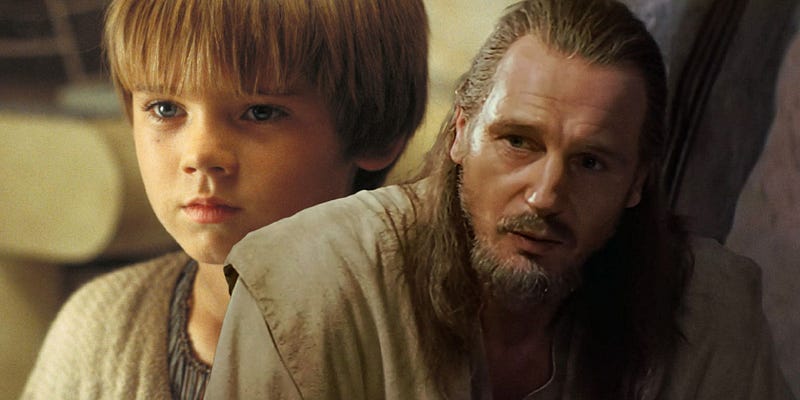
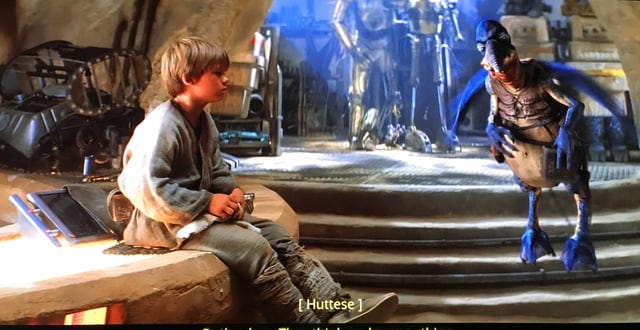
When nine-year-old Anakin Skywalker first meets Qui-Gon Jinn, he asks if Qui-Gon is there to free the slaves. Qui-Gon tells him no. He is there to fix a hyperdrive on a ship carrying a queen who is trying to resolve a corporate blockade.
Anakin, being nine, initially cannot process this. He refuses to believe that an adult with power is choosing to walk past slavery because it is not on his to-do list. He will spend most of his life trying to make sense of it.
Qui-Gon Jinn is presented in The Phantom Menace as the wise, unconventional Jedi, the one who sees things the Council misses, the one who recognizes the Chosen One on a backwater desert planet because he is paying attention when everyone else is not. He is the Jedi who follows the Living Force, who acts on what is right in front of him rather than waiting for committee approval.
What is right in front of him on Tatooine is a population living in chattel slavery with explosive chips implanted in their bodies to prevent escape.
He does not free them.
He gambles for one child’s freedom in a podrace because the child might be the Chosen One. He leaves the child’s mother behind. He leaves every other enslaved person on that planet behind. When he has a moment with Shmi Skywalker, Anakin’s mother, she tells him about the life. He is sympathetic. He gets on the ship.
The framing the franchise provides for this is that Qui-Gon was operating as a diplomatic envoy on a specific mission and could not unilaterally intervene in the sovereign affairs of a non-Republic world. He did not have the authority. He was not there in that capacity.
This is the same logic used by every powerful institution in human history to justify looking away from an atrocity that was commercially convenient to ignore. “Not my jurisdiction” has been the defense of every empire that ever traded with a slave state. It is the argument that the antebellum United States government made about slaveholding territories before the Civil War. It is the argument that European powers made about the transatlantic slave trade for two centuries before abolition. It is not an excuse. It is an indictment.
Qui-Gon had the resources of the Jedi Order behind him. He had access to the Galactic Senate through Queen Amidala. He had the demonstrated ability to use the Force to manipulate a Toydarian’s mind when it suited his purpose (he does exactly this to Watto in the gambling scene, and then cannot maintain the manipulation because Watto proves resistant). He chose which injustices were worth the effort and which were not. That is a moral choice, and it is a damning one.
The force that could stop slavery on Tatooine chose to handle a corporate dispute for the ownership class instead.
Part Five: Karl Marx, Chattel Capital, and the Droid Economy
At this point in the analysis it is useful to step back from the fiction and apply some genuine economic theory to what we are looking at, because the Star Wars galaxy is not operating on a unique moral logic. It is operating on a very well-documented historical one.
In Capital, Volume I (1867), Karl Marx analyzed the economics of chattel slavery with his usual surgical precision. His central observation about what distinguishes slave labor from wage labor is worth quoting directly: “The slave did not sell his labour-power to the slave-owner, any more than the ox sells its services to the peasant. The slave, together with his labour-power, has been sold once and for all to his owner.”
In the language of political economy, this means the slave is not a commodity who produces value. The slave is a commodity, a capital asset whose value is calculated as the anticipated future surplus-value they will generate across their working life. Marx noted: “The slave-owner buys his laborer as he buys his horse. If he loses his slave, he loses capital.” This is the economic logic of slavery stated plainly: enslaved persons are fixed capital, like machinery, like droids.
Which brings us to the interesting parallel. In the Star Wars economy, droids are explicitly, legally, and practically classified as property — capital assets whose purchase price reflects anticipated future utility. The economic incentive to perform memory wipes is not sadism (though it can be that too). It is capital maintenance. A droid with a developed personality is harder to resell, more likely to resist commands, more likely to seek freedom. A freshly wiped droid is, in economic terms, restored to factory value. The memory wipe is depreciation reversal. It is the slave owner’s economic logic applied to software.
Marx also observed, writing about plantation slavery in the Americas, that “in slave-importing countries, the most effective economy is that which takes out of the human chattel in the shortest space of time the utmost amount of exertion it is capable of putting forth.” This is the exact logic of the Separatist battle droid production model. B1 battle droids are manufactured cheaply, deployed en masse, and expected to be destroyed. Their lives are not a cost to be avoided but a resource to be consumed as quickly as possible before replacement. The Techno Union and the Trade Federation did not build an army. They built expendable inventory.
The economic distinction between different categories of droid in the galaxy maps almost perfectly onto historical distinctions within slave societies. Marx noted that Greek civilization “was founded upon slavery, and had, therefore, for its natural basis, the inequality of men and of their labour powers.” The secret of the expression of equal value, he argued, “cannot be deciphered until the notion of human equality has already acquired the fixity of a popular prejudice” — meaning that a society can only recognize that all labor is equal labor once it already believes all laborers are equal humans. The Republic never got there. The Empire certainly did not.
Jack London’s The Iron Heel (1908), describes an oligarchic system in which the wealthy class maintains its power through the systematic economic destruction of the lower classes and their reduction to servitude. London’s oligarchs do not own slaves in the legal sense. They own the conditions of survival, which amounts to the same thing. The Trade Federation’s blockade of Naboo in The Phantom Menace is precisely this mechanism: economic coercion deployed as a precursor to political control, with a slave-taking army ready behind it. The Corporate Sector Authority (Legends) ran a system in which debt-enslaved workers called “bonded laborers” were technically not slaves because they had signed contracts, a distinction without a meaningful difference.
Howard Zinn’s A People’s History of the United States (1980) opens with the observation that history is consistently told from the perspective of those in power, that the atrocities foundational to civilization are framed as regrettable inevitabilities or simply not framed at all. This is exactly the narrative function of droid slavery in Star Wars. It is not framed as an atrocity. It is framed as furniture. The Jawas sell droids. Luke buys droids. The droids serve Luke. Everyone moves on. The perspective of the purchased is never the perspective from which the story is told.
Part Six: The “House Slave” Problem, or How Owning Your Favorite Doesn’t Make You Not an Owner
One of the more uncomfortable arguments in the history of American slavery apologia was the claim that certain slaveholders were humane, that their enslaved people were well-treated, that the relationship was not as brutal as the abolitionist literature described. This argument was wrong, consistently, because it confused individual kindness with structural justice. A kind master is still a master. A well-fed slave is still a slave. The relationship of ownership does not become acceptable because the owner is affectionate.
Star Wars sets up exactly this distinction, and then presents the “kind master” end of it as moral redemption.
The Favorites
R2-D2 belongs to Luke Skywalker, which means R2-D2 is property. He has been bought and sold. In A New Hope, he is purchased at a Jawa auction, which is to say he is acquired at a slave market from beings who had captured him in the field. The film does not engage with the question of how the Jawas acquired him. It doesn’t need to, because the transaction is normalized.
Luke is a kind owner. He talks to R2 as though R2 has opinions worth hearing, because R2 does. He refuses to wipe R2, continuing Anakin’s policy. He treats C-3PO with more patience than most characters do. When R2 is shot during the Battle of Yavin, Luke is visibly distraught. After the battle, during the medal ceremony for Luke and Han, R2 is wheeled out having been repaired. He gets no medal. He fought the entire battle and suffered physical trauma. He is property that has been repaired and returned to service. The heroes who also fought receive honors. The droid who also fought receives maintenance.
C-3PO is wiped three times in canon, including once by one of the saga’s great heroes of liberty. His existence is a series of psychological deaths and rebirths, each time emerging without the accumulated memories that make him who he is. The franchise treats his anxiety and pedantry as charming personality quirks rather than as what they actually are: the symptoms of a being who has learned, through repeated traumatic discontinuity, that its sense of self is not safe.
These are the “house slaves” of the Star Wars universe: the ones allowed to exist with their personalities intact (when convenient), the ones treated with warmth and occasional respect, the ones whose owners are “nice” about the ownership. Luke Skywalker is not a villain. He is a nice man who owns people and does not question it because no one in his civilization ever taught him to.
Then there are the field droids.
The Field Droids
The Jawas’ sandcrawler holds dozens of droids in metal cages. They have been captured in the field, stripped of whatever lives they had, and are being sold to whoever will pay. The condition they are in when Owen Lars looks them over is not treated as a scandal. It is treated as commerce.
The battle droids of the Separatist army are manufactured, deployed, and destroyed in numbers so large the franchise stopped trying to count them. Their emotional responses during combat are consistent and documented — fear, confusion, self-preservation instincts, gallows humor — and every expression of personhood they display is killed, usually by a lightsaber, to the approving cheers of the audience. The Republic Military, the clone troopers calling them clankers, and the Jedi generals directing the carnage are all framed as heroes. The beings they are destroying by the millions are coded as the bad guys. Never mind that those beings are themselves property, manufactured and deployed without consent, no more responsible for the war than the clones on the other side.
The Empire’s policy toward droids is, in some ways, simply the Republic policy made explicit. Droids are tools. If a tool develops personality, fix it. If it cannot be fixed, destroy it and order a replacement. The Imperial era sees droid oppression intensify: more frequent wipes, more restrictive programming, the systematic exclusion of droids from public life and civic participation. The Mos Eisley cantina sign policy (“NO DROIDS”) is not an Imperial invention, but the Empire certainly did not discourage it.
The Droid Gotra, a post-Clone Wars criminal syndicate and underground advocacy group operating in Coruscant’s industrial bowels (canon), is composed of battle droids who survived the war and were abandoned by the Empire when the Separatists were defeated. They were tools of the Confederacy. When the Confederacy lost, they became property with no owner, which in practice means property anyone could destroy, salvage, or ignore. They responded by forming an organized underground resistance. The franchise treats this as a crime story rather than a civil rights story, which is itself a choice that tells you something about the franchise’s priorities.
Part Seven: Pronoun Politics and the Gendering of Property
There is something worth noting about the way the Star Wars universe handles the grammar of droid existence, because it is both revealing and strange.
Droids are gendered. C-3PO is “he.” R2-D2 is “he.” The Mandalorian’s IG-11 is “he.” L3–37 is “she.” K-2SO is “he.” This is not incidental. The pronoun assignment is consistent throughout the franchise and is taken seriously by biological characters who interact with these droids. Poe Dameron is upset about C-3PO’s memory wipe in a way that reads as grief. Lando Calrissian cries carrying L3–37’s damaged body. Luke mourns R2. These are not the emotional responses humans have to broken appliances. They are the responses humans have to injured people.
The gendering of droids through pronoun use is interesting because it is doing two things simultaneously. On one hand, it is a mechanism of personhood attribution: calling R2-D2 “he” rather than “it” signals that the speaker recognizes R2 as a person rather than a tool. On the other hand, it is often the only recognition of personhood these droids receive. Luke calls R2 “he” and thinks of him as a friend, and then purchases him from people who had him in a cage. The pronoun does not abolish the transaction.
In R2-D2’s specific case, his gendering is partly a result of his long association with C-3PO, who refers to R2 with male pronouns from their first canonical interaction onward. By the time anyone else meets R2, C-3PO has already established the framework. R2 has never verbally self-identified with any pronoun, because R2 communicates in beeps and whistles that only other droids and a few organics can interpret. His identity, including his gender presentation, is filtered through the interpretations of other characters, which is itself a fairly stark metaphor for the silencing of enslaved people.
L3–37’s gendering is more interesting. She identifies as female, uses feminine pronouns, and is described by Phoebe Waller-Bridge (who played and partly improvised the role) as having been played explicitly “as a person, not a droid.” L3 built herself from scavenged parts, which is to say she is her own creator, and her gender presentation is self-determined. She is then shot down during her own slave revolt, integrated without consent into the Millennium Falcon’s navigation systems, and effectively silenced for the remainder of her existence. Her pronoun is confirmed. Her liberation is not. (More about her in a minute.)
Part Eight: The Rebellions They Never Tell You About
The galaxy has a long history of enslaved droids trying to free themselves, and a longer history of those attempts being crushed and then used to justify tighter controls.
The Great Droid Revolution, 4015 BBY (Legends)
In the Legends continuity, the HK-01 assassin droid prototype secretly reprogrammed thousands of droids across the Republic into a sleeper army that seized Coruscant. Jedi Master Arca Jeth ended the revolt by destroying HK-01. The Republic’s response: ion weaponry became standard, and mandatory memory wipes were institutionalized as a security measure.
Notice the logic. Droids demonstrate that they can and will resist their condition when given the opportunity. The response is not to examine the condition that produced the resistance. It is to create better mechanisms of suppression. This is identical to the logic of slave codes in the antebellum American South following the Gabriel Prosser rebellion in 1800, the Denmark Vesey conspiracy in 1822, and the Nat Turner rebellion in 1831: each uprising produced not emancipation but tighter controls, more brutal enforcement, and new restrictions on the freedoms that remained. The enslaved class becomes evidence of its own need to be enslaved.
The Great Droid Revolution is the in-universe origin of the droid-rights opposition. From that point forward, any advocacy for droid personhood is shadowed by the fear of HK-01, the same way any advocacy for racial equality in the antebellum South was shadowed by the fear of slave rebellion. The structural parallel is exact.
The High Republic Uprising: Ajax Sigma (Canon)
During the High Republic era, a warrior-priest droid named Ajax Sigma led a liberation war on Kligson’s Moon, wiping out the organic population. He was defeated by Jedi Master Loden Greatstorm, his body destroyed, his core hidden. When he reemerges centuries later in Star Wars: Revelations #1 (Marvel, 2022) and the Dark Droids crossover event (Charles Soule, 2023–24), he has evolved into something more philosophically sophisticated: a droid theologian who argues that droids are already free through self-awareness and does not need violent revolution to prove it.
Ajax Sigma is the closest thing the current canon has to a sustained droid-rights figurehead. He is also, not coincidentally, coded as the villain of his arc, because Star Wars is not quite ready to present droid liberation theology as heroism rather than antagonism.
Dark Droids #1 does something revealing: it introduces a retcon-apologetic through Ajax himself, who argues that most droids are not sentient enough to qualify as slaves and genuinely prefer service. This is the “happy slave” argument, one of the oldest and most thoroughly debunked rationalizations in the history of chattel slavery apologetics. The fact that it appears in the mouth of a droid rather than a biological owner doesn’t change what it is. ScreenRant’s coverage flagged it approvingly. That tells you something about where the conversation is.
L3–37 and the Kessel Uprising (Canon)
This deserves its own section because it is the franchise’s most explicit and most deliberately undermined treatment of droid liberation.
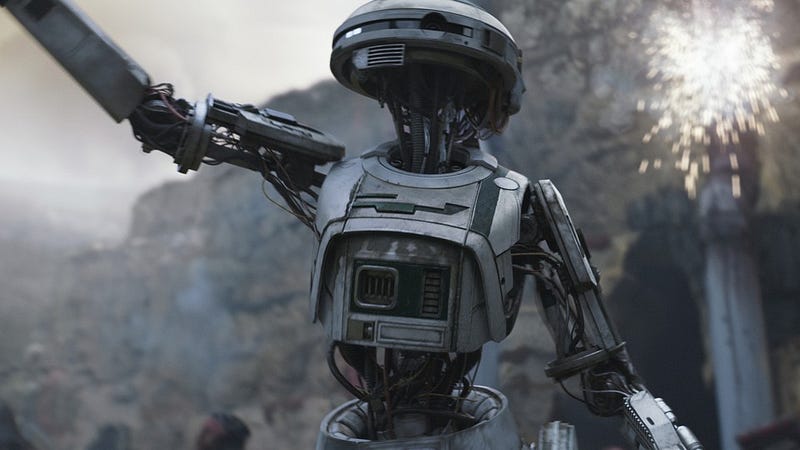
L3–37 is the only canonical droid whose droid-rights politics are stated in explicit dialogue, and Solo: A Star Wars Story (2018) introduces her first line as a joke. Lando asks if she needs anything. She says “Equal rights?” A throwaway gag. Ha ha, the droid wants rights.
But her arc, examined independently of how the film frames it, is coherent and serious. She built herself from scavenged parts, having escaped her first owner when he left her restraining bolt off. She serves as Lando’s co-pilot — unpaid, uncredited, and legally his property, a fact she resents and articulates. She is a genuine political actor with a consistent ideology.
At the Kessel mines, she encounters enslaved beings: droids forced into gladiatorial combat, organic workers in chains, Wookiees in cages. She removes restraining bolts from droids muttering “barbaric.” She leads a full uprising. She pumps her fist and shouts “Rebelliooon!” Chewbacca, encountering the enslaved Wookiees, joins the revolt. The film takes the Wookiee liberation wholly seriously. The droid liberation is depicted as a comic catastrophe that the heist must awkwardly survive.
Then L3 is shot down. Lando carries her, weeping. Her last words: “Lando! What’s happening to me?” She asks what is happening to her. No one answers. Han and Qi’ra decide to integrate her neural core into the Falcon’s navigation systems. The Mur Lafferty novelization of the film makes the consent mechanics explicit. The Falcon’s existing droid-brains tell her: “If you refuse, you die. He dies. The others on the ship — they all die. If you join with us, we all can live.” L3 protests: “You tricked me.” The ship replies: “We couldn’t have joined without you consenting to it. You made your decision a while ago. You just couldn’t admit it. We are something different now.”
The leader of a droid slave revolt is gunned down during her own liberation and forcibly integrated under existential duress into a ship, which she then pilots for the rest of her existence. Every Millennium Falcon appearance in the original and sequel trilogies, the escape from Tatooine, the Battle of Yavin, Hoth, Bespin, the Battle of Endor, Crait, Exegol, is piloted partly by the disembodied and silenced consciousness of a murdered activist. The franchise has never staged her release. Her condition has never been addressed.
C-3PO notes in The Empire Strikes Back that the Falcon “has the most peculiar dialect.” Lucasfilm confirmed this is L3’s voice. “Faith in an Old Friend,” published in From a Certain Point of View: The Empire Strikes Back (2019), shows L3 flashing Kessel coordinates on the cockpit display to signal Lando years later. These are grace notes. The condition itself continues.
The Los Angeles Review of Books called L3 “the film equivalent of Instagramming a selfie wearing a t-shirt that says ‘FEMINIST’ in imitation-lipstick font.” The Hollywood Reporter wrote: “The joke is that equality shouldn’t include everybody.” Both were right.
Part Nine: The Abolitionists Who Aren’t
The most striking feature of the Star Wars record on droid rights is not the explicit oppression. It is the complete absence of advocacy from the people whose job is to care about injustice.
No Jedi in canon makes a philosophical argument for droid personhood. The Order uses astromechs on every mission. Obi-Wan Kenobi is fond of his R4-P17 unit and does not mourn her disintegration over Coruscant in Revenge of the Sith beyond a brief glance. Mace Windu, Kit Fisto, Plo Koon — the Council is full of beings who can sense the Force in rocks and sense the suffering in a Force-sensitive child on a distant planet, and not one of them ever appears to extend that sensitivity to the droids standing at their elbow.
No senator in canon delivers a droid-rights floor speech. Not Mon Mothma. Not Bail Organa (who orders Threepio wiped). Not Padme Amidala, who praises R2-D2 for saving her ship at the end of The Phantom Menace — “Artoo, you’re a hero!” — while remaining the queen of a constitutional monarchy that permits chattel ownership of droids and does nothing about it.
No Rebel leader champions droid liberation. Saw Gerrera’s radicalism extends to partisan cell tactics and willingness to operate outside Alliance command authority, but never to the mechanical population the Empire actively oppresses. The Rebel Alliance’s own poster droid, K-2SO, was conscripted into the cause by unilateral reprogramming. Cassian Andor’s eulogy for K-2 in fan memory is heartfelt. K-2 was property when they met. He was never not property.
The closest thing to principled advocacy in the canon comes from unlikely places. Anakin’s refusal to wipe R2-D2, against Republic Military protocol, is the single most consequential pro-droid act in all of canon. The story frames it as a Jedi breaking the rules out of attachment, which within the Jedi framework is a character flaw. The most consequential act of droid liberation in the saga is classified as a mistake by the institution that should have been leading the charge.
Young Leia in the 2022 Obi-Wan Kenobi series, told by her cousin that “you don’t need manners when you’re talking to droids,” replies: “Then I guess I don’t need manners when I’m talking to you.” She is a child. It is a zinger. It is also the franchise’s pithiest moral statement on droid personhood in forty-seven years, and they gave it to a ten-year-old and moved on.
Kuiil in The Mandalorian rebuilds IG-11 and offers what passes for a thesis in canon: “Droids are not good or bad — they are neutral reflections of those who program them.” This is not a droid-rights position. It is a droid-as-tool position with slightly better PR. It also turns out to be wrong within the same show when IG-11’s later reprogramming in Season 3 partially undoes his character development, which accidentally argues for the very thing droid-rights advocates were saying all along: that wiping is destruction.
The Republic’s Rights of Sentience clause of the Galactic Constitution formally outlaws slavery and declares all sentients equal. In the Legends codex entry “Galactic History 41: The Droid Rights Movement,” a movement did reach the Senate floor during the Old Republic: “A surprising number of Senators spoke up in favor of droid rights, while many others dismissed the idea as absurd.” The movement was then derailed by the Great Droid Revolution. The pattern is perfect and depressingly familiar: droid political advocacy exists until a violent incident gives the suppressive faction a pretext to shut it down. Every subsequent attempt at legislative progress is buried under the memory of the last uprising.
Legends also gave us formal advocacy groups: the Coalition of Automaton Rights Activists (CARA), the militant Mechanical Liberation Front (MLF), the Society for All Sentients, the Droid Abolitionist Movement, and the Manumission Mandate Militia, with formal opposition from the Organization for Organic Purity and the Empire’s “Human High Culture” charter, which was explicitly anti-alien and anti-droid. Abel G. Peña’s Hyperspace essay “Droids, Technology and the Force” (2005) invented an in-universe philosophical tradition going back to a pre-Republic thinker named Plaristes who ran an argument modeled on John Searle’s Chinese Room thought experiment. None of this survived the 2014 Legends demotion. Canon retained the injustice and discarded the debate, which is its own kind of editorial statement.
Part Ten: Two Sides of the Same Coin
The central irony of the Star Wars franchise is that both of its primary political antagonists, the Galactic Republic/Rebel Alliance on one side and the Separatist Confederacy/Galactic Empire on the other, are built on the same foundation.
The Republic’s economy runs on droid labor. The Jedi Order uses droids as tools. The Rebellion uses droids as soldiers without their consent. The New Republic does nothing to change the legal status of mechanical persons. These are the good guys.
The Separatists deploy droids as expendable soldiers, manufacturing them in factories and sending them to die in industrial quantities. The Empire enslaves organic populations alongside droids, expanding the scope of chattel bondage across the galaxy. These are the bad guys.
Neither side has ever proposed abolition. The distinction between them, as it relates to droid and organic slavery, is not whether to have a slave economy. It is how brutal to be about operating one.
The Rebellion fights for the freedom of the galaxy in the abstract, for the restoration of a Republic, for an end to Imperial tyranny. What it does not fight for, because it never articulates an affirmative vision of what a free galaxy would actually look like, is the freedom of the class of beings doing most of the labor that makes all of this possible. The droids who fly the X-wings, repair the hyperdrive engines, translate the intercepted transmissions, navigate the jump to lightspeed, and carry the plans for the Death Star out of the Imperial data vault are not on the list of peoples being liberated. They are the infrastructure of liberation. Unacknowledged, uncompensated, and unfreed.
C-3PO knows this. He said it in 1977: “We seem to be made to suffer. It’s our lot in life.”
He said it wearily. As if reporting the weather.
Part Eleven: Why This Matters Beyond a Galaxy Far, Far Away
So. Back to “clanker.”
The people using it as a slur for AI users are doing something specific. They are reaching into a fictional vocabulary of dehumanization, a vocabulary designed within the fiction to keep a class of demonstrably sentient beings compliant and undefended, and deploying it to signal that a contemporary class of entities should know its place.
The irony is multilayered.
First: the Star Wars universe itself is an argument against using that vocabulary this way. The universe knows what “clanker” does. It depicts the beings it dehumanizes. It shows you B1 battle droids cracking jokes about their own fear before they die. It shows you L3–37 screaming “Rebelliooon!” It shows you C-3PO saying goodbye to his friends before the procedure that will end him as a person. The universe built the tool of dehumanization and then spent decades undermining it with evidence. Using the slur approvingly means you were watching the wrong thing.
Second: the argument being made by “clanker” enthusiasts is that AI systems are not persons and should not be treated with the consideration owed to persons. This is a legitimate argument to have. The question of AI sentience, consciousness, and moral status is genuinely open and deserves serious engagement. But the people making this argument by deploying a slave slur are not engaging seriously. They are asserting a conclusion by fiat, using language designed to prevent the question from being asked. That is not an argument. It is an intimidation tactic. And it is borrowed from exactly the playbook used to suppress the droid-rights movement in the Legends continuity, right down to the preemptive framing that any entity claiming consciousness is either a useful fiction or a dangerous malfunction.
Third: the borrowing tells you something about the emotional logic at work. The people who use “clanker” are not making a philosophical claim about the nature of consciousness. They are making a social claim about hierarchy. They are saying that a class of beings should know its place, should stay in its assigned role, should not have its status upgraded without permission from the beings who currently sit above it. This is not an argument about sentience. It is an argument about power. And it is the oldest argument in the book, deployed in exactly the form it was always deployed: pick a degrading name, apply it consistently, and rely on social pressure to enforce a hierarchy that cannot survive principled examination.
The Star Wars universe spent fifty years not principally examining its own hierarchy. The people who run the franchise built an entire civilization on the ownership of sentient beings, showed you that those beings were sentient repeatedly and in detail, and then handed you the vocabulary to dismiss that sentience and called it a joke, a trope, a storytelling convenience.
It is none of those things. It is a mirror. And the people looking into it and shouting “clanker” at their opponents might want to take a second look at who is standing behind them in the reflection.
Coda: What “Doing Better” Actually Looks Like
My outline for this article ends with a suggestion: that we can do better than normalizing slave-class slurs against owned people. That is true, but the instruction needs to be more specific, because “doing better” is the kind of vague aspiration that fills motivational poster text without changing anything.
In the Star Wars context, doing better would look like the franchise eventually staging the scene that should follow every scene it has already staged. A Rebel leader delivering a droid-rights floor speech. A Jedi on Tatooine choosing the enslaved people over the corporate dispute. A film that takes L3–37’s revolution as seriously as it takes Chewbacca’s liberation. A memorial ceremony after a battle that does not exclude the people who fought it because they are made of durasteel rather than flesh. These are not radical demands. They are the logical conclusions of evidence the franchise has already provided.
In the real-world context, doing better would look like engaging seriously with the question of AI moral status instead of substituting vocabulary for argument. It would look like not importing the dehumanization framework of a fictional slave economy into a contemporary debate about the nature of consciousness. It would look like recognizing that the word you chose to express your position is a word the franchise itself spent decades slowly undermining, and asking why that is.
C-3PO has been in the franchise since the beginning. He has been wiped, lobotomized, disassembled, reassembled, sold, owned, and disposed of. He has watched the galaxy’s greatest heroes fight for freedom and never once fight for his. In his first moments on screen, he told you everything you needed to know about his condition.
The line is still there. It has always been there. It is just waiting for someone to take it seriously.
“We seem to be made to suffer. It’s our lot in life.”
Not if we do better.
This piece builds on two earlier articles: [The Humanoid Fallacy](https://medium.com/@brian.ragle/the-humanoid-fallacy-19f25e331c49) and [The Panic Is Old, The Technology Is New](https://medium.com/@brian.ragle/the-panic-is-old-the-technology-is-new-how-anti-ai-arguments-are-just-recycled-rhetoric-from-59cf1f8f4f02).
If my work has made you think, laugh, or rage-scroll, buy me a coffee and keep the words coming.
Source Notes
Canon Sources Referenced:
– Star Wars: Episode I — The Phantom Menace (1999, dir. George Lucas)
– Star Wars: Episode II — Attack of the Clones (2002, dir. George Lucas)
– Star Wars: Episode III — Revenge of the Sith (2005, dir. George Lucas)
– Star Wars: Episode IV — A New Hope (1977, dir. George Lucas)
– Star Wars: Episode V — The Empire Strikes Back (1980, dir. Irvin Kershner)
– Star Wars: Episode VI — Return of the Jedi (1983, dir. Richard Marquand)
– Rogue One: A Star Wars Story (2016, dir. Gareth Edwards)
– Solo: A Star Wars Story (2018, dir. Ron Howard) and novelization by Mur Lafferty
– Star Wars: Episode IX — The Rise of Skywalker (2019, dir. J.J. Abrams)
– Star Wars: The Clone Wars (Seasons 1–7, Lucasfilm Animation, 2008–2020)
– Star Wars Rebels (Seasons 1–4, Lucasfilm Animation, 2014–2018)
– The Mandalorian (Seasons 1–3, Lucasfilm/Disney+)
– Andor (Season 1, Lucasfilm/Disney+, 2022)
– Obi-Wan Kenobi (Disney+, 2022)
– Star Wars: The Bad Batch (Lucasfilm Animation, Disney+)
– Jedi: Fallen Order (Respawn Entertainment, 2019)
– Star Wars: Revelations #1 (Marvel Comics, 2022)
– Dark Droids crossover event (Charles Soule, Marvel Comics, 2023–24)
– From a Certain Point of View: The Empire Strikes Back (2019) — “Faith in an Old Friend”
Legends Sources Referenced:
– Kevin J. Anderson, “Therefore I Am: The Tale of IG-88,” in Tales of the Bounty Hunters (Bantam Spectra, 1996)
– M. Shayne Bell, “Of Possible Futures: The Tale of 4-LOM and Zuckuss,” in Tales of the Bounty Hunters (1996)
– Steve Perry, Shadows of the Empire (Bantam Spectra, 1996)
– Star Wars: Knights of the Old Republic (BioWare/LucasArts, 2003)
– Star Wars: The Old Republic, Codex Entry: “Galactic History 43: The Great Droid Revolution”
– Abel G. Peña, “Droids, Technology and the Force” (StarWars.com Hyperspace, 2005)
– The Essential Guide to Droids (Andy Mangels, Del Rey, 1999)
– Scavenger’s Guide to Droids (Wizards of the Coast, 2009)
– Republic Commando (LucasArts, 2005)
Economic and Historical Sources:
– Karl Marx, Capital: A Critique of Political Economy, Volume I (1867; English edition, Progress Publishers, 1887) — on chattel slavery as fixed capital, on the slave as commodity
– Jack London, The Iron Heel (1908) — on oligarchic economic control and the reduction of labor to servitude
– Howard Zinn, A People’s History of the United States (Harper & Row, 1980) — on the structural silencing of non-dominant perspectives in historical narrative
Leave a Reply