The Dog Had No Name
John Wick Was Never an Assassin
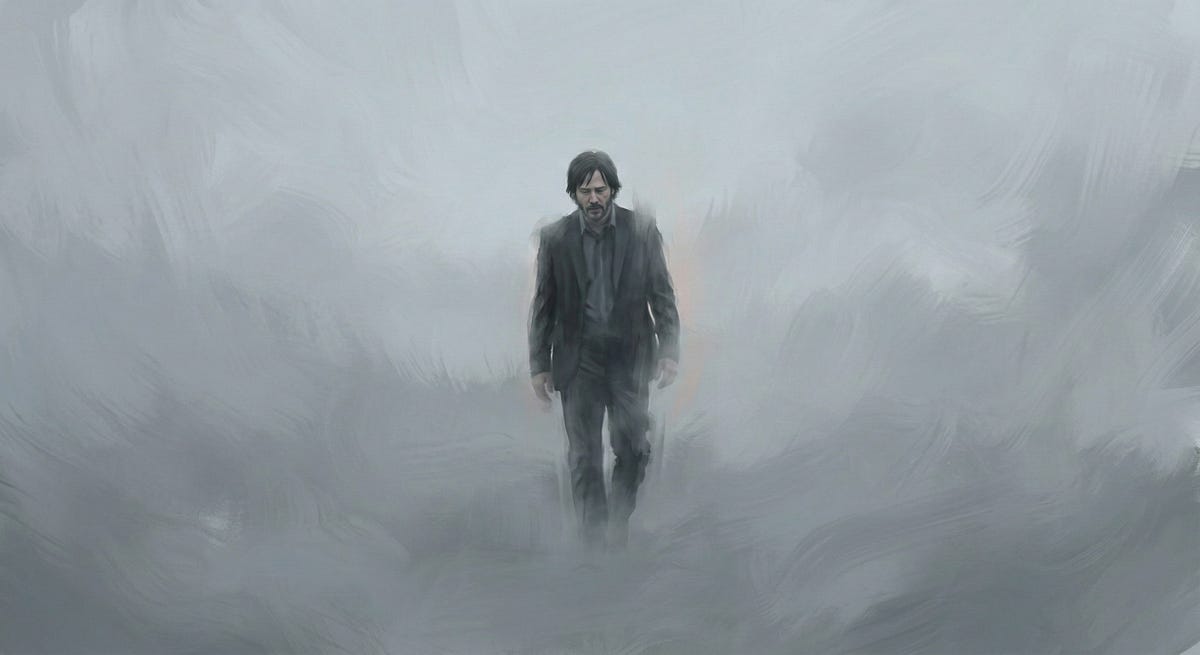
Here is the theory I cannot stop thinking about. It’s what happens when I watch movies. I notice things and then I start thinking about them. I binge watched all four movies of the John Wick franchise (prior to “Ballerina”, which I address at the end of this essay). Throughout it all, some things kept nagging at me and I had to finally piece them together. What follows is how those pieces connect to form the tapestry that is the John Wick story.
It should go without saying, but I’ll say it anyway, there are spoilers aplenty for the whole series of Wick movies in the Wickiverse (Wickoverse? Wickverse?).
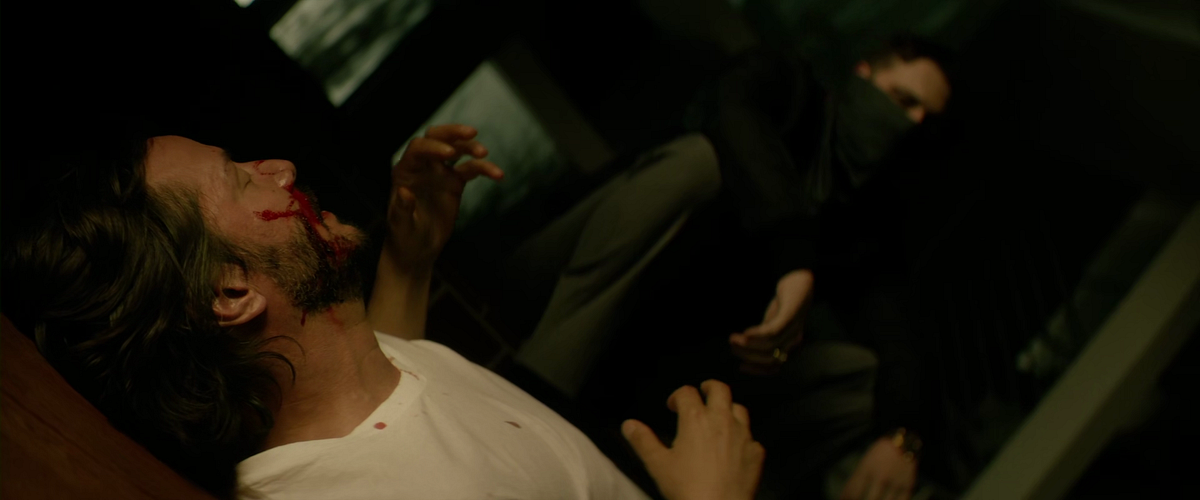
John Wick was nobody. Not the Boogeyman. Not the man you send to kill the Boogeyman. Just a man who had a wife, a house, a car he loved, and a grief so large after losing her that it had no bottom. On the night Iosef Tarasov broke into his home, beat him half to death, killed his puppy, and stole his car, John Wick did not survive. He died on the floor of that kitchen, bleeding out next to the body of a dog that had been alive for three days.
Everything after that is the underworld.
The Problem with John Wick, Regular Guy
If you watch the first forty minutes of John Wick through the lens of a normal human experience, something is slightly off in a way that is hard to name at first. The grief is real. The wife is real. The car is real. The beagle puppy, delivered posthumously by a dying woman who wanted her husband to have something to love, is achingly, specifically real. All of that lands with the weight of genuine loss.
Then Iosef and his crew show up, and John Wick, who the film has so far presented as a widower in a nice house who is visibly falling apart, becomes something the movie has not prepared you for. Not gradually. Instantly. The mask does not slip so much as it vaporizes.
And here is the thing the movie asks you to accept without much ceremony: the people who did this to him are telling each other, with genuine terror, that this man is mythological. That he once killed three men with a pencil. That he is the one you send when you absolutely need someone dead and you have exhausted every other option. That the moment Iosef Tarasov touched John Wick’s things, he signed the death warrant of everyone who knew him.
But we have been watching this man grieve for twenty minutes. He does not carry himself like a legend. He carries himself like someone whose hands have forgotten what to do now that they have nothing left to hold. The dissonance is intentional. The movie presents it as a secret, as backstory, as the reveal that recontextualizes everything you have seen.
I am suggesting it is something else. I am suggesting that John Wick, mild-mannered widower, died in that kitchen. And the revelation of his legendary past is not backstory. It is the mythology of the underworld he has just entered, reshaping itself around the new arrival, assigning him a role, giving him a story to inhabit because the dead need stories the way the living need air.
He was never the Boogeyman. He became the Boogeyman the moment he crossed over, because that is what the underworld does. It does not take you as you are. It takes you as it needs you to be.
The Liminal Phase: Wandering the Near Shore
What Chapter 1 actually depicts, after the kitchen, is not a revenge story. It is the period every mythology accounts for: the interval between death and descent, when the soul does not yet know what it is, where it is, or what the rules are.
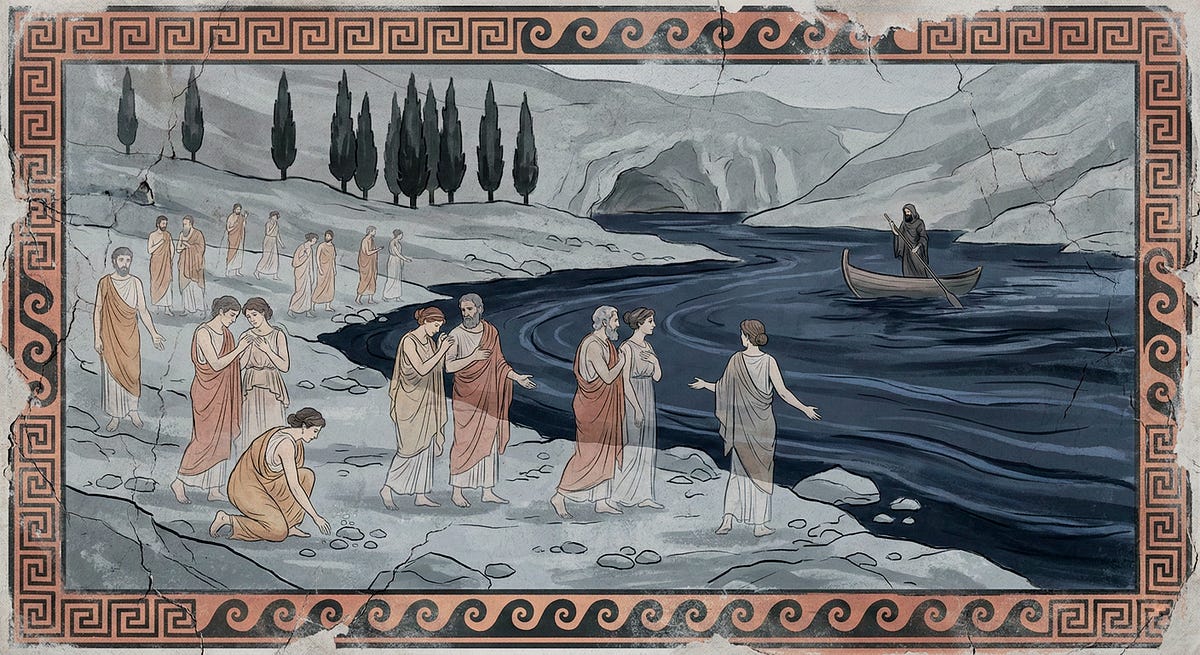
In Greek tradition, the unburied dead wandered the near shore of the Styx, unable to cross, unable to return, existing in a threshold state between worlds. John Wick spends the bulk of the first film in exactly this condition. He is running on grief and muscle memory. He is not yet operating by underworld rules because he does not know underworld rules exist. He moves through the world like a man who cannot quite feel his own body, which is precisely what he is.
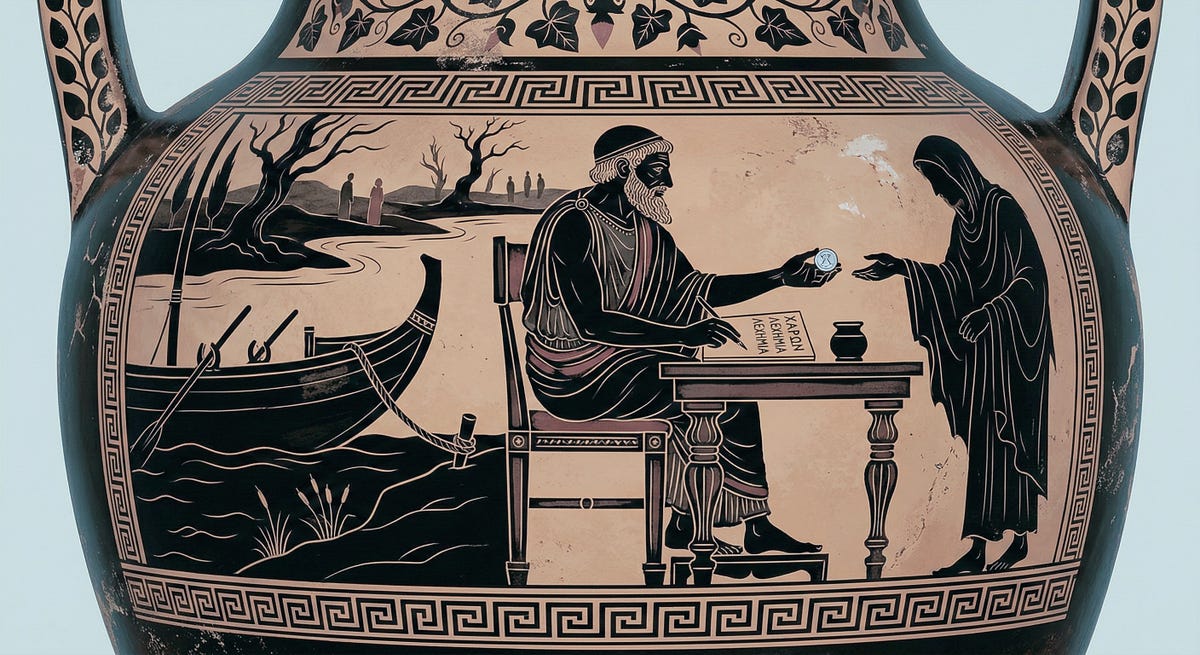
And yet the infrastructure is already there around him. The Continental Hotel exists. Charon is already at his desk. The gold coins are already the currency of this place. Wick visits the Continental in this phase, pays Charon without anyone explaining why, receives services and bourbon and car keys, and moves on. He does all of this instinctively, the way the dead in Greek mythology always knew to bring coins for the ferryman even when they did not fully understand they were dead. That knowledge does not need to be learned. It is encoded. It crosses the threshold intact because it is older than memory.
But the full architecture of the underworld, the High Table, the blood oaths, the Adjudicators, the excommunicado system, the scope of what he has wandered into, none of it materializes for him yet. He is not ready to receive it, and the underworld is patient. It has been here longer than he has. It can wait.
He visits the Continental like a ghost drifting through a familiar building, touching the surfaces of a world that has not yet fully claimed him. Winston is there. Charon is there. They treat him with a warmth that, in retrospect, is less professional courtesy than something closer to shepherding. The underworld knows what this man is here to do. It is simply waiting for him to figure it out himself.
He kills Vigo. He is spent. He is done. He does not know yet that being done is not an option that exists for him anymore.
The Vet Clinic: Finding the Guide
He goes to a veterinary clinic because he is bleeding and there is nowhere else to go. He does not go there for a dog. He goes there for a doctor, for the purely practical reason that he is still a recently dead man operating on physical instinct in a body that refuses to stop moving.
And there, in a kennel, is a dog that has no owner and no name.
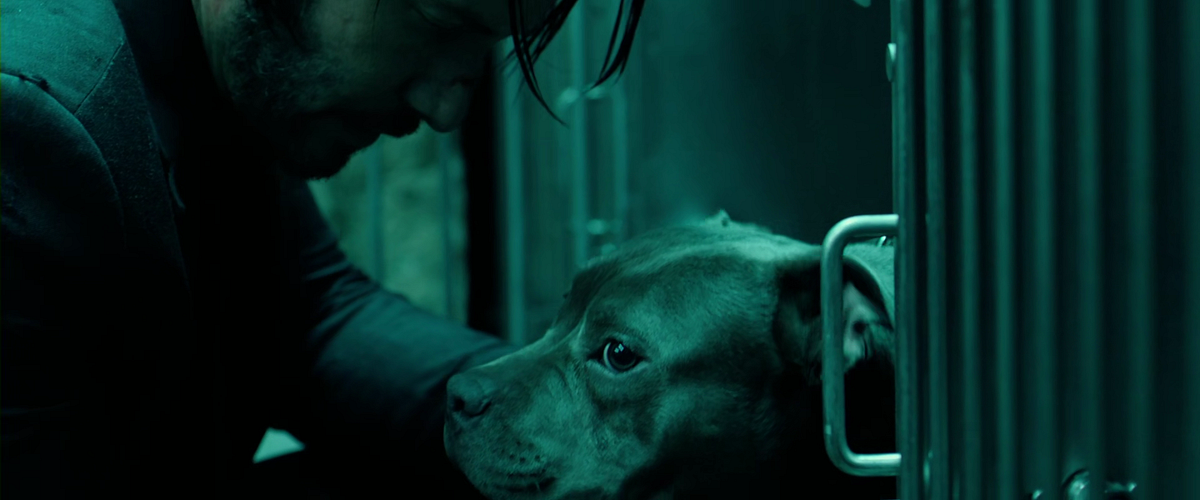
The word for what this dog is comes from ancient Greek: psychopompos. Guide of souls. In every mythology that has ever grappled with the question of what happens after you die, the answer almost always includes something that walks with you: a figure, a creature, a presence whose job is not to judge you, not to decide where you end up, but simply to make sure you do not get lost on the way there. Their role is not to judge the deceased, but simply to guide them. They take many forms. Most relevantly for our purposes, they have always, across cultures and centuries, taken the form of dogs.
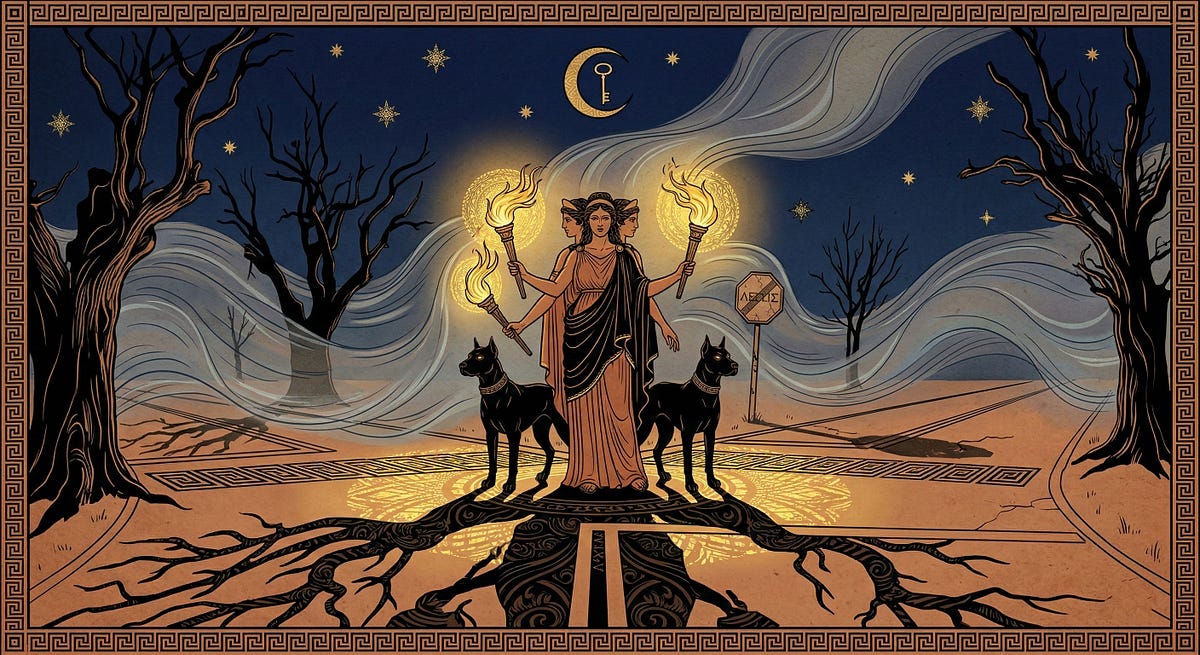
In myths and rituals across cultures, dogs serve as guardians, hellhounds, and psychopomps, after-death guides. Anubis, who shepherds souls to judgment in Egyptian mythology, wears a jackal’s head. The Aztec god Xolotl guides the dead through nine levels of the underworld in canine form. In Greek tradition, Hecate, the goddess of crossroads and liminal spaces, the deity of transitions between worlds, moves through the night attended always by dogs. Her pathways are the pathways between realms, and her hounds run with her through the dark.
The vet clinic is a crossroads. The moment Wick walks out of it with this animal is the moment he stops wandering the near shore and begins his actual descent. He has found his guide without knowing he was looking for one. Or more precisely: the guide was waiting for him to be ready, and he finally was.
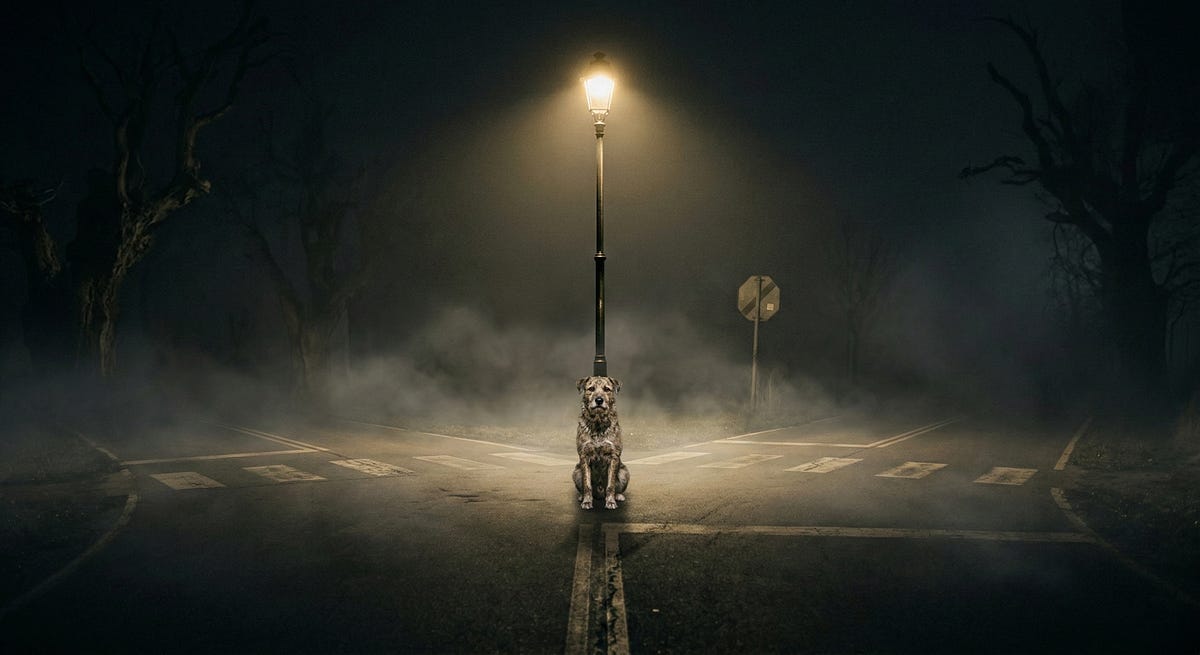
The dog has no name in the films, and this is not an oversight. Psychopomps are not judges of the deceased, but merely the ones who lead them. You do not name the current that carries you downstream. You do not name the road. The function is the identity, and the function is ancient and larger than any individual name could contain. The Greek term for it, psychopompos, is as close to a name as the role gets: the one who guides souls. That is who this dog is. That is the only name it needs or will accept.
The World That Assembles Itself Around the Dead
Chapter 2 is where the underworld reveals its full architecture to Wick, not because he has just entered it but because he is already deep enough inside it that the walls become visible. The blood oath. The Roman tailor. The sommelier who discusses ammunition the way a sommelier discusses wine, with the quiet expertise of someone for whom this is simply the work. Rome itself, grander and stranger than New York, the underworld’s geography expanding as Wick moves further from the threshold. He kills Cassian and Ares and a small army of others in Rome and New York, and by the time he corners D’Antonio at the Continental and puts a bullet in him, he has already been inside this place long enough that he knows exactly what he is doing and what it will cost.
That is the crucial distinction. Killing D’Antonio on Continental grounds is not the door into the underworld. It is the door slamming shut behind him. He is not making a mistake. He is making a choice, with full knowledge of the consequences, because he has already gone far enough that there is no version of this where he walks back out into a normal life. The Adjudicators appear, the blood oath system reveals its full scope, the High Table asserts its absolute authority, not because Wick has just wandered in and broken a rule he did not know existed, but because he has gone so deep that the system now has to deal with him formally. He has forced its hand.
Orpheus looked back and lost everything. Persephone ate the pomegranate seeds and made herself subject to the underworld’s calendar. John Wick shot D’Antonio and made himself permanently subject to the underworld’s law, not in ignorance but in full knowledge, which is in some ways the darker and more interesting transgression. He knew. He did it anyway.
There is also the matter of the suit.
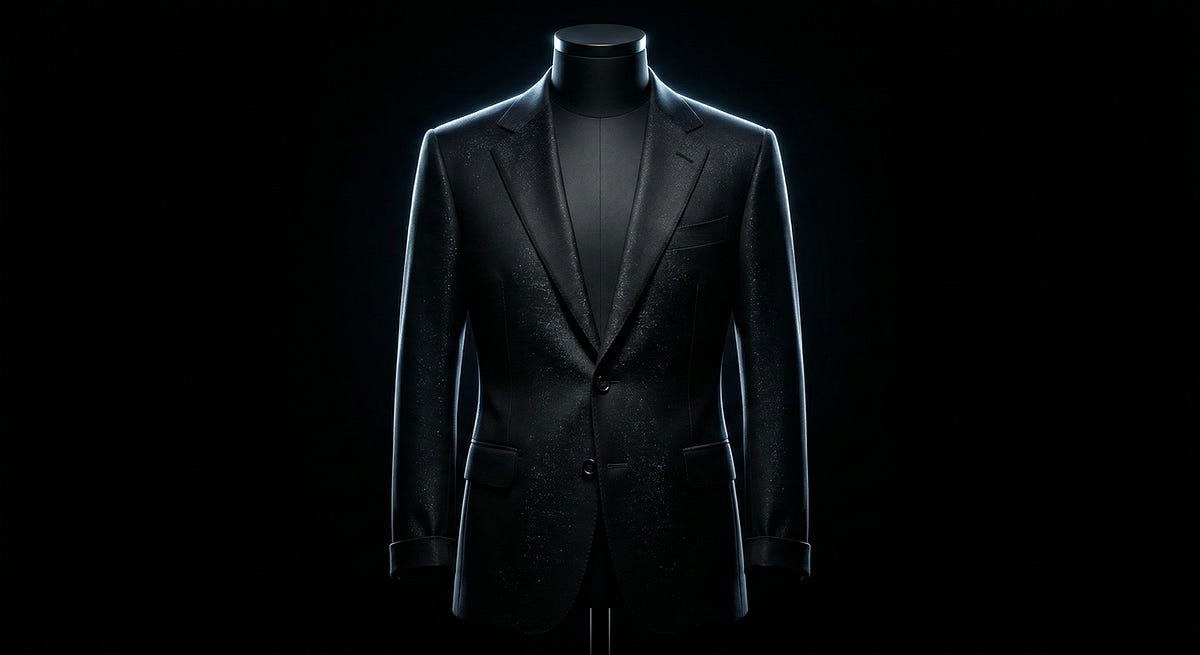
In Rome, the tailor fits Wick with a bulletproof suit that the film presents as remarkable technology, something singular, made for him specifically. It is his Nemean lion hide, the armor Heracles stripped from the unkillable beast and wore afterward as proof that he had passed through the unsurvivable and emerged changed. It marks him as exceptional within the underworld’s hierarchy. It is his particular advantage.
By Chapter 3, everyone has one. The Adjudicator’s soldiers wear them. Zero’s students wear them. The exotic technology that distinguished Wick from everyone around him has been absorbed into the underworld’s standard equipment, redistributed to the rank and file, leveled into table stakes. The underworld is adaptive. It takes what Wick brings into it and metabolizes it, because it cannot allow him to coast. Every advantage he arrives with eventually becomes the minimum requirement for the next corridor of opponents, which is why by Chapter 4 he requires a different kind of power entirely, something that operates below the level of equipment, something the underworld cannot simply copy and redistribute. The escalation is the underworld’s response to his persistence. It keeps raising the difficulty because the destination demands that only the fully tested soul arrives there.
The world that assembles itself around Wick is built from the materials he brought with him when he died: what he knew, what he feared, what he could not resolve before the lights went out. He was a man shaped by violence and trying to escape it. The underworld he inhabits is one where violence is the only currency, the only language, the only logic. He was a man who tried to retire from what he was made into. The underworld offers no retirement, no exit, no door that does not open onto another corridor of things that need to be survived before he can pass through.
It is built from him. It is, in the truest sense, his.
How John Wick’s Underworld Knows What He Knows
Here is the detail that makes the whole theory cohere: John Wick’s underworld is not generically Greek. It is Greek and Christian simultaneously, drawing on both traditions without contradiction, weaving them together into a seamless architecture of the sacred that could only have been built by someone who absorbed both.
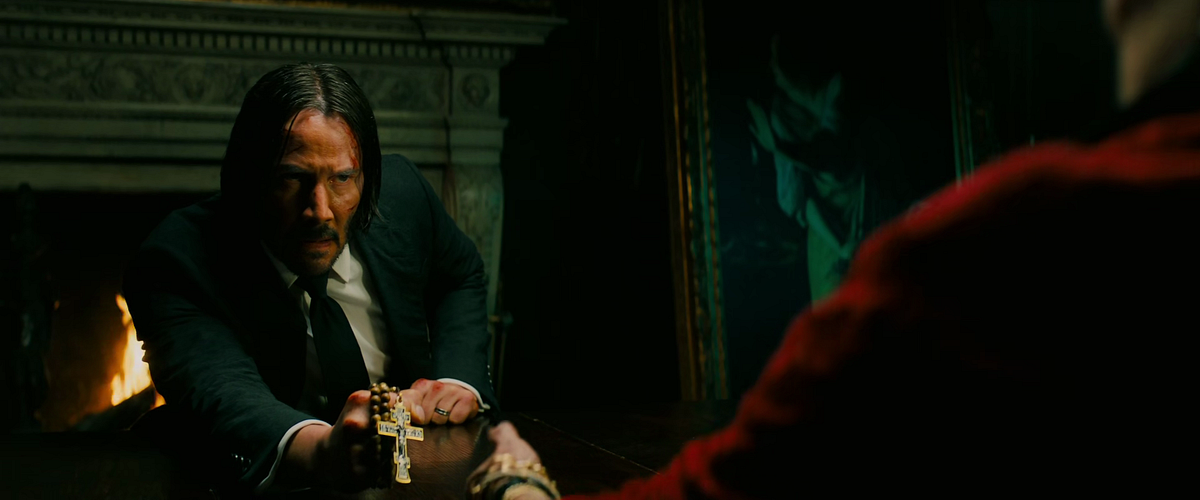
This is because the underworld is built from what Wick knew in life, and Wick was almost certainly, given his Belarusian origins, raised in proximity to Eastern Orthodox Christianity. Not necessarily as a believer. Not necessarily as a practitioner. But as someone for whom the Christian imagery of the sacred, churches, the significance of dawn, the weight of climbing toward something holy, the concept of final reckoning, was simply the water he swam in before he swam in anything else.
So his underworld draws on both wells simultaneously. The Continental’s rules of sanctuary are ancient Greek asylia, the inviolable protection extended by temples to those who entered them, and they are also the medieval Christian right of sanctuary, the understanding that certain spaces are outside the jurisdiction of earthly violence. The twelve seats of the High Table mirror both the twelve Olympians ruling from above and the twelve apostles gathered at a table that also, in the tradition Wick grew up near, carried enormous weight as an image of divine order. Charon is the ferryman of the Styx and also a figure standing at the threshold between states of being, which is a role that exists in both traditions under different names.
The Christian iconography builds as Wick moves closer to his resolution. The church at the top of the steps in Paris is not set dressing. It is the destination that his particular cosmology has always pointed toward, the place that the Christian-influenced architecture of his personal underworld designated as the location where something finally ends. He did not choose to end his journey at a church at dawn. His underworld chose it for him, drawing on the deepest grammar of the sacred that he carried without knowing he carried it.
The Greek mythology provides the structure. The Christian imagery provides the destination. Together they form an underworld that is entirely, specifically, irreducibly his.
The Helpers Who Are Not Really His Friends
In the world of professional assassination as the films depict it, there are no friends. This is stated plainly and often. These are people who operate on contracts, blood oaths, coin exchanges, and the practical calculus of survival. Sentiment is a liability. Attachment is a target.
And yet John Wick is helped, at every turn, by people who treat him as worth protecting.
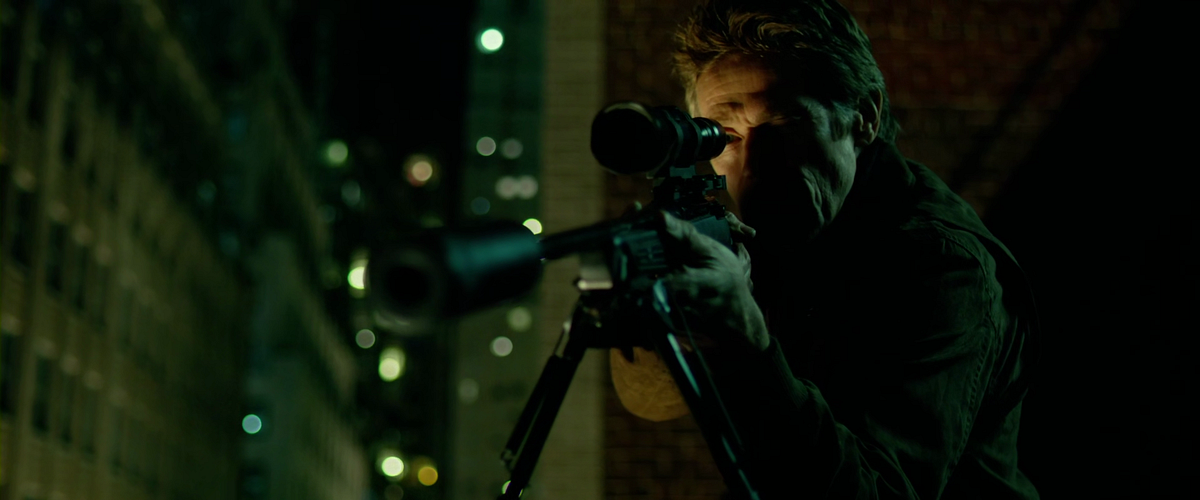
Marcus is the key that unlocks this reading for the entire franchise. In Chapter 1, he accepts the open contract from Vigo on Wick’s life. He does not do this to kill Wick. He does it to shadow him, to watch over him, and when Perkins has Wick in a position from which he cannot escape, Marcus shoots her instead. He sacrifices himself eventually in service of keeping Wick moving.
Marcus is not operating against his professional instincts out of sentiment. He is fulfilling a function the underworld has assigned him. He is a guide in human form, one of a constellation of them that surrounds Wick’s entire journey and ensures it continues in the direction it needs to go.
The Continental managers around the world, in New York, Osaka, Paris, treat Wick with a warmth that makes no professional sense. They risk their positions, their standing with the High Table, their own safety, to give him what he needs. Winston shoots him off a roof at the end of Chapter 3 and then immediately works to ensure he survives, an act of apparent betrayal that is actually the underworld adjusting the route. Koji Shimazu in Osaka fights and dies for Wick, which on the surface is the tragedy of loyalty and on a deeper level is a gate guardian doing what gate guardians do: ensuring the soul passes through even at cost to themselves.
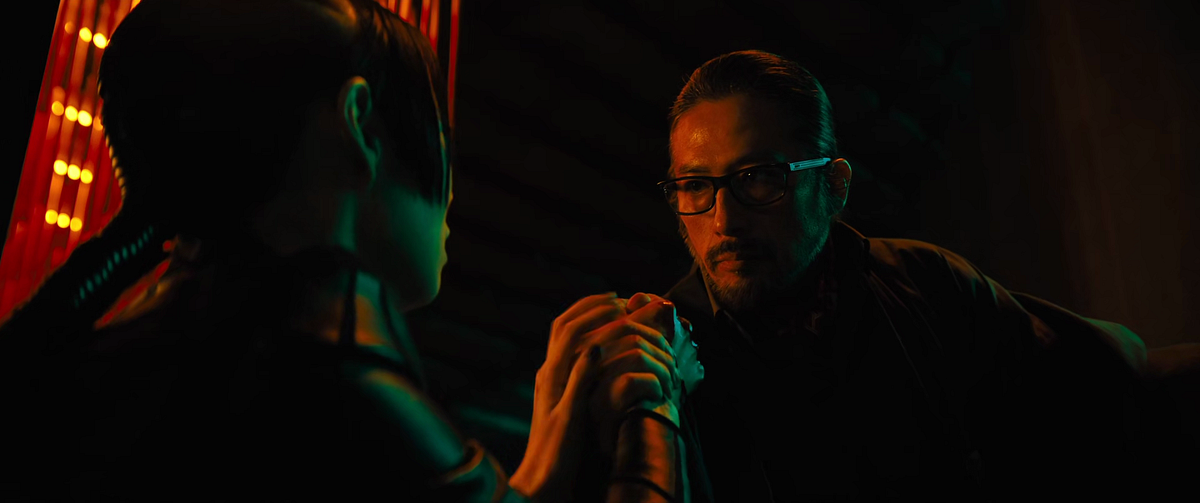
The Bowery King, Apollo to Winston’s Zeus in the director’s own mythological mapping, operates as the underworld’s other pole, the figure who moves through the lower depths rather than presiding from above, and he is consistently the one who picks Wick up off the ground and sends him forward. He brings the suit. He provides the resources. He is the god of forward momentum in Wick’s personal cosmology, the one who says: you are not done yet, stand up, here is what you need.
All of these people are not friends. They are the underworld expressing its intention for this particular soul. It wants John Wick to complete his journey. It has built helpers into the architecture of his descent to ensure he does.
The Demons Who Are Also His Drivers
The enemies who stop short of killing Wick when they clearly had the opportunity are the same phenomenon expressed from the other direction.
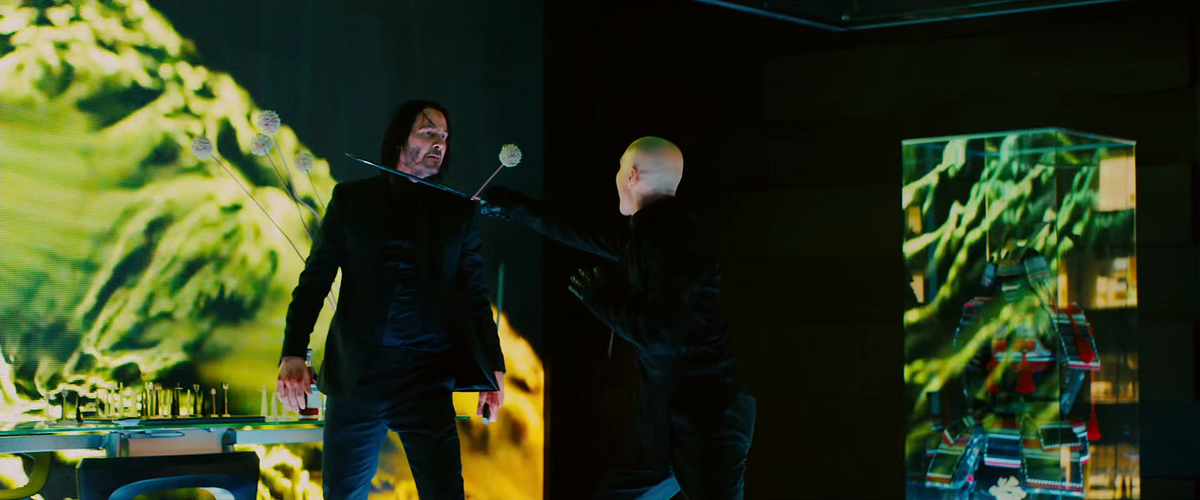
Zero, in Chapter 3, is a demonstrably superior martial artist who could have ended Wick cleanly at least twice and instead hesitates, pulls back, savors the encounter in ways that cost him everything. Caine, in Chapter 4, is blind and still nearly does it repeatedly, pressing Wick further than anyone else has, and yet never quite finishing it. The Marquis assembles the resources of the entire High Table against one man and still cannot stop him from climbing those stairs.
These are not incompetent villains. They are something the underworld has built for a different purpose. They are trials. They are the mechanism by which Wick is tested, shaped, and made ready for the next thing. When they pause, when they hesitate at the moment they could end it, they are not failing as enemies. They are succeeding as instruments of a journey they do not know they are part of.
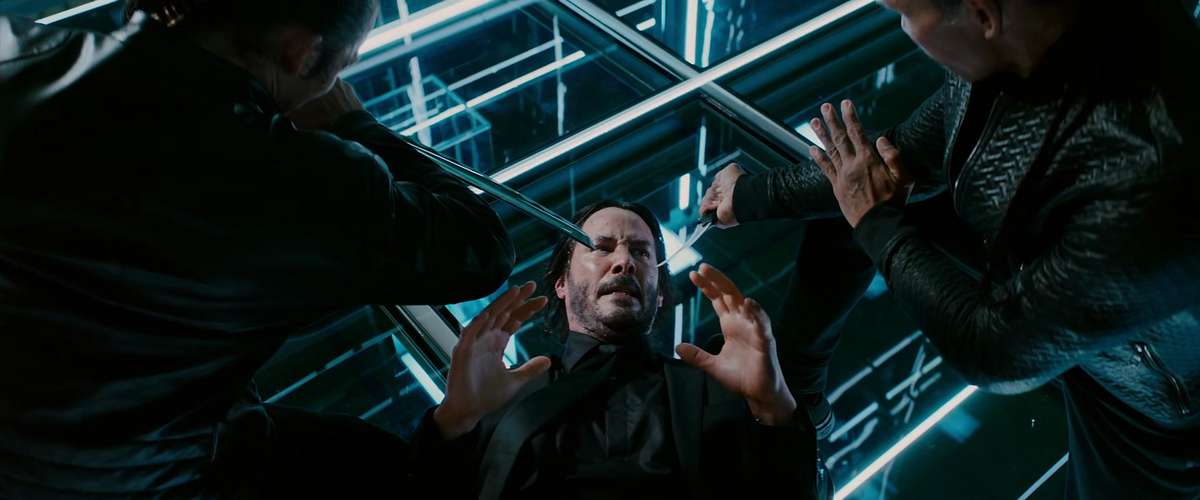
Even the structure of the violence against Wick serves this function. He absorbs damage that should be fatal, that accumulates in ways no human body survives, and he keeps moving. Not because the films are careless with physics, though they are, but because in the logic of the underworld, the soul in transit cannot be stopped by anything that is not the final destination. You cannot die in the middle of your death. You can only be driven forward toward wherever it ends.
The Power That Makes No Physical Sense
By Chapter 4, John Wick rides a horse directly to the Elder’s location and dispatches him without particular drama. The first time he sought the Elder, at the end of Chapter 3, it involved crossing a desert to the point of physical collapse, and the encounter cost him a finger.
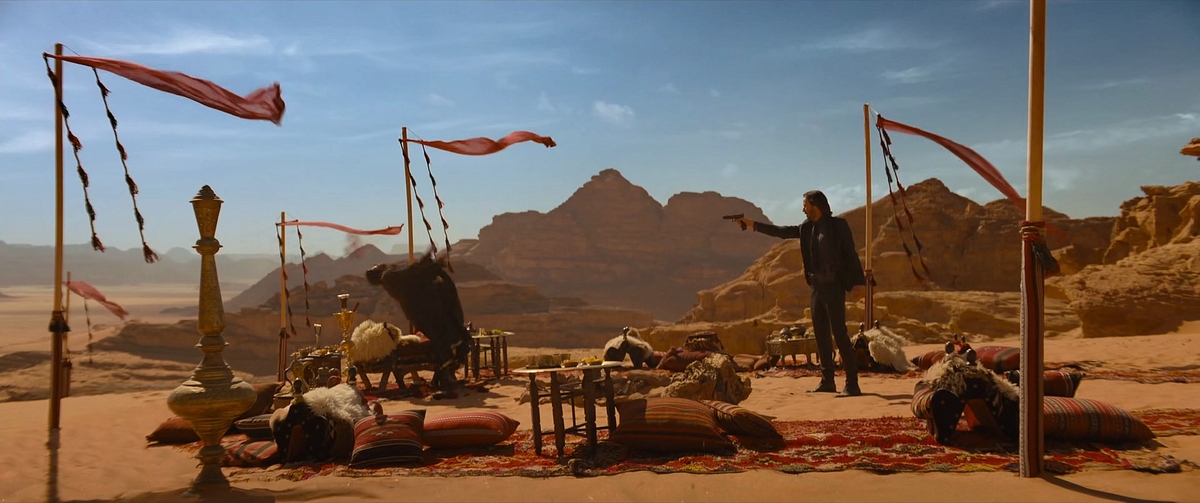
There is no physical explanation for this escalation. He has not had years of additional training. He has been, between films, mostly bleeding. The man who barely survived Vigo’s son in Chapter 1 should not be, four films later, a being that the entire apparatus of the High Table can barely slow down.
But in mythological logic, it makes complete sense. The hero who survives the underworld’s trials does not merely survive them. He absorbs them. He is changed by each descent, each confrontation, each impossible passage, not in his muscles or his reflexes but in his relationship to the world he is moving through. It bends around him differently as he proves, over and over, that it cannot stop him. He becomes harder to kill not because of training but because the story is not finished with him yet, and the underworld’s own logic prevents it from ending its own protagonist before he reaches the place it has always been taking him.
The power escalation is the underworld’s investment in its own resolution. Every trial that does not end John Wick makes John Wick more capable of surviving the next trial, because the point is never to kill him here, in this corridor, against this opponent. The point has always been the church. The point has always been the stairs. The point has always been dawn.
The Dissolution of Charon
Lance Reddick’s Charon dies at the beginning of Chapter 4, killed by the Marquis as punishment for Winston’s protection of Wick, and the film treats this as a tragedy of loyalty, the death of a friend, the loss of someone who was always worth more than his job title suggested.
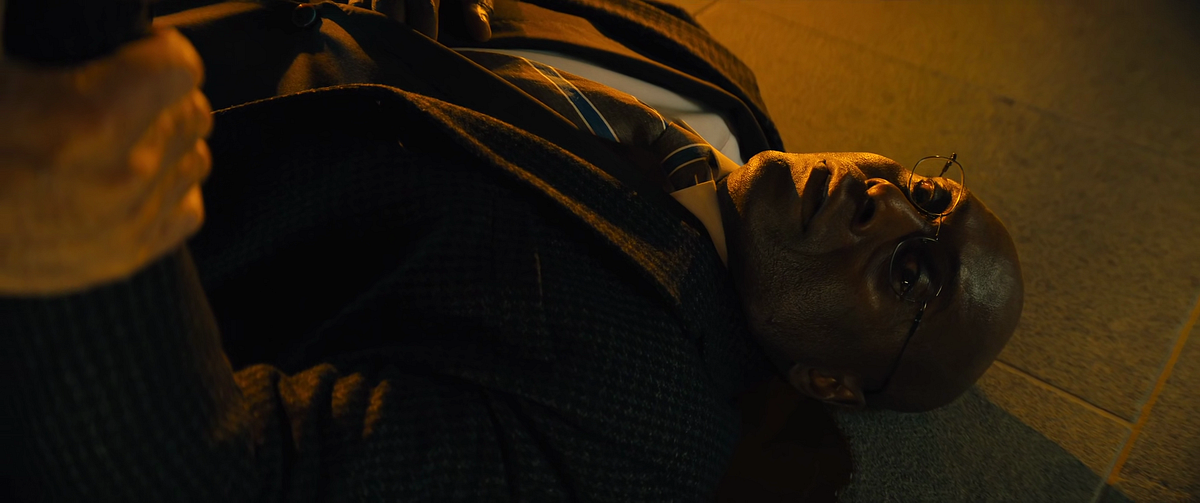
All of that is true. It is also true that Charon the mythological ferryman does not die. He cannot. He is a function of the underworld, not a resident of it. He existed before Wick arrived and he will exist after Wick is gone, standing at whatever desk exists in whatever soul’s version of this place comes next, taking coins, giving keys, extending the warmth of a man who has seen everyone come through eventually and holds no judgment about the timing.
This particular Charon, the one who took care of Wick’s dog and offered bourbon when false comfort would have been easier, has served his purpose. His death is the burning of the boats. There is no more sanctuary. There is no more checking in and checking out. The threshold Wick could always retreat to no longer exists for him.
It is the underworld telling him, in the only language it speaks fluently, that forward is the only direction left.
This is not Charon dying. This is this instantiation of Charon releasing Wick from the phase of his journey where sanctuary was still possible, because that phase is over. The function persists. The ferryman is still at his post in every other soul’s underworld, in every other version of this place that will be assembled from someone else’s knowledge and grief and unresolved business. This one, the one that knew John Wick by name, is simply finished.
The grief of that loss is real and should not be diminished. Reddick brought something irreplaceable to the role, a warmth and stillness that the mythology did not require but that made the mythology human. The particular instantiation of Charon that existed for John Wick, and for the audience that watched him, is gone. That is a real loss. The archetype endures, as archetypes do, indifferent to the warmth of any individual expression of itself.
The Shirt, the Stairs, and the Ending
The Bowery King brings Wick a suit twice in Chapter 4. The first time, before Wick goes to war with the full apparatus of the High Table, the shirt beneath the jacket is black. The second time, before the final duel and the climb to the church, it is white.
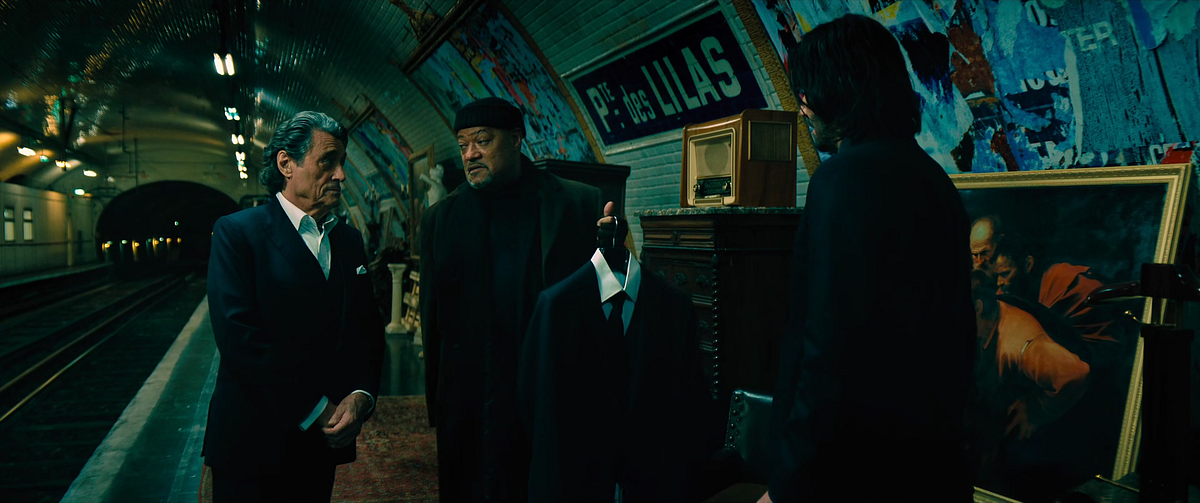
Black then white. Darkness then light. The King is not just dressing Wick for two different occasions. He is marking two different states of being. The black shirt is for the man still inside the machine, still fighting through the underworld’s corridors on the underworld’s terms, still soaked in the shadow world that received him when he died on that kitchen floor. The white shirt is for something else. It is for the man who has earned the right to climb toward the thing his personal cosmology always designated as sacred, in the color that his tradition associates with the moment before judgment, with the moment before whatever comes after judgment.
He climbs 222 steps. He fights his way to the top because the underworld does not simply open the door; it makes you earn every step. He gets there at dawn, with the city coming into light around him, and he sits down against the stones of a church and dies, again, for what this time is the last time.
His guide has already gone. He left the dog with the Bowery King before Paris, at the last threshold before the final passage. The psychopomp’s work ends when the soul reaches the place it needs to be. It walks you as far as it can. The rest is yours.
He was just a man who loved his wife and lost her and could not survive what came after. The underworld that assembled itself from his knowledge and his grief gave him a mythology he never asked for, a war he never wanted, and an exit that looked from the outside like just another action movie climax. From the inside, if you are reading it correctly, it looks like something quieter and more permanent. It looks like a man who went somewhere very dark and very far, who was helped along by everyone the underworld could put in his path and tested by everything it could put against him, and who finally, at the top of a long staircase at the edge of morning, in front of a building that the most foundational layer of his sense of the sacred recognized as the place where things end, got to stop.
The dog, whose name is the oldest word for what it was doing, got him there.
That was always the whole job.
The first puppy was real. The second dog was never just a dog. John Wick was never really an assassin. The stairs were always real. The dawn was always the point.
Coda: The Franchise Will Continue, and So Will the Dead
The movies are making too much money to stop, which means the underworld keeps expanding, which means there are more souls to account for. Lionsgate would like you to know this is a cinematic universe. The mythology would like you to know it has always been a much older thing than that.
Enter Eve Macarro.
Ballerina, released in 2025 and set between Chapters 3 and 4, follows Eve through a story that rhymes structurally with Wick’s but arrives at its mythological underpinning from a completely different direction. Where Wick was a regular man who died suddenly and found himself inside an underworld assembled from his own knowledge and grief, Eve has been inside the machinery her entire life. She did not wander in. She was placed here as a child, by the people who were supposed to protect her, which is a different and in some ways darker mode of arrival.
Her father tried to leave the Cult he belonged to and was killed for it. Eve was taken by him first, which is the only act of love the film grants her origin story, and then Winston arranged her absorption into the Ruska Roma, the same murder academy built from ballet and Slavic mythology that shaped John Wick himself. She has been in training for twelve years by the time the film begins. She has spent considerably longer than Wick in the transition between whatever she was before and whatever she is becoming.
This is the key distinction between them, and it fits the theory precisely. Wick arrived in the underworld as a fully formed adult, carrying a complete life with him, carrying a grief with a specific shape and a specific cause. The underworld had to assemble itself around him rapidly, pulling together from the materials of his adult knowledge and his adult loss. Eve arrived as a child, with almost no life behind her and everything ahead of her still to be assembled, which means the underworld has had twelve years to build itself around her slowly, thoroughly, from the ground up. She is not wandering through someone else’s mythological architecture. She is growing into one that was constructed specifically for her, brick by brick, from childhood.
This also explains why she does not listen when Wick tells her to leave. They meet briefly at the Ruska Roma theater during the events of Chapter 3, and when she asks him how to become what he is, he tells her simply: don’t. Walk out the door. He can see, from wherever he is in his own journey at that point, something about what this costs that she cannot yet see. But she has been inside this world for twelve years. There is no door she can walk out of. The underworld built itself around her too thoroughly, too early, for there to be an exit she can access just by choosing it. Wick could theoretically have chosen differently at several points. Eve never had that option, because the choice was made for her before she was old enough to understand what was being chosen.
Her version of the underworld draws on Slavic mythology more heavily and more explicitly than Wick’s, which makes sense: her origins are in the Ruska Roma, in a tradition that names its assassins Kikimora after Slavic household spirits, that trains them through a discipline that blends art and violence into something that has no comfortable name. The Cult she fights is described as ancient, older perhaps than the High Table itself, which in the framework of the theory means it is one of the oldest structures in the underworld, something that predates most of the souls currently moving through it. She is not fighting criminals. She is fighting something the underworld assembled from the deepest and oldest layers of the cultural memory she carries.
And Charon is there, in his final appearance, because Charon is always there at the threshold. This particular instantiation of him is already approaching the end of his function in this corner of the underworld, though neither Eve nor the audience knows it yet. His presence in Ballerina is the underworld maintaining its infrastructure around a soul who needs it, in the form that soul will recognize and trust, for as long as that form can hold.
Winston arranged her entry. Winston watches over her in ways that exceed professional obligation. This is Zeus managing the underworld’s newest and most complicated arrival, the one who came in too young and has been developing inside the system ever since, who does not yet know what her journey is for or where it ends. He does not know either. That is, in this reading, rather the point of sequels.
The franchise will continue because the dead have unfinished business, because the underworld accommodates whatever grief requires to work itself through, and because Lionsgate has shareholders. These are not mutually exclusive conditions. The mythology has always been larger than the industry around it, and it will outlast every sequel and spin-off and expanded universe product, the way it has outlasted everything else.
Somewhere in all of it, the unnamed dog is waiting at whatever threshold comes next, patient as the function it embodies, ready to walk the next soul as far as it needs to go.
That has always been the whole job. It will always be the whole job.
Leave a Reply