Freddie & Friends: Teenage Nazi Hunters History Tried to Forget
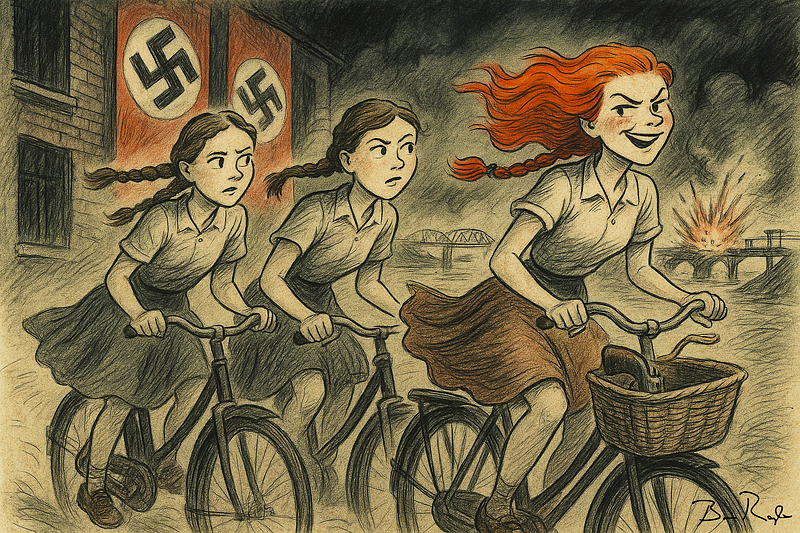
History is picky about its heroes. Men with cigars and medals get biopics. Women who carried pistols in their bicycle baskets and shot Nazis in the back of the head? They get footnotes, if they’re lucky.
That’s the fate that befell Freddie Oversteegen, who at fourteen years old joined the Dutch resistance alongside her sixteen-year-old sister Truus and their twenty-year-old friend Hannie Schaft. Together, they blew up railways, smuggled Jewish children to safety, lured Nazi officers into the woods, and pulled the trigger. They were clever, lethal, and devastatingly effective. Yet while Soviet propaganda immortalized the “Night Witches” and American intelligence mythologized Virginia “Limping Lady” Hall, Freddie and her compatriots vanished into the shadows of Cold War politics and gender bias.
No streaming series dramatizes their story. No glossy biopic brings their courage to multiplex screens. Just three teenage girls who helped save their country, then got buried by the very history they helped write.
Raised for Revolution
The path to armed resistance began long before the Nazi invasion, in a cramped apartment in Haarlem where Trijntje van der Molen raised her daughters with unwavering communist principles. After their father Jacob abandoned the family (singing them, oddly enough, a farewell serenade in French), Trijntje became the sole influence shaping her daughters’ moral framework. She was a member of International Red Aid, a communist relief organization, and from the mid-1930s onward, she packed their small flat with refugees fleeing Nazi Germany: Jews, political dissidents, and even gay people who faced persecution under Hitler’s regime.
The Oversteegen girls gave up their own beds to make room for strangers. Their mother’s guiding principle was characteristically blunt: “If you have to help somebody, like refugees, you have to make sacrifices for yourself.” This wasn’t abstract political theory; it was lived practice. The girls learned to sew dolls for children suffering in the Spanish Civil War and helped distribute relief supplies to political prisoners worldwide. By the time the Nazis invaded the Netherlands in May 1940, Freddie and Truus had already spent years learning that resistance to fascism wasn’t optional but obligatory.
When Frans van der Wiel, a commander in the Haarlem Council of Resistance (Raad van Verzet), came to recruit the teenage sisters, he tested their loyalty first. He appeared at their door disguised as a Gestapo officer, demanding information about hidden Jews. Instead of betraying anyone, the sisters physically attacked him. Their mother Trijntje gave permission for them to join the resistance, but only on one condition that would echo through their entire wartime service: “Always stay human.”
The Weaponization of Innocence
The sisters started with what seemed like small acts: distributing underground newspapers like de Waarheid (The Truth), pasting anti-Nazi warnings over German recruitment posters, and helping to coordinate safe houses for Jewish families. But even these “small” acts carried the death penalty if caught. The genius of using teenage girls for these operations quickly became apparent. Freddie, petite with dark braids carefully arranged, looked perhaps twelve years old even at fourteen. German soldiers, trained to see threats in adult men, in uniformed enemies, in armed partisans, had no framework for processing danger from what appeared to be a child carrying schoolbooks.
The bicycle became their primary weapon system, though it never fired a shot itself. In the Netherlands, where everyone cycled everywhere, where German checkpoints processed thousands of cyclists daily, girls on bikes were invisible. Weapons traveled hidden in bicycle baskets beneath layers of books and food. Illegal newspapers were stuffed into handlebar tubes. Explosives nestled under innocent-looking parcels tied to rear racks.
Their youth provided perfect operational cover. As Freddie later recalled, “I wore braids, looked younger than I was, and Germans would often not even check my basket when I cycled past. They saw a little girl, not a resistance fighter.” This invisibility allowed them to conduct reconnaissance, trail Nazi officers, and identify collaborators without arousing suspicion. They could loiter near German installations, memorizing guard rotations and defensive positions, all while appearing to be schoolgirls gossiping about boys.
From Pamphlets to Pistols
By 1943, the Oversteegen cell expanded to include Hannie Schaft, a law student from the University of Amsterdam who had refused to sign a loyalty oath to the Nazi regime. Hannie brought intellectual rigor to complement Truus’s natural leadership and Freddie’s tactical cunning. Together, they formed one of the most effective assassination cells in the Dutch resistance, though you won’t find that fact in most history books.
Their signature tactic, what resistance members called the “honey trap,” exploited Nazi assumptions about feminine helplessness. The girls would dress up, apply makeup carefully, style their hair, and approach German soldiers or Dutch collaborators in bars and cafes. Speaking broken German with calculated shyness, they would suggest a romantic walk in the woods. Once isolated from help, the target would discover that the helpless girl he’d followed was actually an armed resistance fighter. Sometimes the girls themselves pulled the trigger. Sometimes they led targets to ambush sites where other resistance members waited.
Freddie’s first kill came while riding on the back of Truus’s bicycle. As they passed a German officer, Freddie opened fire, watching him crumple to the pavement as they pedaled away into the stream of civilian traffic. She was fifteen years old. That image, she later admitted, never left her: “Yes, I’ve shot a gun myself and I’ve seen them fall. And what is inside us at such a moment? You want to help them get up.”
The documented operations read like a litany of targeted violence. On June 21, 1944, Hannie and Truus assassinated Willem Ragut, a Dutch police officer and Nazi collaborator, in Zaandam. On March 1, 1945, they executed NSB police officer Willem Zirkzee near the Leidsevaart canal in Haarlem. On March 15, 1945, they wounded Ko Langendijk, a hairdresser from IJmuiden who worked for the Sicherheitsdienst (Nazi Security Service). These weren’t random killings but strategic eliminations of collaboration networks that enabled the Holocaust in the Netherlands.
The Infrastructure of Resistance
Beyond assassination, the trio conducted major sabotage operations that crippled German logistics. Their most significant operation involved using dynamite to destroy the railway line between IJmuiden and Haarlem, a critical supply route connecting the coast to the interior. They learned to handle explosives from Jan Bonekamp, a factory worker and resistance leader, practicing in the woods behind sculptor Mari Andriessen’s home. British cargo planes dropped weapons and explosives by parachute at night, which the girls transported via their bicycle network to hidden arsenals throughout North Holland.
The scope of their operations extended far beyond violence. They coordinated the rescue of Jewish children, walking hand-in-hand with them through German checkpoints, appearing as innocent sisters on a family outing while actually conducting underground railroad operations. They stole and distributed hundreds of false identity cards, saving lives with forgery as effectively as with firearms. The Oversteegen family personally hid a Jewish couple in their home, though tragically, the couple was later arrested and died in concentration camps.
Their work was part of a massive resistance infrastructure that by autumn 1944 was hiding over 300,000 people from German authorities, supported by 60,000 to 200,000 “illegal landlords” and tolerated by approximately one million Dutch citizens. The girls operated within the Raad van Verzet (Council of Resistance), which maintained close ties to the Communist Party of the Netherlands and represented one of three major armed resistance groups alongside the Ordedienst and Landelijke Knokploegen.
The Girl with the Red Hair
Hannie Schaft’s distinctive red hair, which earned her the nickname “the girl with the red hair,” became both her trademark and her doom. By early 1945, she topped the Nazi most-wanted list in North Holland. She tried dyeing her hair black and wearing glasses to avoid detection, but on March 21, 1945, she was arrested at a military checkpoint in Haarlem while carrying resistance documents. The red roots growing out beneath the black dye gave her away.
On April 17, 1945, just eighteen days before the Netherlands was liberated, Hannie Schaft was executed in the dunes at Bloemendaal. According to resistance lore, when the first bullet only wounded her, she told her executioners with characteristic defiance: “I’m a better shot.” She was twenty-four years old.
Her death devastated Freddie and Truus. Hannie had been more than a comrade; she was their best friend, their “soulmate” as Freddie later described her. For the rest of her life, Freddie brought red roses to Hannie’s grave, never reconciling with the cruelty of her friend dying so close to freedom. Hannie was reburied with full state honors on November 27, 1945, in the presence of Queen Wilhelmina, Princess Juliana, and Prince Bernard. She received the Dutch Cross of Resistance, awarded to only 95 people in total, and posthumously, a Medal of Freedom from General Dwight Eisenhower.
The Weight of Survival
While Hannie became a martyr, safely symbolic in death, Freddie and Truus had to live with what they’d done. Both sisters suffered from what we would now recognize as severe post-traumatic stress disorder. They experienced nightmares that made them scream and fight in their sleep. Truus reflected years later: “It was tragic and very difficult. We did not feel it suited us. It never suits anybody, unless they are real criminals. One loses everything. It poisons the beautiful things in life.”
Each sister sought different ways to cope. Truus married fellow resistance fighter Piet Menger in November 1945, just months after the war ended. She channeled her trauma into art, becoming a sculptor and painter who often incorporated war themes into her work. She wrote a memoir in 1982 titled “Not Then, Not Now, Not Ever,” and spent decades speaking at schools and universities about the war, antisemitism, and the importance of tolerance. She named her eldest daughter Hannie, ensuring her fallen friend’s name lived on.
Freddie took a different path. She married Jan Dekker, a steelworker at the Hoogovens company, and focused on raising their three children. As she bluntly told an interviewer decades later, she tried to cope “by getting married and having babies.” But the war never left her. She suffered chronic insomnia and felt annual dread as Dutch Remembrance Day approached. The image that haunted her most wasn’t glory but grief: the human impulse to help someone she had just shot as they fell to the ground.
The Architecture of Erasure
The systematic forgetting of the Oversteegen sisters wasn’t accidental; it was constructed through overlapping systems of marginalization. The Cold War created the first layer. Their communist affiliations made them politically inconvenient in a NATO-aligned Netherlands. In 1951, the Dutch government actually attempted to suppress public commemoration of Hannie Schaft because of her communist connections. The message was clear: certain heroes didn’t fit the new narrative.
Gender created the second layer. Women comprised 15% of the 450,000 active Dutch resistance fighters, yet their contributions were systematically minimized in favor of male narratives. As researcher Bas von Benda-Beckmann noted: “There were a lot of women involved in the resistance in the Netherlands but not so much in the way these girls were. There are not that many examples of women who actually shot collaborators themselves.” The very exceptionalism of their actions made them harder to assimilate into comfortable stories about women’s wartime roles.
The third layer was survival itself. Dead heroes can’t contradict the stories told about them. Living ones have opinions, refuse sanitization, and remind people that resistance involves ugly choices. While male resistance figures like Erik Hazelhoff Roelfzema became household names with bestselling books and films like “Soldier of Orange,” Freddie lived what she called “a little bit out of the limelight.”
Parallel Shadows: Night Witches and Limping Ladies
The contrast with other female resistance fighters illuminates how institutional support shapes memory. The Soviet 588th Night Bomber Regiment, the famous “Night Witches,” flew over 30,000 sorties in wooden biplanes too slow for radar detection, dropping 23,000 tons of bombs on German positions. Like the Dutch teenagers, they exploited German assumptions about female capacity for violence. But they flew for Stalin’s Soviet Union, which needed heroes for propaganda. Marina Raskova, who founded the regiment, became a Soviet icon. Museums were built. Medals were awarded. Stories were told and retold.
Virginia Hall, the American OSS operative who coordinated French resistance networks despite her prosthetic leg (which she nicknamed “Cuthbert”), represents another path to remembrance. Working for American intelligence and later the CIA, Hall’s story was preserved in institutional archives, celebrated in agency histories, and eventually declassified for historians. Her disability made her compelling, but her institutional backing ensured her story survived.
The Oversteegen sisters had neither state propaganda nor institutional archives. They fell into the gap between acceptable narratives, too communist for the West, too independent for the East, too violent for traditional gender roles, too alive to be convenient symbols.
The Long Road to Recognition
It took 69 years for the Netherlands to officially recognize what Freddie and Truus had done. On April 15, 2014, Prime Minister Mark Rutte awarded them the Mobilisation War Cross, calling it “an act of historical justice.” By then, both sisters were in their nineties, having spent most of their lives watching others receive recognition for less dangerous wartime service.
Freddie’s response to the belated honor was characteristically blunt: “It’s about time.” She had spent decades feeling invisible, her high-pitched voice and petite stature that once made her a perfect operative now making her feel unheard in peacetime. “Nobody listens to me!” she complained to friends. She admitted feeling jealous of Hannie’s fame and even of Truus’s higher profile: “I have always been a little jealous of her because she got so much attention after the war. But then I’d just think, ‘I was in the resistance as well.’”
The 1981 film “The Girl with the Red Hair” brought some attention to their story, but it focused solely on Hannie Schaft and took significant historical liberties. The Oversteegen sisters’ partnership with Hannie was completely omitted, reinforcing their marginalization. It wasn’t until Sophie Poldermans, who knew the sisters personally for twenty years as a board member of the National Hannie Schaft Foundation, published “Seducing and Killing Nazis” in 2019 that their full story reached a wider audience.
The Model We Need Now
As authoritarianism rises globally, as fascist movements adapt to democratic systems, as the vocabulary of the 1930s returns to political discourse, the Oversteegen model of resistance becomes urgently relevant. Their story offers crucial lessons for contemporary anti-fascist action.
First, effectiveness matters more than appearance. The girls succeeded precisely because they didn’t look like resistance fighters. Modern resistance often fails because it privileges performative opposition over effective action, protests that feel righteous but change nothing.
Second, fascism’s assumptions are its vulnerabilities. The Nazis couldn’t conceive of teenage girls as threats because their ideology prevented them from seeing women as capable of strategic violence. Modern authoritarian movements have similar blind spots about who constitutes a “real” threat.
Third, resistance requires moral boundaries even within necessary violence. The girls killed Nazis but refused to harm children. When ordered to kidnap the children of a Nazi official, Hannie refused outright: “We are no Hitlerites. Resistance fighters don’t murder children.” They maintained humanity within inhumanity.
Fourth, memory requires deliberate construction. The only reason we know about the Oversteegen sisters today is because Truus wrote her memoir, because they founded the National Hannie Schaft Foundation in 1996, because they fought for decades to be heard. Resistance without documentation disappears.
Always Stay Human
Freddie Oversteegen died on September 5, 2018, one day before her 93rd birthday. She was the last surviving member of the teenage resistance trio. In one of her final interviews, when asked about the current rise of fascism in Europe, she returned to her mother’s instruction from 1940: “We must remain human.”
This wasn’t sentiment; it was strategy. Remaining human while doing inhuman things, maintaining moral clarity within moral emergency, refusing to become what you fight: this was the impossible balance the sisters maintained through war and its aftermath. Their mother’s advice wasn’t just operational guidance but a framework for conducting resistance without losing your soul.
The tragedy isn’t just that they were forgotten; it’s that their forgetting left us tactically and morally impoverished as we face resurging authoritarianism. We needed their model during the Cold War. We needed it during decolonization. We need it now as democracy retreats globally.
The Bicycle in the Basket
Somewhere in the Netherlands, in a museum or private collection, sits one of the bicycles the Oversteegen sisters rode during the war. It’s an ordinary Dutch bicycle, the kind millions rode then, the kind that still fills Amsterdam’s streets today. Looking at it, you wouldn’t know it had carried weapons to kill Nazis, or Jewish children to safety, or teenage girls to missions from which they might not return.
That ordinariness is the point. Resistance doesn’t announce itself with uniforms or flags. It looks like a teenage girl going about her day until the moment she pulls a pistol from her basket and changes history. The Oversteegen sisters’ greatest innovation wasn’t tactical but psychological: proving that resistance can come from anyone, anywhere, at any time, if they’re willing to pay the price.
Their story reminds us that fascism, for all its military might and ideological fervor, can be defeated by schoolgirls on bicycles if they’re willing to do what’s necessary. The question for our current moment isn’t whether we’ll need such models again. The rising authoritarian tide suggests we will. The question is whether we’ll remember the lessons the Oversteegen sisters taught: that resistance is ordinary, horrible, necessary, and possible.
Three teenage girls hunted Nazis across occupied Holland and helped save their country. Then history hunted them, burying their story under layers of political convenience and gender bias. They deserve more than recognition. They deserve to be understood. And in a world sliding toward familiar darkness, we deserve to remember that sometimes changing history is as simple as a girl on a bicycle, riding toward danger with books in her basket and steel in her spine.
Bibliography
Primary Sources
- Menger-Oversteegen, Truus. Not Then, Not Now, Not Ever (Original Dutch: Niet toen, niet nu, niet ooit). Amsterdam: Progress Publishers, 1982.
- Jonker, Ellis. Under Fire: Women and World War II. Amsterdam: Amsterdam University Press, 2014.
Books
- Poldermans, Sophie. Seducing and Killing Nazis: Hannie, Truus and Freddie: Dutch Resistance Heroines of WWII. BookBaby, 2019.
- Brady, Tim. Three Ordinary Girls: The Remarkable Story of Three Dutch Teenagers Who Became Spies, Saboteurs, Nazi Assassins and WWII Heroes. New York: Citadel Press, 2021.
Newspaper Articles and Obituaries
- Little, Becky. “This Teenager Killed Nazis With Her Sister During WWII.” History.com, September 19, 2018. Updated June 30, 2025.
- O’Leary, Naomi. “Freddie Oversteegen Obituary: ‘Her war never stopped’: the Dutch teenager who resisted the Nazis.” The Guardian, September 23, 2018.
- Poldermans, Sophie. “As Teenagers, These Sisters Resisted the Nazis. Here’s What They Taught Me About Doing the Right Thing.” Time Magazine, August 30, 2019.
- Roberts, Sam. “Freddie Oversteegen, Gritty Dutch Resistance Fighter, Dies at 92.” The New York Times, September 25, 2018.
- Smith, Harrison. “Freddie Oversteegen, Dutch resistance fighter who killed Nazis through seduction, dies at 92.” The Washington Post, September 16, 2018.
Magazine Articles
- “What We Can Learn from the Teenage Dutch Girls Who Led the Resistance During World War II.” Ms. Magazine, November 27, 2019.
- Amaral, Marina. “The teenage girls who seduced and killed Nazis.” Substack, 2023.
- Castellanos Clark, Valorie. “#51 — Freddie Oversteegen.” Unruly Figures Substack, 2023.
Academic and Historical Sources
- Byron, Hannah. “The Dutch Resistance: A Complex Tapestry of Non-Violent Heroism.” hannahbyron.com, 2023.
- National Hannie Schaft Foundation. Official website and archives. hannieschaft.nl
- NIOD Institute for War, Holocaust and Genocide Studies. Dutch Resistance Archives. Royal Netherlands Academy of Arts and Sciences.
- TracesOfWar.com. “Hannie Schaft” and “Oversteegen Sisters” entries.
- United States Holocaust Memorial Museum. Oral History Collections: Dutch Resistance Survivors.
- Verzetsmuseum (Dutch Resistance Museum). Archive of H. Schaft and Oversteegen materials.
Documentary Films
- Het meisje met het rode haar (The Girl with the Red Hair). Directed by Ben Verbong. Netherlands, 1981.
Online Resources
- “Freddie Oversteegen.” Wikipedia. Accessed 2025.
- “Hannie Schaft.” Wikipedia. Accessed 2025.
- “Truus Menger-Oversteegen.” Wikipedia. Accessed 2025.
- “Dutch Resistance.” Wikipedia. Accessed 2025.
Leave a Reply