The party of “family values” has a child abuse rap sheet longer than its platform
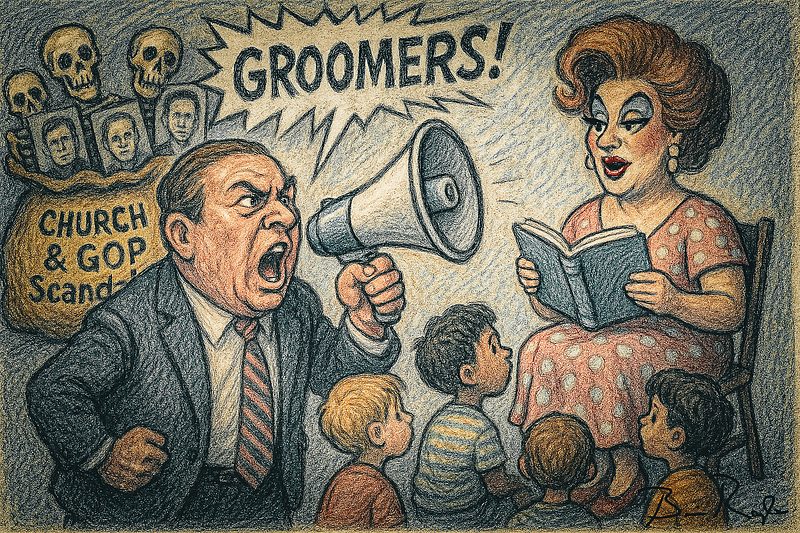
If you’ve spent any time on social media lately, you’ve probably seen conservatives throwing around the word “groomer” like confetti at a parade. Teachers reading books about families with two dads? Groomers. Drag queens hosting story hour at the library? Groomers. Anyone who thinks trans kids deserve basic respect? You guessed it: groomers.
The irony here is almost too thick to cut through. Because while conservatives are busy pointing fingers at everyone else, their own house is on fire with actual, documented cases of child sexual abuse. And not just isolated incidents, but systematic patterns of protection, enablement, and cover-ups that span decades.
This moral panic isn’t new. It’s the same playbook Anita Bryant ran in the 1970s with her “Save Our Children” campaign, which painted gay people as predators recruiting innocent kids. Go back further and you’ll find the same template in medieval blood libel accusations against Jews, later formalized in the Protocols of the Elders of Zion. The formula is devastatingly simple: pick an outgroup, accuse them of harming children, then watch as the torches and pitchforks appear.
Enter “pedocon theory,” the internet’s sardonic response to this projection festival. The basic observation goes like this: for all their screaming about protecting children, conservatives seem to have a remarkable tolerance for actual child abuse when it happens in their own ranks. And before you dismiss this as partisan mudslinging, consider the receipts. They’re extensive, they’re documented, and they keep piling up like evidence in a prosecutor’s office.
When Marrying Children Was “Traditional”
To understand how deep this problem runs, we need to start with some history that should make your skin crawl. For most of American history, what we now correctly identify as child rape was perfectly legal if you called it marriage. Under the English common law that shaped early American jurisprudence, the age of consent hovered between ten and twelve years old. Yes, ten. As in fourth grade.
Some U.S. states in the 19th century went even lower, setting the age of consent at seven. The logic, if you can call it that, was breathtakingly simple: once a girl hit puberty, she was marriage material. Her opinion on the matter was irrelevant because she wasn’t really a person so much as property being transferred from father to husband.
The people who fought to change this weren’t conservatives defending traditional values. They were progressive reformers, suffragists, temperance activists, and women’s rights advocates who recognized that maybe, just maybe, second-graders shouldn’t be considered sexually available. These reformers faced fierce resistance from conservative lawmakers, particularly in the South, who saw age-of-consent laws as attacks on parental authority and male prerogatives.
According to historians documenting this period, many lawmakers, particularly in the conservative, segregated South, resisted raising consent ages out of explicitly racist motives. They feared that stricter laws would empower Black girls to accuse white men of rape. Better to keep the age of consent in the basement than risk disrupting the racial hierarchy.
Between 1886 and 1900, the age of consent was raised in most states from these appallingly low ages to 16 or 18, but only after decades of progressive campaigning against conservative obstruction. Male politicians resented what they saw as “meddling” in men’s sexual access to young women. This history matters because it establishes a pattern: when it comes to protecting children from sexual exploitation, conservatives have consistently been on the wrong side of history, fighting to preserve systems that enable abuse.
America’s Quiet Child Marriage Crisis
Here’s something that might surprise you: child marriage was legal in all 50 U.S. states until 2018. Not 1918. Two thousand and eighteen. As I write this, only 16 states plus Washington D.C. have banned it completely. In the rest, minors can still get married with parental consent, judicial approval, or both. Some states have no minimum age at all.
The numbers are staggering. Between 2000 and 2018, nearly 300,000 children under 18 were married in the United States. About 80% were girls married to adult men. In roughly 60,000 of these marriages, the age gaps were so extreme or the children so young that the relationship would constitute statutory rape in most states if not for the marriage exception.
Now here’s where the partisan pattern emerges with crystal clarity. The states with the highest rates of child marriage read like a roll call of conservative strongholds: Nevada, Idaho, Arkansas, Kentucky, Oklahoma, Wyoming, Utah, Alabama, West Virginia, and Mississippi. These aren’t outliers. They’re the heartland of American conservatism, where “family values” apparently includes letting grown men marry teenagers.
Historian Elizabeth Clement explains that support for child marriage “tends to be rooted in conservative or religious beliefs around premarital sexuality and teen pregnancy.” In these communities, if a girl becomes pregnant or is sexually active, marrying her off, even if she is underage, is viewed as preferable to non-marital sex or abortion. This attitude effectively tolerates what would otherwise be statutory rape by laundering it through marriage.
When reformers try to ban child marriage, guess who shows up to oppose them? In 2018, Missouri legislators voted on a bill to ban marriages for anyone under 15. The bill passed, but 48 Republicans voted against it. Only 2 Democrats joined them in opposition. Think about that for a second. Forty-eight elected officials looked at a bill saying “children under 15 shouldn’t get married” and said “no, actually, sometimes they should.”
The arguments these legislators make are revealing. In Wyoming, Republican lawmakers argued that preventing teenage girls from marrying would “discourage teen parents” from staying together. They suggested the legal marriage age should simply track puberty, because apparently the onset of menstruation is all the consent a girl needs. In Tennessee, Republicans introduced a bill that would have eliminated age requirements for marriage entirely. When critics pointed out this would legalize child brides, sponsors scrambled to add an age minimum only after public outcry.
In Missouri, which had been known as a “destination wedding spot for 15-year-old brides,” one Republican legislator defended child marriage as a matter of “parental rights.” The implication is clear: parents should be able to sign away their daughter’s childhood if they think it’s best. Usually because she’s pregnant. Often because the alternative would be admitting that an adult man committed statutory rape.
One lawmaker noted the hypocrisy: “Last week they [Missouri Republicans] were arguing that the government should approve a minor’s abortion, but now they say a minor not even old enough to sign a contract can enter a marriage that makes statutory rape legal.”
This isn’t about edge cases or Romeo-and-Juliet situations where two teenagers want to get married. The vast majority of child marriages involve adult men and teenage girls. It’s about whether we think a 15-year-old who’s been impregnated by a 30-year-old should be forced into marriage to preserve someone’s notion of “family honor.” Conservatives, by and large, think she should.
The Church Abuse Industrial Complex
If legislative battles over child marriage reveal conservative priorities, institutional scandals reveal conservative methods. Two of American conservatism’s most powerful institutions, the Catholic Church and the Southern Baptist Convention, have been exposed as systematic enablers of child sexual abuse.
The Catholic Church’s crimes are well-documented but bear repeating. Investigations worldwide have uncovered tens of thousands of victims abused by priests over decades. The church’s response? Move the predators to new parishes, silence the victims with money or threats, and protect the institution at all costs. This wasn’t a few bad apples. It was an orchestrated cover-up spanning continents and centuries.
In Pennsylvania alone, a 2018 grand jury identified over 1,000 victims of clergy abuse. In France, a 2021 investigation estimated that 216,000 children were abused by Catholic clergy since 1950. The pattern is consistent worldwide: when given the choice between protecting children or protecting the church’s reputation, church leaders chose reputation every time.
The Southern Baptist Convention, America’s largest Protestant denomination and a cornerstone of conservative politics, has its own horrific record. A 2022 independent investigation found that over a 20-year period, at least 380 Southern Baptist pastors, staff, and volunteers were accused of sexually abusing more than 700 victims, most of them children.
The SBC’s executive committee didn’t just fail to act. They actively stonewalled survivors, maintained secret lists of abusers while doing nothing about them, and opposed reforms that would protect children. When survivors pressed for a database of abusive pastors, leaders argued that churches shouldn’t be told what to do about protecting kids. Local church autonomy, apparently, matters more than children’s safety.
According to testimony before the Kansas legislature, a comprehensive study of convicted child molesters found that 93% described themselves as “religious,” viewing church communities as easy to fool due to their trusting nature. In other words, many predators specifically seek out devout conservative spaces where they can hide behind piety and traditional values.
These aren’t isolated incidents. They’re the predictable result of patriarchal institutions that prize authority over accountability, reputation over justice, and male power over children’s welfare. The men who run these churches talk endlessly about protecting children from secular threats, then turn around and protect the predators in their own pulpits.
The Republican Rogues’ Gallery
The list of Republican politicians and operatives caught in child sex scandals is so long it’s become a meme. Not a funny meme, but the kind where someone posts another mugshot and everyone wearily responds “pedocon theory remains undefeated.”
Start with Dennis Hastert, the longest-serving Republican Speaker of the House. Turns out he was a serial child molester who abused boys when he was a wrestling coach. When he was finally exposed and convicted, 41 of his Republican colleagues and friends wrote letters begging for leniency. One former GOP majority whip called Hastert a man of “integrity” with “very few flaws.” Apparently serial child molestation is just a minor character quirk in Republican circles.
Then there’s Roy Moore, the Alabama Senate candidate who was credibly accused of sexually pursuing multiple teenage girls when he was in his thirties, including one who was 14. After initial distance, the Republican National Committee resumed funding his campaign at President Trump’s urging. Moore only narrowly lost, meaning nearly half of Alabama voters were fine with electing an alleged pedophile as long as he had an R next to his name.
The list goes on and on. Ruben Verastigui, a Trump digital strategist, got 12 years for child porn possession including material showing the rape of babies. Ralph Shortey, Oklahoma state senator, was caught in a motel with an underage boy he was paying for sex. Ray Holmberg, North Dakota’s longest-serving state senator, was indicted for child sex tourism and possession of child pornography. Tim Nolan, Trump’s campaign chair in Kentucky, got 20 years for human trafficking minors. Bo Michael Dresner, a Texas GOP leader, was sentenced to over 400 years for child sex abuse.
These aren’t random nobodies. They’re elected officials, campaign chairs, and party strategists. And in case after case, their colleagues knew or suspected something was wrong and did nothing until arrests made denial impossible.
The Trump Connection
No discussion of conservative hypocrisy on child abuse would be complete without examining Donald Trump, the man who weaponized “groomer” rhetoric while surrounding himself with actual predators.
Trump’s own history with minors is deeply troubling. He’s been accused in court filings of raping a 13-year-old girl at an Epstein party, though the case was dropped after the plaintiff received death threats. He bragged to Howard Stern about walking into the dressing rooms of teenage beauty pageant contestants while they were changing: “I sort of get away with things like that”.
He’s made sexual comments about his own daughter since she was a teenager, telling multiple interviewers he’d probably be dating her if she weren’t his daughter. When asked what he and Ivanka had in common, he said “sex.” She was 24 at the time, but he’d been making these comments since she was 16.
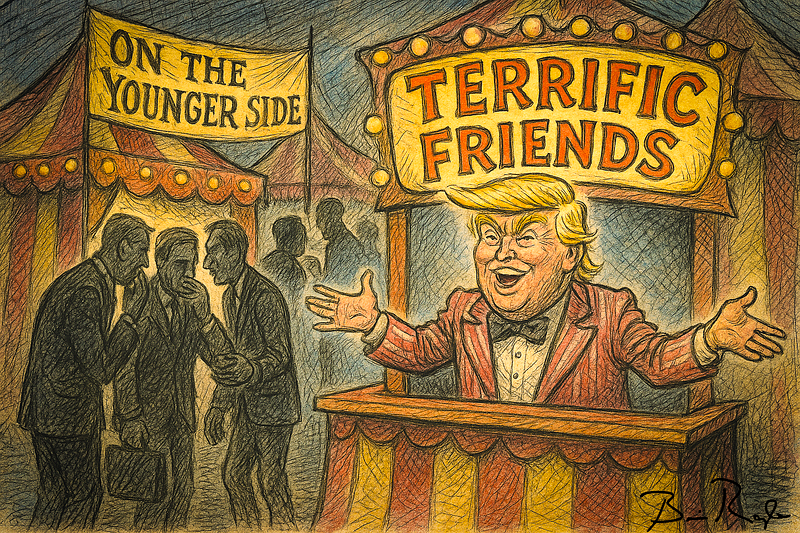
Trump’s social circle reads like a who’s who of convicted pedophiles. Jeffrey Epstein, who Trump called a “terrific guy” who enjoyed women “on the younger side.” Ghislaine Maxwell, who Trump wished well after her arrest for child sex trafficking. George Nader, a Trump transition advisor, convicted of child pornography and transporting a minor for sex. Roy Cohn, Trump’s mentor, who ran underage blackmail operations. Anton Lazzaro, John Casablancas, Tevfik Arif… the list keeps going.
When confronted with child sexual abuse, Trump’s responses are telling. He defended adult women who rape underage boys, saying if the women are attractive, the boys are “having a great time.” He supported Roy Moore after the pedophilia allegations. He made Alex Acosta his Labor Secretary after Acosta gave Epstein a sweetheart plea deal. The pattern isn’t subtle.
The Psychology of Projection
So why do conservatives scream “groomer” at everyone else while harboring actual groomers? It’s projection, plain and simple. Accuse your enemies of your own sins loudly enough and maybe no one will notice the skeletons in your closet.
QAnon took this to its logical extreme, creating an elaborate fantasy where Democrats run underground child sex trafficking rings while ignoring the actual child sex criminals in the Republican Party. The conspiracy theory served its purpose: it let conservatives claim the moral high ground on protecting children while supporting politicians and institutions that demonstrably harm them.
This isn’t just hypocrisy; it’s strategic deflection. Every hour spent arguing about whether drag queens are “grooming” kids by existing in public is an hour not spent asking why Tennessee Republicans tried to eliminate age requirements for marriage, or why 48 Missouri Republicans voted to keep child marriage legal, or why Southern Baptist leaders kept lists of child abusers but didn’t stop them from preaching.
As columnist Osita Nwanevu put it, Republicans are “a party that’s repeatedly defended the abusers of children with few lasting consequences, a party whose hypocrisies rarely matter.”
The Authoritarian Family Blueprint
There’s a deeper ideological connection between conservatism and child abuse that goes beyond individual criminals. Conservative ideology, particularly its religious variants, promotes authoritarian family structures where fathers rule, mothers submit, and children obey without question.
This creates perfect conditions for abuse. Children are taught never to question authority figures. Victims who speak up are often punished for “dishonoring” their parents or causing trouble. Communities close ranks around abusers to protect the institution or family reputation. Sexual abuse gets reframed as moral failing that can be fixed through prayer, marriage, or simply moving to a new town.
The conservative obsession with female purity and male authority means that when abuse happens, the focus shifts to protecting the abuser’s reputation and the family’s honor rather than protecting the child. A pregnant 14-year-old isn’t seen as a rape victim who needs help; she’s seen as a moral problem that needs to be solved, preferably through marriage to her rapist.
This connects to the broader conservative pro-natalist ideology that treats women and girls primarily as vessels for reproduction. In this worldview, a girl’s autonomy matters less than her fertility. Her education, dreams, and childhood itself are all secondary to her biological capacity to produce children for the cause, whether that cause is religious, racial, or political.
The “Great Replacement” conspiracy theory, popular in far-right and white nationalist circles, holds that white Christian populations are being demographically “replaced” by immigrants and minorities. The suggested antidote is for white families to have more babies. This has led some white nationalists and ultra-conservatives to valorize very early motherhood for their in-group and to oppose anything that might limit births, from contraception to abortion.
In this mindset, a teen girl becoming pregnant is not a tragedy but a potential warrior in the battle to bolster the favored population’s numbers. Republican lawmakers in places like Wyoming argued that preventing a 15-year-old from marrying her baby’s father would threaten “family unity.” They implicitly prefer a teenage mother married off, rather than allowing her an abortion or even just remaining an unwed minor.
This prioritization of birth and “family” over the girl’s personal well-being aligns with pro-natalist, authoritarian values. It’s not that mainstream conservatives openly advocate for underage pregnancy, but when faced with the choice between protecting a child from sexual exploitation versus promoting a birth inside a traditional marriage, many choose the latter. That choice effectively condones the exploitation as collateral damage for a “greater good” of higher birthrates and preserved family honor.
Journalist Talia Lavin, who studies the far right, notes that this vision of nation and family “dominated by authoritarian, unaccountable fathers” creates a logic wherein child sexual abuse gets rationalized or overlooked as part of the social order. The abuser sees himself as the patriarch entitled to exploit those below him.
The Global Pattern
This phenomenon isn’t uniquely American. Wherever you find conservative religious institutions wielding political power, you find similar patterns of child abuse and cover-ups.
In Poland, the Catholic Church’s alliance with the right-wing government has stymied investigations into clerical abuse. In Ireland, the church’s grip on society enabled decades of abuse in schools, orphanages, and parishes. France’s 2021 investigation estimated that 216,000 children were abused by Catholic clergy since 1950.
Across cultures, the most reliable predictor of tolerance for child sexual abuse isn’t religion or nationality but adherence to patriarchal, authoritarian values. Conservative cultures that emphasize male authority, female submission, and unquestioning obedience to tradition consistently produce higher rates of child marriage, more institutional abuse, and weaker protections for children.
In parts of South Asia, the Middle East, and sub-Saharan Africa, it is conservative customary norms, not “conservative” in a Republican sense but in the sense of clinging to old patriarchal traditions, that keep child marriage alive. In Afghanistan and Yemen, deeply conservative Islamic customs have allowed men to wed girls of 13 or younger.
Ironically, Western conservatives often condemn those practices as barbaric without acknowledging that until recently, their own communities had legal child marriage on the books too. The common thread is not religion or ethnicity per se, but an authoritarian patriarchal structure: wherever you find a system where male authority is unchecked, female chastity is obsessed over, and youth are expected to obey elders, you often find higher rates of underage sexual exploitation.
The few historical examples of progressives tolerating pedophilia, like some French intellectuals in the 1970s who signed petitions to lower the age of consent, have been thoroughly repudiated by the modern left. There’s no contemporary progressive movement pushing to legalize child marriage or defending child abusers. The same cannot be said for conservatives.
Comparing Left and Right
No political ideology has a monopoly on virtue. Sexual predators exist across the political spectrum, and any sweeping claim should be met with healthy skepticism. However, when comparing the contemporary American left and right on this issue, clear contrasts emerge in both policy and scandal.
Generally, progressives and left-leaning officials have led efforts to strengthen protections for minors, while conservatives have often lagged or objected. We see this in the push to ban child marriage, spearheaded by Democrats and women’s rights groups. We see it in advocacy for comprehensive sex education and access to contraception, which reduce teen pregnancy and exploitation, typically championed by liberals. We see it in support for stronger enforcement against sexual assault.
Democrats, though hardly without flaws, do not as a rule defend colleagues accused of pedophilia. They were quick to ostracize figures like former congressman Anthony Weiner who sexted a 15-year-old girl. They investigated Jeffrey Epstein’s ties even when Epstein mingled in elite liberal circles. When accusations surface, the typical Democratic response is to distance themselves from the accused and support investigations.
Meanwhile, one struggles to find a recent example of Democratic Party officials explicitly shielding a confirmed child molester in their midst. This doesn’t mean no Democrat has ever committed such crimes. Epstein infamously courted figures in both parties, and Bill Clinton’s name appears in his flight logs. But crucially, “pedocon theory” is not claiming only conservatives commit abuse; rather, it suggests a greater propensity for and acceptance of it within right-wing subcultures.
The difference is systemic. There is no current liberal equivalent of the way conservative institutions, be it certain churches or the GOP itself, have again and again closed ranks around accused abusers or facilitated conditions for abuse. The concept of “pedocon” is a reaction to this asymmetry: it’s calling out that the self-proclaimed party of family values has an alarming track record of either participating in or excusing the sexual abuse of minors.
The Evidence Speaks
So, is “pedocon theory” a legitimate concept to be taken seriously, or just an internet polemic with an illusory veneer of credibility? The evidence, while not always straightforward, indicates there is a real pattern underpinning the provocative label.
Conservatives, especially those in the orbit of religious right or “family values” politics, have been linked to a notable number of child sex abuse cases and permissive policies. From high rates of child marriage in red states, to Republican officials defending accused molesters, to church abuse cover-ups in conservative denominations, the trend is hard to ignore.
Statistics on general child abuse don’t conclusively prove conservatives offend more, as abuse occurs in all communities. But in specific realms like institutional abuse and underage sexual relations, the correlation with conservative contexts is strong. The causal factors likely include a conservative emphasis on patriarchy, purity, and pronatalism that inadvertently provides cover for abuse or rationalizes it.
Historically, campaigns to raise the age of consent and end child exploitation have faced resistance from those upholding traditional ways, whether that was 19th-century men resisting women’s reforms, or 21st-century legislators clinging to child-marriage loopholes. The alignment of the conservative position with allowing younger sexual access under certain guises is not a new development.
According to a nationwide county-level study, reported child maltreatment rates were actually lower in communities with greater religious or political conservatism, possibly because of stronger social networks or underreporting in tight-knit conservative areas. However, that study mainly examined overall child abuse and neglect rates, which include physical abuse and neglect, rather than sexual abuse specifically.
When focusing on sexual misconduct, some startling correlations appear. The comprehensive study of convicted child molesters finding that 93% described themselves as “religious” suggests that abusers seek out conservative environments where authority figures, usually male, are revered and not questioned, giving them more opportunity to prey on the vulnerable.
Not Just a Meme Anymore
“Pedocon theory” started as a snarky internet comeback, a way to point out the hypocrisy of conservatives who scream about protecting children while enabling their exploitation. But like many uncomfortable jokes, it highlights a real pattern that deserves serious attention.
This isn’t about claiming all conservatives are pedophiles. They’re not. It’s about recognizing that conservative ideology, particularly in its religious and authoritarian forms, creates structures that protect abusers and silence victims. It’s about acknowledging that the political movement that claims to defend “family values” has consistently opposed efforts to protect children from sexual exploitation.
When someone shouts “groomer” at a teacher for acknowledging that gay people exist, remember that they’re probably voting for politicians who think 14-year-olds should be able to marry their rapists. When they panic about drag queens reading picture books, remember that they’re likely tithing to churches that shuffled pedophile priests between parishes. When they share QAnon conspiracies about Democratic pedophile rings, remember that their last president hung out with Jeffrey Epstein and wished Ghislaine Maxwell well.
The pattern is real, it’s documented, and it’s ongoing. Every week brings new arrests, new revelations, new examples of conservative institutions and politicians protecting predators while pointing fingers at everyone else. At some point, we need to stop treating this as a series of unfortunate coincidences and recognize it for what it is: a systematic failure of conservative ideology to protect the children it claims to value.
All that said, “pedocon theory” as a coined term is largely the product of polemical online discourse. It emerged in part as a rebuttal to QAnon and the “groomer” smear, essentially a way for the left to say, “Actually, look in your own backyard.” It’s not a rigorously defined scientific theory, and one should be cautious not to imply that all or even most conservatives are pedophiles, which would be an inaccurate and unfair generalization.
The value of the concept is in drawing attention to the structural hypocrisy and enabling factors in certain conservative milieus. On that score, the theory highlights something very real. As one observer wryly noted, every new revelation of a Republican lawmaker caught with child pornography or a church scandal can feel like “pedocon theory undefeated.” The pattern persists with almost gravity-like regularity.
Until conservatives reckon with this reality, until they stop protecting abusers in their ranks while demonizing everyone else, “pedocon theory” will remain less like a provocative meme and more like, as one writer memorably put it, “a theory the way gravity is a theory.” The evidence keeps pulling us back to the same uncomfortable conclusion: the call is coming from inside the house.
Only by honestly confronting these failings in churches, parties, and families can conservatives dispel the notion that they tacitly accept what they claim to abhor. Until then, the pattern remains, and it is worthy of serious attention, not just as a meme, but as a call to action to reform the cultural and institutional practices that have allowed the exploitation of the most vulnerable to persist.
Bibliography
- Unchained at Last — U.S. Child Marriage Study
- AP News — Missouri Child Marriage Bill
- Reuters — Dennis Hastert Sentencing
- Vox — Trump Endorses Roy Moore
- NBC News — Ralph Shortey Arrest
- AP — Ray Holmberg Indicted
- NYT — Tim Nolan Conviction
- CNN — Trump in Miss Teen USA Dressing Rooms
- Rolling Stone — Trump Quotes About Ivanka
- Daily Beast — Trump on Teachers Having Sex with Students
- NY Mag — Trump on Epstein
- BBC — Trump Wishing Maxwell Well
- Houston Chronicle — Abuse of Faith Investigation
- Pennsylvania Attorney General — Grand Jury Report
- BBC — France Clergy Abuse Report
- USHMM — Protocols of the Elders of Zion
Leave a Reply