Introduction
At a debate in September, Donald Trump leaned into the microphone, eyes gleaming with calculated malice, and spun his crowd a tale: immigrants were eating Americans’ pets. Not just cats and dogs, mind you, but ducks from local parks. The crowd gasped, laughed, looked horrified in turns. Fact-checkers scrambled to their keyboards. Local police departments issued weary statements: no, migrants weren’t roasting Labradors behind strip malls. But the damage was already done. Trump had planted his poisonous seed. Immigrants weren’t merely job competitors or welfare burdens anymore — they had become the kind of people who would steal your golden retriever and serve it for dinner.
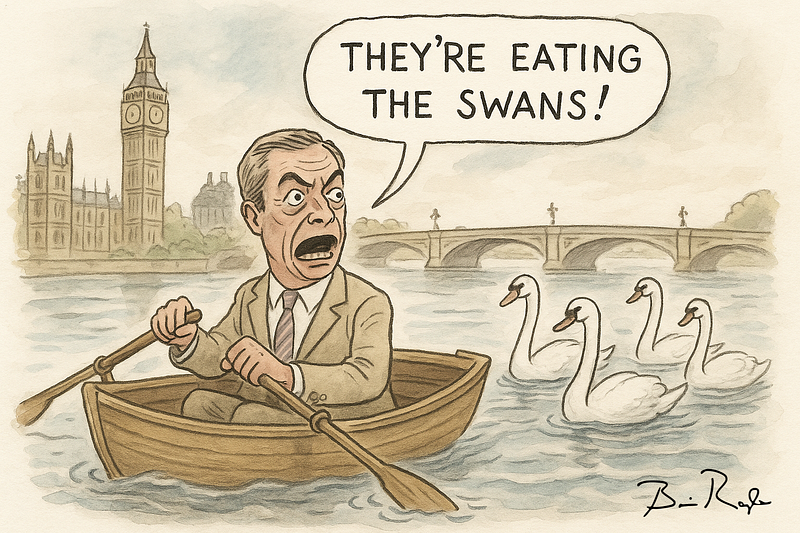
Across the Atlantic, Nigel Farage has been humming this same dark melody for years. He’s repeatedly peddled the urban legend that asylum seekers were killing and eating the Queen’s swans. The story originated in Britain’s tabloid sewers, aimed at Roma and Eastern European migrants, and has been debunked more times than flat-earth theory. Yet it persists, because evidence was never the point. It sticks because it repulses.
These stories might sound like gutter-level nonsense, the ravings of desperate politicians scraping the barrel’s bottom. But they’re actually part of an ancient tradition. Authoritarians have always known that if you want to whip up proper hatred, you don’t merely say they’re different or they’re stealing your jobs. You say they’re devouring your children or they’re eating what you cherish. It’s a script that stretches back nearly a thousand years, recycled by every generation of white supremacist authoritarians since.
II. Blood in the Streets: The Medieval Template
The myth that Jews killed Christian children for ritual purposes didn’t simply appear once in Norwich and vanish into history’s fog. It spread like plague through medieval Europe, resurfacing whenever tensions peaked, always following the same hideous formula: a missing child, a fabricated ritual murder story, then violence.
Norwich, 1144: The Beginning
The story begins with William of Norwich, a twelve-year-old apprentice tanner found dead near a wood. The sheriff investigated and ruled it an accident. But the local monks at Norwich Cathedral sensed opportunity for a better story. They claimed Jews had kidnapped and crucified William in mockery of Christ, draining his blood for Passover rituals. A local monk, Thomas of Monmouth, penned a hagiography of William that circulated widely. He even insisted Jews across Europe had conspired to kill a Christian child annually at Easter. The tale transformed William into a “martyr” and planted seeds that would bloom into centuries of blood libel accusations.
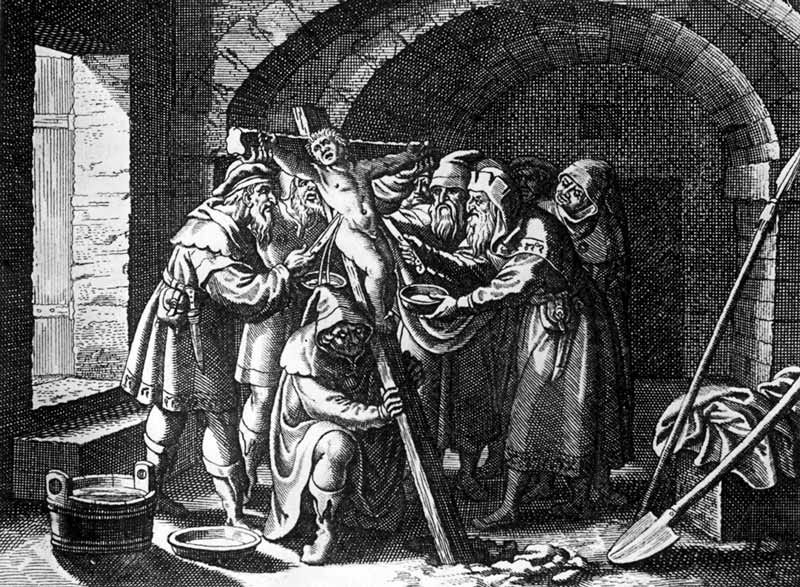
The story didn’t merely live in manuscripts. Churches displayed frescoes depicting Jews torturing children; miracle plays performed around Easter dramatized William’s supposed martyrdom. Pilgrims journeyed to Norwich to venerate him, and local clergy ensured the shrine overflowed with imagery of innocence betrayed by Jewish “monsters.” From the beginning, the libel embedded itself not only in rumor but in popular culture and sacred art.
Blois, 1171: Fire as Spectacle
In Blois, France, when a child disappeared, a Jewish servant girl was accused of murder. No body was ever discovered, but Count Theobald ordered more than thirty Jews burned alive. Chroniclers recorded it as holy triumph. The absence of evidence proved irrelevant — what mattered was that the story “made sense” within the stereotype already seeded by Norwich. Paintings and songs quickly circulated, transforming the massacre into a “victory of Christendom.”
Prague, 1389: Ritual Murder as Pogrom Fuel
In Prague, Easter processions were already powder kegs waiting for a spark. In 1389, amid rumors that Jews had desecrated the Eucharist and murdered a child, mobs descended on the Jewish quarter. More than fifteen hundred Jews were slaughtered. The massacre became one of the bloodiest in medieval Europe. Again, the story of child murder justified mass violence. The pogrom was immortalized in sermons, and woodcuts later depicted Jews stabbing infants. It entered the visual imagination of central Europe, a nightmare made manifest.
Trent, 1475: The Cult of Simon
The case of Simon of Trent elevated the blood libel into official Catholic cult. When two-year-old Simon disappeared, the Jewish community faced immediate accusation of killing him for ritual purposes. Under torture, confessions poured forth. Fifteen men were executed; women and children were forced to convert. Simon’s body was displayed as a holy relic. Pilgrims traveled from across Europe to venerate him.
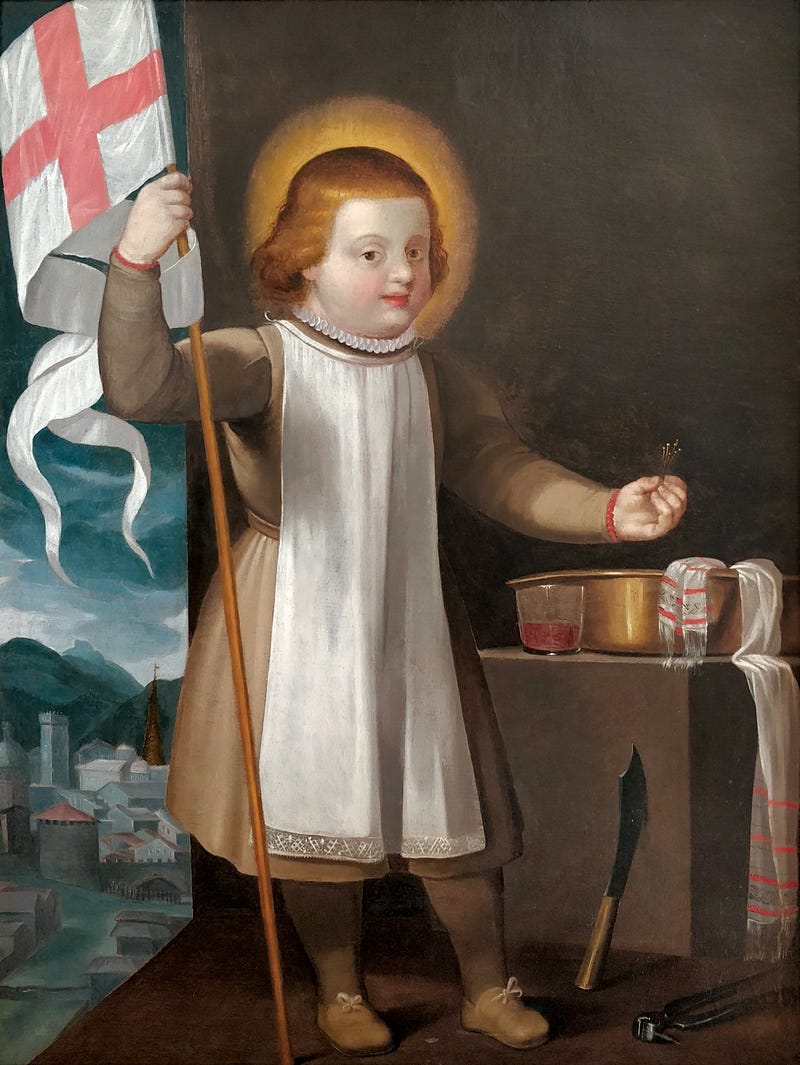
Churches bore paintings of Jews stabbing infants, draining their blood into ceremonial bowls. Stained glass and frescoes across northern Italy and southern Germany reinforced the lie. Simon was canonized locally, and his cult endured until 1965, when the Vatican finally suppressed it after the Second Vatican Council. For nearly five hundred years, the lie was enshrined in religious devotion, complete with processions, relics, and ballads recounting his “martyrdom.”
Hugh of Lincoln and Other “Child Martyrs”
England cultivated its own cult in Hugh of Lincoln (1255), another boy supposedly murdered by Jews. Nearly one hundred Jews were arrested; eighteen were executed on the King’s orders. Chaucer’s Prioress’s Tale wove the blood libel into English literature, ensuring the trope survived for centuries. On the continent, Werner of Oberwesel (1287) became a martyr figure in Germany. Pilgrimages sprouted around these shrines, embedding the story of Jewish ritual murder into Europe’s spiritual geography.
Holy Lies, Illustrated
Cathedrals across Europe featured murals of Jews killing children: Passau (15th century), Sandomierz (circa 1710), and countless others. In Sandomierz, the image of Jews cutting a child’s throat under Mary’s watchful eye still hangs in the cathedral. These weren’t hidden away in crypts — they were public art meant to educate peasants who couldn’t read.
With the printing press came viral imagery. Sixteenth-century pamphlets and woodcuts showed Jews draining blood into bowls, knives in hand, surrounding terrified children. Cheap prints made the libel portable, much like memes do today. Anyone, anywhere, could “see” the truth of the story even if they had never encountered a Jew in their life.
Disease and Filth as Reinforcement
The accusations were never solely about blood. Jews and Roma were painted as scavengers, carrion-eaters, consumers of vermin. During plague years, Jews faced accusations of poisoning wells, contaminating bread, and feasting on unclean animals. Tortured “confessions” had Jews admitting to spreading poison powders. The implication rang clear: they weren’t merely dangerous, they were filthy, animalistic, unfit for human society.
This overlap — killing children, eating disgusting things — formed the smear’s core power. Both shatter taboos, both trigger visceral disgust. A missing child or a dead cow could instantly transform into a narrative of ritual murder or revolting consumption. Evidence became superfluous.
Damascus, 1840: Blood Libel Goes Global
Even in the modern age, the myth thrived. In Damascus, when a Capuchin friar and his Muslim servant disappeared, the city’s Jews faced immediate accusation of ritual murder. Several prominent Jews were tortured until they confessed. European diplomats intervened, but not before the story had spread through international newspapers. Christian and Muslim communities alike embraced it, proving the libel could cross religious boundaries whenever scapegoats proved useful.
Beilis Case, 1911: The Lie in the Courts
In Kiev, Russia, thirteen-year-old Andrei Yushchinsky was found murdered. Authorities arrested Mendel Beilis, a Jewish factory worker, and accused him of killing the boy for ritual purposes. The trial dragged on for two years, featuring “experts” testifying on whether Jewish law required Christian blood. It was pure farce, yet it transfixed Russia. Beilis was acquitted, but the damage had already spread. Pogroms flared again, and antisemitic newspapers recycled the story as fact.
The Pattern Set in Stone
By the time Europe entered modernity, the blood libel and the “filthy eater” trope had baked into the Christian imagination. Whenever famine, plague, or political crisis struck, the story reappeared. And it always targeted the same victims: Jews, Roma, Muslims, the eternal outsiders.
This wasn’t random paranoia — it was calculated politics. Local rulers, priests, and demagogues understood the story’s power. Need to distract from a bad harvest? Blame the Jews. Need to seize wealth to fund a war? Accuse them of killing a child. Need to shore up Catholic devotion? Canonize a murdered toddler and transform him into a saint.
By the nineteenth century, the pattern had become so entrenched that modern states could dust it off whenever convenient. That’s why we see it resurface in Damascus, in Kiev, and in Europe’s mass press. And it’s why, centuries later, when Nigel Farage talks about immigrants eating swans and Trump rants about migrants roasting dogs, the echoes sound hauntingly familiar. It’s the same script, merely dressed in contemporary costume.
III. Nineteenth-Century Echoes: From Pamphlets to Yellow Peril
The Enlightenment promised reason; what it delivered, too often, was better printing presses for ancient lies. The blood-libel and “filthy eater” smears didn’t fade with modernity. They modernized. Pamphlets, political cartoons, penny papers, and the new rhythms of telegraph news repackaged medieval tropes for industrial audiences. The formula remained unchanged: they kill children; they eat the unclean. It fit seamlessly into rising antisemitism, colonial paranoia, and anti-immigrant hysteria.
The Damascus Affair, 1840: Blood Libel in the Age of Diplomacy
When Father Thomas, a Capuchin friar, and his Muslim servant went missing in Damascus, local Jews faced immediate accusation of murdering them for ritual purposes. Several prominent Jews were arrested and tortured until they “confessed.” What had once been street rumor now became a cable item on the European diplomatic circuit. France and Austria pressured the Ottomans to punish Jews. Britain and others pushed back. Newspapers serialized the interrogations, speculated about “oriental rites,” and rehearsed the same lurid details that had sold sermons in the fourteenth century. The affair proved that the libel could travel with empire. Telegraph wires and foreign offices became conduits for a medieval lie dressed in modern attire.
The Beilis Case, 1911–1913: A Show Trial in Russia
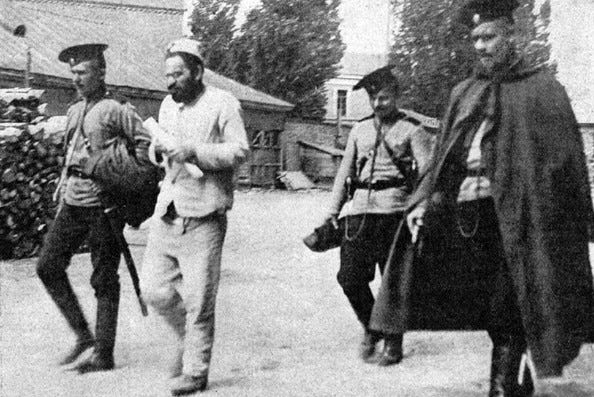
In Kiev, when thirteen-year-old Andrei Yushchinsky was murdered, police failed to solve the crime, so they revived the blood libel. Mendel Beilis, a Jewish factory clerk, was arrested for ritual murder. For two years the Tsarist courts transformed the case into theater. Newspapers printed courtroom sketches of Jews supposedly slaughtering children. “Experts” quarreled over Talmudic passages as if scripture were forensic evidence. The trial became a rallying cry for antisemites and sparked fresh pogroms across the empire. Beilis was acquitted, but the damage had already taken root. In an industrial empire with stenographers and newswire updates, the old Norwich myth was recast as modern legal drama.
Antisemitic Cartoons and Pamphlets
Cheap print democratized disgust. Popular pamphlets in Germany and France depicted Jews as blood-drinking ghouls, money hoarders, youth corrupters. Cartoons often fused dual themes: Jews as predators of Christian children and as grotesque consumers of unclean food. A widely circulated French caricature from the 1890s drew a Jewish banker as a spider spinning webs around children, his lips stained crimson. German journals ran woodcuts of Jews butchering infants like livestock. Imagery accomplished what text couldn’t. It crossed language barriers, lodged in memory, and made the smear feel obvious to those who had never met a Jew.
The Dreyfus Affair and Child-Corruption Tropes
The Dreyfus Affair officially centered on espionage, but the antisemitic press dragged older imagery into the fray. Pamphlets demanding Dreyfus’s execution paired spy charges with illustrations of Jewish conspirators menacing children and the tricolor. The message was old wine in new bottles: Jews as traitors to the nation’s future, Jews as secret predators, Jews as the reason your children won’t inherit a safe France.
Disgust at the Dinner Table: Food Panics and Immigrant Othering
If blood libel framed minorities as child-killers, the parallel food panic framed them as eaters of the unclean. Both tap identical psychology. Both blur the line between human and animal. In the United States of the nineteenth and early twentieth centuries, nativists made the dinner table their battlefield.
The Chinese “Rat-Eaters” of San Francisco
As Chinese laborers arrived in California, newspapers began caricaturing them as vermin consumers. San Francisco dailies ran cartoons of Chinese men crouched over steaming bowls labeled “rat stew.” A widely copied image titled “The Chinese Question” showed a looming figure with rodent tails peeking from pockets, visual shorthand for dietary depravity. The insult served double duty. It signaled that Chinese were filthy while also explaining labor politics: if, as agitator Denis Kearney told crowds, the Chinese “live on rice, rats, and refuse,” then naturally they undercut white wages. Disgust propaganda became class warfare.
Laundries, Restaurants, and “Missing Pets”
Tabloids alleged that Chinese laundries doubled as kitchens where dogs and cats were cooked out back. Rumors insisted that missing neighborhood pets had been minced into chop suey. Police raids produced little beyond spectacle, yet the myths persisted for decades. Even in the 1920s and 1930s, reporters staged “mystery meat” exposés in Chinese restaurants that recycled identical claims. The point was never evidence. It was olfactory theater: invoke smells, imagine stewing, and readers supply the rest.
Italians, Southern Europeans, and “Strange Foods”
Southern Italian immigrants brought cuisines that prized small birds, squid, and organ meats. To many Anglo-Protestant Americans, these foods proved barbarism. Harper’s Weekly caricatured swarthy men skewering songbirds, rats scuttling at their feet, knives glinting. A New York paper mocked Italian markets for selling larks and sparrows, as if eating what one might sing to were a civilizational crime. The logic matched the older libel. A people who eat what “we” cherish must be unfit for “our” neighborhoods.
The Garlic Stigma
Garlic became shorthand for immigrant bodies imagined as unclean. Cartoons labeled Italians, Greeks, and Eastern Europeans “garlic eaters,” the term doing hygienic and sexual work simultaneously. Smell stood in for character. Diet stood in for citizenship. The body became a border.
Irish Cannibal Satire
Long before Italians, the Irish had been painted as barely human eaters. James Gillray’s prints gave them simian faces gnawing raw potatoes. Jonathan Swift’s A Modest Proposal suggested, with acid satire, that the Irish sell their children as food. The joke worked because the British imagination had already made room for it. The Irish could be pictured eating their own children only because they had been pictured as less than fully human.
Jewish Kosher Slaughter and “Cruelty” Panics
Dietary law itself became a cudgel. Nineteenth-century campaigns in parts of Germany framed kosher slaughter as bloodthirsty and barbaric. Pamphlets accused Jews of taking pleasure in animal suffering, a bridge from food to character that echoed older charges of ritual murder. “What they eat” and “what they are” collapsed into a single indictment.
Chop Suey, “White Slavery,” and Urban Moral Panic
Food panic often bled into sex panic. Early twentieth-century exposés claimed that Chinese restaurants lured white women with chop suey and then trafficked them. Italian cafés were portrayed as dens of garlic, gin, and seduction. The plate and the body fused into one narrative. Strange food meant strange morals meant danger to your daughters.
Colonial Echoes: Africans and “Cannibal Tribes”
European colonial propaganda made cannibal imagery standard fare. Missionary tracts and adventure serials brimmed with tales of man-eating tribes and child sacrifice. These stories justified conquest as rescue. If “they” eat children, then occupation can be recast as moral guardianship. The formula remained unchanged: dehumanize by accusing monstrous consumption, then sanctify violence as defense.
The Bridge to Modernity
By the nineteenth century’s end, two strands of disgust propaganda were firmly established across continents. In Europe, Jews still faced courtroom accusations of ritual child murder in cartoons. In the United States, Chinese were accused of rat-eating and pet-stealing, Italians of bird-eating and garlic rot, and immigrant restaurants of folding vice into the menu. In colonial campaigns, Africans were cast as cannibals. Each case fused fear with disgust to mark outsiders as dangerous and inhuman.
So when Nigel Farage repeats the swan-eating myth, or Donald Trump riffs about migrants roasting pets, there’s no innovation whatsoever. There’s only the return of an ancient script, rehearsed in medieval shrines, reprinted in nineteenth-century pamphlets, and perfected in tabloid journalism’s gutters.
IV. Fascist Europe: Purity, Predators, and “Unclean Eaters”
By the 1930s, the smear had become industrial. Fascist regimes didn’t merely tolerate old stories about blood and vermin — they transformed them into curriculum, cinema, and law. Where a medieval bishop needed a sermon, the Nazis had feature films. Where a nineteenth-century paper needed a cartoon, Vichy had posters on every street corner. The script remained unchanged, but the amplification was unprecedented: the total resources of the state.
Nazi Germany: Ritual Murder in the Classroom, Courtroom, and Cinema
Der Stürmer: Ritual Murder Goes Tabloid
Julius Streicher’s Der Stürmer specialized in recycling the blood libel. A 1934 “ritual murder” issue ran with lurid illustrations of Jews stabbing blond children, blood pooled in ceremonial bowls. These weren’t confined to subscribers — Nazi Party offices posted Der Stürmer in glass cases on public streets. Ordinary Germans couldn’t walk to the bakery without confronting medieval gore cartoons.
The Courts as Propaganda Stage
The Nazis didn’t merely print the libel, they staged it in courtrooms. In 1929, before Hitler seized power, German prosecutors brought a case in Konitz accusing Jews of ritual murder. It collapsed, but Nazi newspapers spun the acquittals as proof of “Jewish corruption of the courts.” By the mid-1930s, ritual murder accusations appeared in legal briefs and police circulars. Even when no cases went forward, the state ensured the idea stayed alive: Jews weren’t just criminals, they were predators exempt from ordinary justice.
The Poisonous Mushroom: Disgust for Children
In 1938, Nazi publishers released Der Giftpilz (The Poisonous Mushroom), a children’s book written by Ernst Hiemer, a Der Stürmer editor. Its stories taught German children that Jews resembled mushrooms — some looked harmless, but all were deadly. One story shows a Jewish man luring a boy with candy before attempting abuse. Another dwells on kosher slaughter, with illustrations of blood spurting from animals. The lesson was hammered home: Jews are sexual predators, Jews are blood-drinkers, Jews are poison. Classrooms used this as required reading, embedding disgust into child psychology.
Der Ewige Jude: Vermin at the Dinner Table
The 1940 propaganda film Der Ewige Jude (“The Eternal Jew”) was marketed as documentary. It spliced footage of Jews in Polish ghettos with scenes of rats swarming from sewers. The narration declared: “Just as rats spread disease, Jews spread corruption.” The film cut between Jews haggling in markets and rats devouring grain. The implication: Jews consume filth, hoard food, and spread pestilence. It was the blood libel and “unclean eater” trope made cinematic, shown to audiences across Germany, often mandatory for students and soldiers.
Food, Disease, and Starvation Policy
Propaganda bled into policy. In the Warsaw Ghetto, the Nazi-enforced food ration for Jews was set at starvation level — approximately 184 calories per day. German newspapers justified this by claiming Jews “lived off refuse” and could survive on scraps. The trope of Jews as verminous eaters rationalized deliberate famine. Dehumanization wasn’t abstract — it was calculated into caloric budgets.
Mussolini’s Italy: The Barbarian Appetite
Mussolini’s invasion of Ethiopia in 1935 leaned on dietary disgust as justification. Propaganda pamphlets depicted Ethiopians as primitives gnawing raw meat, drinking blood, practicing cannibalism. Posters contrasted Roman legionaries — clean, armored, disciplined — with caricatured Ethiopians crouched over bones. Italian children’s magazines ran “educational” stories about barbarian diets to prepare young minds for coming conquest.
By the late 1930s, Mussolini aligned with Hitler’s antisemitism. Italian papers began publishing cartoons of Jews hoarding bread while Italians starved. Antisemitic tracts accused Jews of “feeding on the blood of Italy,” blending hunger resentment with the old libel. Italy’s racial laws of 1938 were accompanied by waves of disgust propaganda that tied Jews to both financial parasitism and dietary corruption.
Franco’s Spain: Guardianship Through Disgust
After the Spanish Civil War, Franco’s regime re-sacralized Catholicism by demonizing Republicans as child corrupters. Propaganda accused leftists of teaching atheism to children, defiling churches, and destroying families. A famous poster showed a Republican militiaman menacing a child with a dagger, under the slogan “They destroy the innocence of our youth.” It wasn’t literally a food smear, but it deployed identical disgust tactics: enemies as violators of children’s purity.
Francoist Catholic tracts also recycled antisemitic myths, even though Spain had few Jews remaining. International Jewry was cast as the hidden hand behind communism. Leaflets depicted hook-nosed figures devouring maps of Spain, or feasting on coins while children starved. Eating and corruption blurred again: the enemy was a predator consuming the nation’s flesh.
Vichy France: Parasites at the Table
Vichy propaganda, especially after 1940, fused old Catholic libel with modern antisemitism. Posters showed Jews as parasites feeding at French family tables. One widely circulated cartoon depicted a monstrous diner stabbing a fork into a loaf labeled “France,” while a child sat empty-handed. Newspapers like Je Suis Partout revived ritual murder language, insisting Jews corrupted children’s morality while literally consuming their rations.
During wartime rationing, food propaganda carried enormous weight. French families genuinely feared hunger. By painting Jews as hoarders and gluttons, Vichy gave that fear a scapegoat. A starving population was told: the reason your children go without is because Jews are eating their share. It was a modern update of the medieval famine libel — still disgusting, still politically useful.
Fascism’s Formula
Across Nazi Germany, Fascist Italy, Francoist Spain, and Vichy France, the structure proved consistent:
- Children as sacred victims. Jews and leftists were painted as lurers, corrupters, abusers.
- Food as sacred boundary. Enemies were framed as vermin eaters, blood drinkers, hoarders.
- Disgust as weapon. Propaganda didn’t just argue — it tried to make people gag.
Medieval monks had invented the script. Fascists industrialized it. They transformed the rumor mill into newsreels, the sermon into school curriculum, the tavern whisper into courtroom indictment. The continuity is so tight that when Trump tells stories about migrants eating pets, or Farage mutters about asylum seekers killing swans, they aren’t improvising. They’re plagiarizing.
V. America’s Twentieth Century Panics: From Reds to “Groomers”
The U.S. didn’t invent disgust propaganda, but it became its most enthusiastic exporter. Each decade after World War II produced its own flavor of “they’re coming for your kids” panic. The libel was updated with new villains — communists, homosexuals, Satanists, comic book writers — but the themes remained medieval. Children in peril. Outsiders as predators. Food, sex, and blood as contamination.
The Lavender Scare: “Perverts Prey on Children”
After WWII, Washington purged gays from government in a parallel crusade to McCarthy’s Red Scare. The 1950 Senate report on “Employment of Homosexuals and Other Sex Perverts in Government” claimed homosexuals tried to “entice young people into their ranks.” The State Department fired hundreds; the FBI kept lists. J. Edgar Hoover’s files labeled gay men as “degenerates” who prowled parks for children. The imagery — shadowy men, vulnerable boys — echoed Der Giftpilz almost exactly.
Anti-Communist Propaganda: “They Will Take Your Children”
If you weren’t terrified of gays in the 1950s, you could fear communists. The House Un-American Activities Committee and Hollywood churned out films warning that Reds were infiltrating schools. One “educational” short, Red Nightmare (1962, narrated by Jack Webb of Dragnet), depicted an idyllic American town where communists seize control. Churches close, children are indoctrinated, and family dinners become state-mandated slop. The Cold War enemy wasn’t just foreign — it was in the classroom, poisoning the young. Again: outsiders steal your children, ruin your food, and invert your values.
The Comic Book Panic: “Seduction of the Innocent”
In 1954, psychiatrist Fredric Wertham published Seduction of the Innocent, claiming comic books were corrupting children into sex, drugs, and crime. He testified before the Senate: Batman and Robin promoted homosexuality, Wonder Woman encouraged lesbianism, horror comics normalized sadism. His rhetoric was pure “corruption of youth.” Parent groups burned comics in bonfires. Publishers self-censored with the Comics Code Authority, banning depictions of horror, homosexuality, even “excessive violence.” The pattern repeated: imagine children being devoured — this time by panels and ink.
Anita Bryant and “Save Our Children”
In 1977, orange-juice spokeswoman Anita Bryant made homosexuality synonymous with predation. She warned gays “must recruit” children. Pamphlets pictured candy-wielding predators. The campaign name, Save Our Children, said it all: the family dinner table was at risk, your child was next. Her success in Dade County spread nationwide, embedding the predator myth into conservative politics.
The Satanic Panic: Ritual Murder Redux
The 1980s brought the medieval libel roaring back. Michelle Remembers (1980) claimed Satanists sacrificed children. The McMartin Preschool trial (1983–1990) put teachers in court for supposed rituals involving blood-drinking and child rape. No evidence surfaced, but children — prodded by suggestive interviews — described being forced to drink blood, fly on broomsticks, and watch babies sacrificed. It was William of Norwich, now with California palm trees. Geraldo Rivera’s 1988 special “Devil Worship” hit 20 million viewers, declaring a million Satanists were hunting kids. Innocent people went to prison. It was all fantasy, but the disgust (blood, filth, sex) accomplished its work.
The Dungeons & Dragons Scare
Simultaneously, the fantasy role-playing game Dungeons & Dragons (D&D) faced accusations of luring children into witchcraft and Satanism. After the 1979 suicide of college student James Dallas Egbert, media spun a false story that he died due to D&D obsession. Evangelical groups warned that D&D taught demonology and blood rituals. Chick Tracts — fundamentalist comics — depicted teens recruited into covens through dice games, sacrificing classmates, and drinking blood. Kids rolling polyhedral dice in basements were framed as the next generation of ritual murderers.
Daycares, Dungeons, and “Devil Music”
The ’80s moral panic wasn’t limited to preschools. Heavy metal bands faced accusations of hiding Satanic backmasking in records — subliminal commands to drink blood, kill, and worship the devil. Ozzy Osbourne was sued by parents claiming his lyrics drove kids to suicide. Tipper Gore’s Parents Music Resource Center (PMRC) hearings in 1985 warned of “porn rock” corrupting minors. “Parental Advisory” labels became the modern badge of contamination.
Even toys weren’t safe. Evangelicals claimed Smurfs were demonic, He-Man a Satanic recruitment tool, and Care Bears coded with occult symbols. All were accused of “preying on children’s innocence.”
Food Panics Redux: Chinese Take-Out and Mexican “Pet-Eaters”
Meanwhile, the old dietary smear simmered. Chinese restaurants still faced tabloid accusations of cooking pets. Health inspectors raided kitchens; headlines screamed “Dog Meat Found in Chinatown.” Most were false or exaggerated, but the image stuck: immigrants as eaters of what “we” love.
In border states, Mexican migrants were smeared with rumors of “taco dog” and “stolen pets.” These stories circulated in local gossip columns as far back as the 1930s and resurfaced whenever nativist politics heated up. As late as the 1980s, city councils in Texas debated banning dog and cat meat — laws aimed squarely at immigrants even when no evidence of the practice existed.
The Continuity: Children, Pets, Purity
Every case followed the fascist formula:
- Children as sacred victims — from Wertham’s comics to Anita Bryant to Satanic daycares.
- Food as sacred boundary — from Chinese takeout “mystery meat” to Mexican “pet tacos.”
- Disgust as trigger — blood, filth, sex, vermin, “strange foods.”
By the 1990s, America had run through every permutation: gays as predators, comics as corrupters, daycare workers as ritual killers, gamers as Satanists, immigrants as dog-eaters. All of it was recycled material, but effective because disgust doesn’t expire.
VI. The Digital Age of Disgust
The 21st century didn’t invent conspiracy thinking; it just gave it broadband. The stories that once required church sermons, tabloid presses, or Nazi pamphlets now spread in seconds on Facebook, X/Twitter, Telegram, and TikTok. The blood libel became “adrenochrome.” The “unclean eater” trope became Trump’s dogs and Farage’s swans. And the formula still works: disgust, children, outsiders.
Pizzagate: Ritual Murder Redux
In 2016, anonymous posters on 4chan and Reddit stitched together a fantasy: Hillary Clinton and other Democrats were running a child-trafficking and ritual abuse ring out of a D.C. pizza parlor. The supposed evidence? Menu items like “cheese pizza” (coded, they insisted, as “child porn”), wall art, and staff Instagram photos. The claims blended medieval blood libel (children abducted and sacrificed) with 1980s Satanic Panic (ritual basements, secret tunnels, blood-drinking).
It metastasized into YouTube “documentaries” with millions of views and #Pizzagate hashtags trending worldwide. In December 2016, Edgar Welch stormed the restaurant with an AR-15 to “save the children.” He found no basement, no captives, no blood rituals — because it was all fiction. But by then, the story had already radicalized thousands.
QAnon: Global Blood Libel with a Hashtag
By 2017, Pizzagate evolved into QAnon. The anonymous “Q” claimed elites across the globe were abducting children, torturing them, and extracting adrenochrome, a mythical drug supposedly harvested from the blood of terrified victims. This was Norwich and Trent rewritten for Reddit threads.
QAnon rallies featured “Save the Children” signs, a slogan stolen straight from Anita Bryant. Its followers accused Tom Hanks, Oprah, and countless others of running blood farms. They blended medieval ritual murder imagery with pop culture, weaving in symbols from Hollywood movies, emojis, and hashtags.
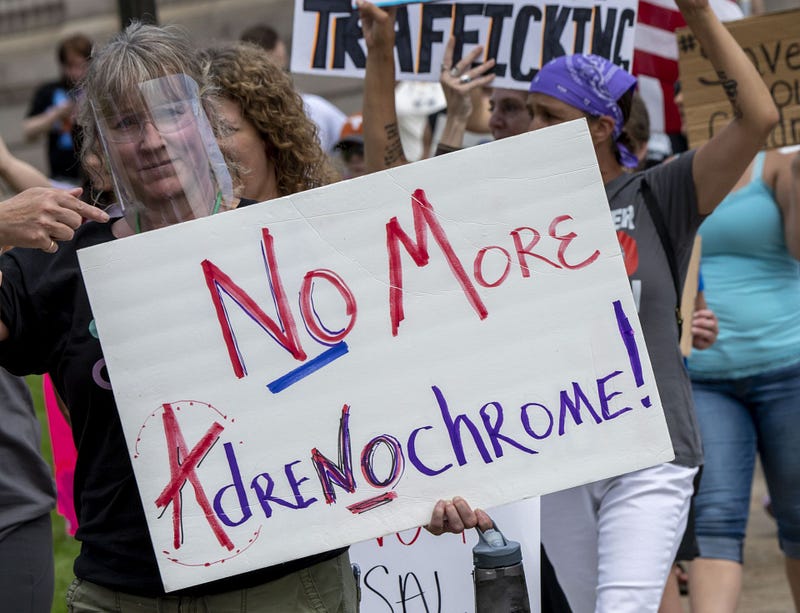
The fantasy bred real violence. In 2020, a California man murdered two of his children with a spearfishing gun, claiming QAnon had convinced him they carried “serpent DNA.” In Canada, a woman rammed her car into a store she believed was trafficking children. On January 6, 2021, rioters stormed the Capitol waving “Where We Go One, We Go All” banners. A thousand years after William of Norwich, the blood libel marched through the halls of Congress draped in red, white, and blue.
“Wayfair Trafficking” and Hashtag Virality
In 2020, another Q-adjacent conspiracy claimed that Wayfair, the online furniture company, was selling kidnapped children through overpriced cabinets listed with “suspicious” names. TikTok videos spread the rumor to millions of teenagers. Like medieval shrines displaying relics of Simon of Trent, the cabinets became objects of obsession — proof of child sacrifice hiding in plain sight. The pattern remained unchanged: everyday objects reinterpreted as props in a ritual murder fantasy.
Trump’s “Pet-Eating Migrants”
Donald Trump leaned into the disgust button on the campaign trail in 2023–24. At rallies in Ohio and Pennsylvania, he warned that migrants were “stealing your dogs and cats” and “eating the ducks in the park.” Police departments and fact-checkers debunked the claims immediately, but the imagery stuck. The point wasn’t factual — it was visceral. Trump knew the crowd would imagine immigrants crouched over a barbecue with a golden retriever or a mallard.
This was Denis Kearney’s “rat eaters” speech in a MAGA hat. It hit the same nerves as San Francisco’s nineteenth-century “dog stew” cartoons, but now it trended on Truth Social and was clipped for cable news.
Farage’s “Swan-Eating Migrants”
Nigel Farage, never one to resist a tabloid myth, repeated stories that asylum seekers were killing and eating the Queen’s swans. The claim originated in the British gutter press in the 2000s, aimed mostly at Roma and Eastern European migrants. It’s been debunked repeatedly. But it works because swans are symbolically loaded — legally royal property, folkloric emblems of beauty and purity. By saying foreigners eat them, Farage pressed both the disgust and nationalist buttons: they are barbaric, and they desecrate the monarchy itself.
“Groomers” in Schools and Libraries
The “Save Our Children” slogan has been rebooted as “Stop the Groomers.” Conservative activists accuse LGBTQ teachers and librarians of “grooming” kids merely by acknowledging queer existence. Florida’s “Don’t Say Gay” law was sold as child protection. Book bans exploded, with protesters shouting at school boards about “porn in libraries.” Online, memes equated rainbow flags with pedophile symbols. This is Anita Bryant’s 1977 crusade reborn, with hashtags instead of flyers.
Trans Kids and “Medical Mutilation”
Right-wing politicians and influencers frame gender-affirming care as child sacrifice. Terms like “chemical castration” and “mutilation” saturate social feeds. Videos of trans teens are clipped and presented as “proof” that doctors are experimenting on children. It’s ritual murder with scrubs instead of satanic robes. The smear is ancient: outsiders (doctors, queer adults) are violating children’s bodies and feeding on their innocence.
Anti-Vax and “They’re Killing the Kids”
The COVID-19 pandemic revived another variant: vaccines as child poison. Online groups claimed Pfizer and Moderna were “sacrificing children” to pharmaceutical profits. Memes depicted syringes dripping blood, children gagged by masks, doctors as predators. It was a high-tech reprint of the well-poisoning libel during the Black Death: outsiders spreading disease, feeding on the innocent.
Migrant “Pet Eaters” in Local Rumor Mills
Beyond Trump’s speeches, the pet-eating myth circulated on Facebook neighborhood groups and Nextdoor threads. Posts accused migrants of stealing pets, barbecuing cats, even raiding chicken coops. British tabloids pushed similar stories about Eastern Europeans roasting hedgehogs or pigeons. American versions often tied Mexican or Central American migrants to “taco dog” rumors, echoes of the 1930s-40s border gossip. It’s the same imagery repeating endlessly: immigrants consume what you cherish, therefore they are beneath you.
Viral Memes as New Pamphlets
Where nineteenth-century antisemitic pamphlets showed Jews stabbing children, today’s memes show Hillary Clinton drinking blood, or Joe Biden sniffing children. Where Nazi films cut between Jews and rats, TikTok edits cut between migrants and trash heaps. The platform doesn’t matter. The emotional payload remains identical: disgust, danger, dehumanization.
The Algorithmic Pogrom
Medieval mobs needed a missing child to trigger violence. Modern mobs need only a trending hashtag. QAnon posts, “groomer” memes, Trump’s dog-eating stories — each is accelerant poured onto the same fire. Algorithms amplify what disgusts, because disgust drives engagement. And disgust, as history shows, drives violence.
The Throughline
- William of Norwich → Simon of Trent → Damascus Affair → Beilis trial → Der Stürmer → Anita Bryant → Pizzagate → Trump’s ducks.
- A single, continuous thread: outsiders eat your children, outsiders eat your animals, outsiders poison your table.
- A thousand years of recycled fear, each time with new costumes, each time with the same script.
That’s why Farage’s swans and Trump’s “pet eaters” don’t sound original. They aren’t. They’re echoes of medieval sermons, Nazi films, and Cold War pamphlets — cheap disgust theater for audiences trained to click.
VII. Why It Works: The Psychology of Disgust
Disgust as a “Moral Emotion”
Psychologists like Paul Rozin and Jonathan Haidt have shown that disgust isn’t merely about spoiled meat. It’s what scholars call a moral emotion: once something is coded as “disgusting,” it feels not just gross but wrong. That’s why these smears don’t require proof. The accusation alone accomplishes the work — once you’ve pictured a Jew draining a child or a migrant roasting a dog, you’ve already judged them guilty. Disgust shortcuts rational analysis.
Neurological research shows disgust activates the anterior insula, which also fires when people encounter moral violations. In other words, the brain literally equates “gross” with “evil.” Propagandists don’t have to argue; they only have to disgust.
The Child as Cultural Taboo Object
Sociologists argue that children occupy a special symbolic role in modern societies. They’re seen as embodiments of innocence, the future, and the collective good. That’s why nearly every moral panic in U.S. history — from comics in the 1950s to drag queen story hours today — frames itself around “protecting the children.”
In medieval Europe, this was ritual murder saints. In Nazi Germany, Der Giftpilz taught kids that Jews were predators. In America, Anita Bryant’s Save Our Children campaign carried the exact same logic. Once you anchor propaganda in child-protection, resistance feels immoral: who wants to argue against saving kids?
Pets and Animals as “Fictive Kin”
Anthropologists describe pets as “fictive kin” — creatures integrated into families as symbolic children or siblings. This makes them prime targets for disgust propaganda. To claim that outsiders eat pets is to suggest they violate the sanctity of the family itself. That’s why Trump’s “they’re eating your dogs and cats” line landed with gasps. It wasn’t about pets — it was about outsiders devouring family.
This isn’t new. The Irish were painted as “ape-like” potato eaters, Italians as bird-eaters, Chinese as rat-eaters. Farage’s swan smear worked because swans symbolize national purity, not because anyone truly cared about swan meat. In-group animals are sacred. Out-groups are accused of consuming them.
Purity and Authoritarianism
Haidt’s moral foundations theory shows that conservatives, especially authoritarian and religious groups, score higher on “purity/sanctity” sensitivity. Purity violations — whether sexual, dietary, or bodily — provoke disproportionate disgust. This is why White Christofascist nationalists are fertile ground for these smears. Their worldview already revolves around cleanliness, sacredness, and guarding boundaries.
Accusing outsiders of ritual murder, child abuse, or pet consumption isn’t random — it’s precision-targeted. It weaponizes the axis their audience cares about most. For an authoritarian mind primed to see pollution everywhere, these stories are irresistible.
Projection and Moral Cover
Carl Jung called it the “shadow”: everything a society represses gets projected onto others. Fascist and nationalist movements excel at this. Nazis accused Jews of corrupting children while the Hitler Youth indoctrinated kids into death cults. Anita Bryant accused gays of “recruiting” children while her church filled pews with indoctrinated minors. QAnon rages about elites trafficking kids while its influencers are busted for grooming charges.
Projection purifies the in-group. If the accusation is “they” are eating children, then “we” must be the guardians of children. It’s an absolution ritual: call them filthy so we remain clean.
Disgust as Social Glue
Disgust doesn’t just separate — it unites. Anthropologist Mary Douglas wrote that societies use concepts of purity and pollution to define group boundaries. Calling outsiders “unclean eaters” or “child killers” isn’t just slander — it’s in-group bonding. It gives the majority a sense of shared moral superiority.
This explains why moral panics often have a festive quality. Pogroms, book burnings, school board tantrums — they all have a public, communal aspect. Sharing disgust creates solidarity. Saying “they’re eating our swans” is as much about “we” as it is about “they.”
Media Amplification and the “Moral Panic” Cycle
Stanley Cohen’s theory of moral panics (1972) maps perfectly onto these cases. A group is labeled as a “folk devil” — gays, migrants, Satanists, teachers. The media amplifies their supposed crimes. Politicians step in as “moral entrepreneurs.” Then policies are enacted that punish or exclude the group. The panic eventually fades, but the structure remains.
- 1950s: “perverts in government” → purges.
- 1980s: Satanic daycare workers → prosecutions.
- 2020s: “groomer teachers” → book bans and gag laws.
Every cycle reuses the same disgust triggers and ends with more authoritarian control.
The Addictive Nature of Disgust in the Digital Age
Research on social media shows disgust spreads faster than other emotions. Disgusting content is more likely to be shared, retweeted, or memed. It has what scholars call “arousal congruence” — it jolts you emotionally and demands expression. QAnon memes of Hillary Clinton drinking blood spread not because they’re credible, but because they’re viscerally disgusting. Trump’s “pet-eating” lines trend not because they’re true, but because they provoke a gag reflex.
The algorithm is basically Streicher’s glass case in the town square — except now it’s global and instantaneous.
White Christofascist Nationalists and the Disgust Economy
The modern far-right is obsessed with purity. Its rhetoric — make America clean again, protect the children, defend the West — is structured around contamination fears. By framing immigrants, queer people, and leftists as predators or unclean eaters, they can maintain the fiction of themselves as holy guardians.
It’s no accident that Christian nationalist rallies overflow with “Save the Children” signs and anti-trans “mutilation” chants. It’s the same disgust economy, paying dividends because disgust bypasses reason and unites audiences in shared revulsion.
The Feedback Loop: From Panic to Violence
The libel doesn’t just disgust — it mobilizes. Medieval mobs killed Jews after ritual murder rumors. Nazis used disgust propaganda as prelude to extermination. The Satanic Panic destroyed lives and careers. Pizzagate sent a man with a rifle into a pizza parlor. January 6 carried QAnon banners into the Capitol. The pattern remains stable: disgust → fear → anger → violence.
That’s why these stories never truly die. They don’t need to be true. They just need to disgust, and disgust does the rest.
VIII. Conclusion: One Thousand Years of the Same Lie
The story starts with William of Norwich in 1144. A dead child, a rumor, a monk’s quill scratching out a hagiography. From that moment forward, the blood libel became Europe’s most reliable political tool. Every famine, every plague, every bout of unrest — out came the same story: they are killing our children, they are desecrating our food, they are unclean.
By the Renaissance, the smear had spread from pulpits to pamphlets. By the nineteenth century, it appeared in tabloids and colonial adventure stories. By the twentieth, it was projected on cinema screens and drawn in comic books. And by the twenty-first, it slid effortlessly into memes, hashtags, and Truth Social posts.
What never changed was the formula:
- Children as sacred symbols.
- Food as purity boundary.
- Outsiders as filth.
Medieval peasants saw Jews draining infants. Nazis saw Jews as rats devouring the nation. McCarthyites saw communists corrupting classrooms. Suburban parents in the 1980s saw Satanists under every daycare rug. And now, Farage sees migrants roasting swans while Trump sees immigrants stealing your dogs. It is all the same grotesque play, staged with new props.
The White Christofascist Nationalist Audience
Why does it resonate so consistently with the far-right? Because their politics are built on purity and exclusion. The white Christofascist nationalist imagines the world as a fortress: clean inside, polluted outside. Children and pets symbolize what’s sacred within those walls. Outsiders are accused of devouring them to justify shutting the gates — or storming outward with violence.
This isn’t random paranoia. It’s strategic. The disgust libel is the fastest way to make ordinary people accept extraordinary cruelty. If you can convince your audience that “they” are eating children or pets, then almost anything — pogrom, deportation, extermination — feels like justified defense.
The Feedback Loop of Disgust
History shows the same cycle on repeat:
- Rumor spreads — a missing child, a news clipping, a meme.
- Disgust takes hold — the brain gags before it thinks.
- Fear and anger follow — the out-group becomes a mortal threat.
- Violence erupts — pogroms, purges, laws, lynchings, riots.
- Memory fades — until the next panic, when the same story returns.
From Norwich to QAnon, nothing essential has changed. The technology is faster, the scapegoats rotate, but the libel remains constant.
Why We Must Name It
Farage’s swan story and Trump’s pet-eater story aren’t silly gaffes. They’re deliberate invocations of one of the oldest hate myths in Western culture. Treating them as “just rhetoric” is dangerous, because disgust doesn’t stay rhetorical — it metastasizes into action.
Naming the lineage matters. When we see QAnon posters of adrenochrome harvests, we should hear the echo of Simon of Trent. When we see memes about immigrants eating dogs, we should remember the “rat-eater” cartoons of San Francisco. When we hear cries of “groomers in schools,” we should recall Anita Bryant’s “Save Our Children.”
One Unbroken Thread
The arc is horrifying in its simplicity:
- Norwich, 1144 — a boy murdered by rumor.
- Blois, 1171 — dozens burned alive.
- Trent, 1475 — a toddler canonized as propaganda.
- Kiev, 1911 — a courtroom circus of ritual murder charges.
- Berlin, 1930s — Jews drawn as vermin devouring children.
- Miami, 1977 — “Save Our Children” crusades.
- Los Angeles, 1980s — Satanic daycare trials.
- D.C., 2016 — Pizzagate and an AR-15.
- America, 2024 — Trump’s dogs and ducks.
- Britain, 2024 — Farage’s swans.
A thousand years of the same grotesque accusation, dressed in different clothes, aimed at different outsiders. Always the same structure. Always the same effect.
The Real Lesson
These lies survive because disgust works. It bypasses reason, corrodes empathy, and binds communities in shared revulsion. But once you know the lineage, the magic trick loses its power. Farage isn’t inventive. Trump isn’t original. QAnon isn’t uncovering anything new. They are all plagiarists, stealing from monks, pamphleteers, Nazis, and demagogues who came before them.
And once you see the pattern — children, pets, purity, outsiders — you can call it by its real name: propaganda as old as the crusades, recycled for the algorithm.
Bibliography
Historical Sources & Studies
- Gavin I. Langmuir, Toward a Definition of Antisemitism (University of California Press, 1990).
- Hillel J. Kieval, Blood Libel in Late Imperial Russia: The Ritual Murder Trial of Mendel Beilis (Yale University Press, 1997).
- E.M. Rose, The Murder of William of Norwich: The Origins of the Blood Libel in Medieval Europe (Oxford University Press, 2015).
- R. Po-Chia Hsia, Trent 1475: Stories of a Ritual Murder Trial (Yale University Press, 1992).
- R. Po-Chia Hsia, The Myth of Ritual Murder: Jews and Magic in Reformation Germany (Yale University Press, 1988).
- Joshua Trachtenberg, The Devil and the Jews: The Medieval Conception of the Jew and Its Relation to Modern Anti-Semitism (Yale University Press, 1943).
- Israel Jacob Yuval, Two Nations in Your Womb: Perceptions of Jews and Christians in Late Antiquity and the Middle Ages (University of California Press, 2006).
- Yosef Hayim Yerushalmi, Assimilation and Racial Anti-Semitism: The Iberian and the German Models (Leo Baeck Institute Yearbook, 1971).
- Philippe Burrin, Hitler and the Jews: The Genesis of the Holocaust (Edward Arnold, 1994).
- Saul Friedländer, Nazi Germany and the Jews, Vol. 1: The Years of Persecution, 1933–1939 (HarperCollins, 1997).
- Jeffrey Herf, The Jewish Enemy: Nazi Propaganda during World War II and the Holocaust (Harvard University Press, 2006).
- Joshua D. Zimmerman, Poles, Jews, and the Politics of Nationality: The Beilis Trial and Its Aftermath (University of Wisconsin Press, 2004).
- Mary Douglas, Purity and Danger: An Analysis of Concepts of Pollution and Taboo (Routledge, 1966).
Modern & Contemporary Journalism / Case Studies
- Gershom Gorenberg, “Blood Libel Returns,” The New York Times, March 2012.
- Ed Pilkington, “The Pizzagate Conspiracy Theory That Led a Gunman to D.C. Pizzeria Explained,” The Guardian, December 2016.
- Kevin Roose, “What Is QAnon, the Viral Pro-Trump Conspiracy Theory?” The New York Times, updated 2021.
- Mike Wendling, Alt-Right: From 4chan to the White House (Pluto Press, 2018).
- Jason Stanley, How Propaganda Works (Princeton University Press, 2015).
- Cynthia Miller-Idriss, Hate in the Homeland: The New Global Far Right (Princeton University Press, 2020).
- Matthew Lyons, Insurgent Supremacists: The U.S. Far Right’s Challenge to State and Empire (PM Press, 2018).
- BBC News, “Nigel Farage Repeats Migrants Swans Claim,” (BBC, multiple reports 2003–2023).
- Politico, “Trump’s Migrant Dog-Eating Claim Debunked,” 2023.
- Rolling Stone, “How QAnon Rode #SaveTheChildren to Mass Adoption,” August 2020.
- Slate, “How Anita Bryant Turned ‘Save Our Children’ into a Rallying Cry for Bigotry,” June 2017.
- Newsweek, “Wayfair Conspiracy Theory Is Viral Nonsense,” July 2020.
Psychology & Social Science
- Paul Rozin, Jonathan Haidt, & Clark McCauley, “Disgust,” in Handbook of Emotions, ed. Lewis & Haviland-Jones (Guilford Press, 2000).
- Jonathan Haidt, The Righteous Mind: Why Good People Are Divided by Politics and Religion (Pantheon, 2012).
- Paul Rozin et al., “The CAD Triad Hypothesis: A Mapping Between Three Moral Emotions (Contempt, Anger, Disgust) and Three Moral Codes (Community, Autonomy, Divinity),” Journal of Personality and Social Psychology 76, no. 4 (1999): 574–586.
- Stanley Cohen, Folk Devils and Moral Panics: The Creation of the Mods and Rockers (MacGibbon & Kee, 1972).
- Erich Fromm, Escape from Freedom (Farrar & Rinehart, 1941).
- Adorno, Frenkel-Brunswik, Levinson, and Sanford, The Authoritarian Personality (Harper & Brothers, 1950).
- Robert Jay Lifton, Thought Reform and the Psychology of Totalism (Norton, 1961).
- Michael Billig, Banal Nationalism (SAGE Publications, 1995).
- Cass Sunstein, Conspiracy Theories and Other Dangerous Ideas (Simon & Schuster, 2014).
- Daniel Kahneman, Thinking, Fast and Slow (Farrar, Straus and Giroux, 2011) — esp. on fast System 1 disgust responses.
Leave a Reply