The Lost Cause of Fascism: D’Souza’s Comfort Lies for the Right
Dinesh D’Souza has one job: make history less threatening to conservatives by rewriting it into bedtime stories where the right are always the heroes. He’s not trying to win over liberals or anyone who’s read a book in the last fifty years. He’s working the reassurance beat. His audience already thinks they’re the “good guys” and he’s there to tell them that yes, even fascism and Nazism were really just the left in disguise.
This is his usual routine. When the GOP’s Southern Strategy gets too blatant, he rewrites it as a Democratic plot to smear Republicans, like claiming there was no racist realignment at all ( PolitiFact ). When Barack Obama won, D’Souza responded not with critique but with conspiracy: the president’s ideological leanings derive from being the illegitimate son of a Marxist revolutionary, plucked straight from his book-turned-propaganda film ( 2016: Obama’s America , ). The New Yorker
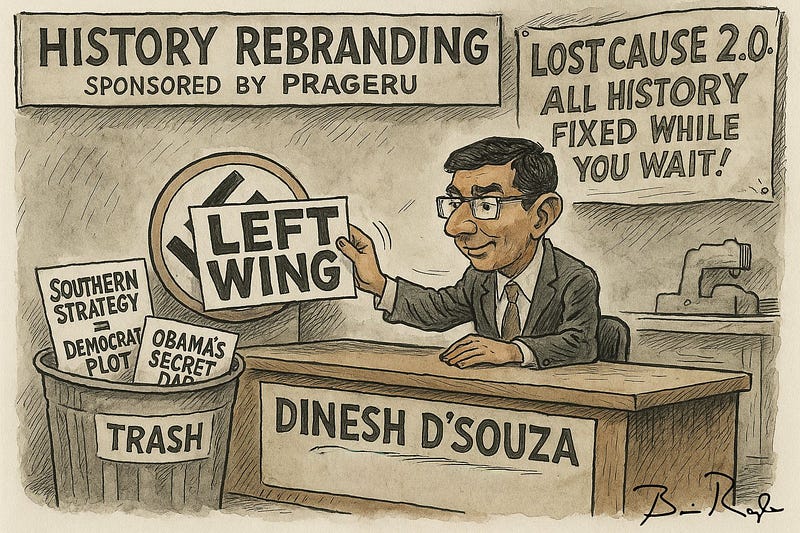
His “fascism was left-wing” routine is just the latest spin. It’s not history, it’s right-wing therapy. The problem for him is that the fascists themselves, their contemporaries, and every serious historian have said the same thing for a century: fascism was a far-right project obsessed with destroying socialism. The receipts are everywhere, and we’re about to go through them one by one.
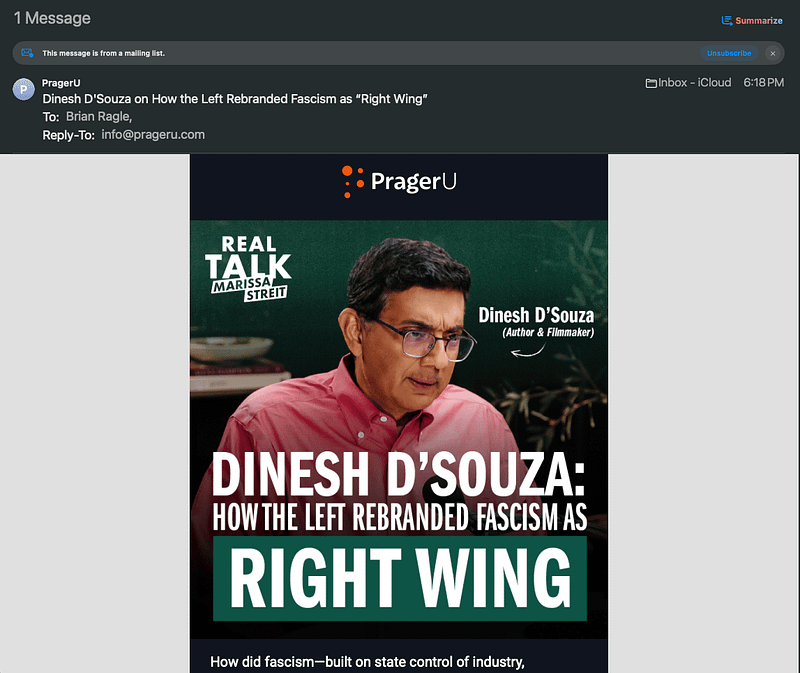
By the way, he’s hardly alone. PragerU has become one of the right’s most reliable disinformation factories, pumping out slick videos that dress propaganda up as education. Now that they’re enjoying state sponsorship under the Trump regime, their output is only going to intensify. Which means this isn’t a one-off rebuttal: it’s the start of an ongoing series taking apart their claims one release at a time, receipts included.
Mussolini began as a socialist journalist, but in 1914 he was expelled from the Italian Socialist Party for supporting Italy’s entry into WWI. He turned to militant nationalism and built paramilitary squads that literally beat socialists in the streets. By 1932, his Doctrine of Fascism declared: “Fascism… is opposed to Socialism, which clings rigidly to class struggle.” | Italian Socialist Party | Italy: The Fascist Era The Doctrine of Fascism PDF
Scholars like Roger Griffin define fascism as “palingenetic ultranationalism”: a project of national rebirth through authoritarian unity and violence. The US Holocaust Memorial Museum (USHMM) and Britannica both classify fascism as a far-right movement rooted in dictatorship and anti-left repression. Far from socialism, fascism was its sworn enemy. Palingenetic Ultranationalism | | USHMM: Fascism Britannica: Fascism
The NSDAP’s 1920 platform mixed antisemitic bile with some “social” planks, but practice tells the story. Within six months of power, the Nazis:
Sidebar: Did Hitler nationalize like the USSR? No. Germany kept private property intact. A landmark economic history shows “hardly any nationalizations” under Nazism. The exception was the Reichswerke Hermann Göring, a state conglomerate created when private steel firms balked. In fact, the mid-1930s saw privatizations. The regime practiced “commanded capitalism”: private ownership under authoritarian direction, rewarding cronies and punishing enemies, with rearmament as the only true priority. Buchheim & Scherner | | Economy of Nazi Germany | Nazi Privatization
“Aryanization” wasn’t socialism; it was racist plunder, handing Jewish firms to loyal “Aryan” owners. Crony capitalism with jackboots, not Marxist redistribution. USHMM: Aryanization
Neither leader ever called himself leftist after 1914. Mussolini’s fascists outlawed strikes and unions, set up corporatist “class collaboration,” and jailed socialist leaders. Hitler framed Marxism as his mortal enemy in and in his 1933 Reichstag speech. Nazi propaganda literally carried banners reading “Death to Marxism.” | Fascist Labour Charter | Hitler’s Reichstag Speech Nazi Party Platform
Contemporary critics recognized this. Antonio Gramsci called fascism a counter-revolutionary alliance with business elites, not a variant of socialism. The USHMM labels the NSDAP one of Weimar’s “radical right-wing parties.” Far from comrades, the Left saw fascists as executioners. USHMM: Volksgemeinschaft
This is conspiracy fantasy. Fascism was identified as far-right long before 1945. Italian fascists won conservative backing by violently smashing strikes in the 1920s. German conservatives and industrialists put Hitler in power as a bulwark against Marxism. Italy: The Fascist Era | USHMM: Adolf Hitler
Interwar analysis, from Harold Laski to American journalists, already described fascism as reactionary and anti-left. Today’s consensus (Britannica, USHMM) simply continues that classification. No “rebrand” necessary.
D’Souza waves away fascism as “just nationalism,” but historians don’t. Roger Griffin’s definition centers on palingenetic ultranationalism, a myth of national rebirth through dictatorship, violence, and purging the left. Common traits include:
Gandhi was a nationalist. Washington was a nationalist. Fascists were ultranationalists fused with authoritarian hierarchy and anti-left politics. That’s why institutions place them firmly on the far right.
The fact that people call Netanyahu or random politicians “fascist” doesn’t change what fascism was between 1919 and 1945. The Nazis banned socialists, communists, and unions in 1933. They fused party and state through Gleichschaltung and murdered their own “socialist” faction. Scholars like Robert Paxton, Roger Griffin, and institutions like USHMM and Britannica define fascism by what it did, not by postwar PR. | USHMM: Nazi Terror Begins | USHMM: Gleichschaltung | | Night of the Long Knives USHMM: Fascism Britannica: Fascism
And this is where the absurdity of D’Souza’s argument really comes into focus. He treats the word “socialist” in “National Socialist German Workers’ Party” as if it’s a notarized contract. But by that logic, the Democratic People’s Republic of Korea must be both democratic and a republic. Spoiler: it’s a dynastic dictatorship run by the Kim family. The German Democratic Republic…the former East Germany…wasn’t democratic either, unless you count one-party ballots as democracy. The People’s Republic of China still carries the “people’s” label while running a Leninist one-party state with heavy surveillance and censorship. Even the Holy Roman Empire wasn’t particularly holy, Roman, or much of an empire.
Political branding is cheap. Authoritarian movements often slap a feel-good label on the front door while practicing the opposite inside. Fascism and Nazism did exactly that. Their actions-banning left parties, crushing unions, building leader cults, and waging racial war-are what define them. The nameplate on the letterhead was window dressing.
D’Souza’s six talking points collapse under their own weight:
If someone insists “Nazis were socialists,” they’re parroting propaganda debunked by the fascists’ own words and their first acts in office. History has receipts, and they all point in the same direction.
Originally published at https://vagabondvisions.beehiiv.com.
Leave a Reply